DEA Marijuana Hearing Concludes July 15: What It Means for DOT Drug Testing and CDL Employers
The DEA's historic hearing on rescheduling recreational marijuana to Schedule III ended July 15, 2026. Here is what motor carriers and CDL employers need to know about the timeline ahead, DOT's unchanged zero-tolerance stance, and the testing authority question that could reshape compliance.
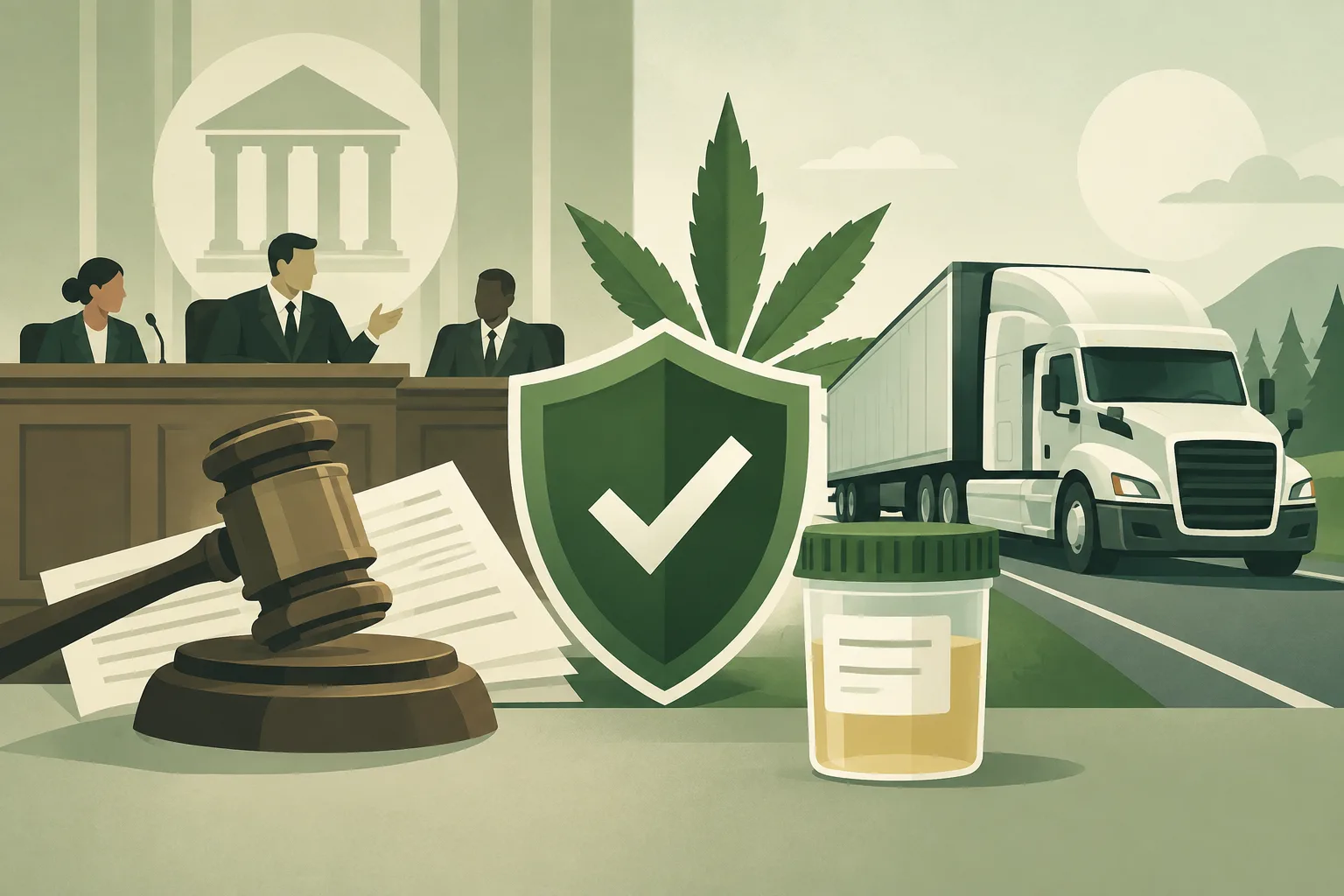

The DEA's administrative hearing on whether to reschedule recreational marijuana from Schedule I to Schedule III concluded its testimony phase on July 15, 2026. For the motor carrier industry, the hearing's close marks the beginning of a new and potentially long period of regulatory uncertainty — not the end of it.
If you operate a fleet, manage CDL drivers, or oversee a DOT drug and alcohol program, the most important thing to understand right now is this: nothing has changed for DOT-regulated drug testing. Marijuana remains a prohibited substance for every safety-sensitive transportation worker in the country. But the legal foundation supporting that prohibition is under more scrutiny than it has been in decades, and carriers that fail to prepare for possible downstream changes risk being caught off guard.
What Happened at the DEA Hearing
The DEA opened its administrative hearing on June 29, 2026, to evaluate whether all marijuana — including adult-use recreational cannabis — should be moved from Schedule I to Schedule III of the Controlled Substances Act. This followed the April 22, 2026 order by Acting Attorney General Todd Blanche, announced by the Justice Department on April 23, that placed FDA-approved marijuana products and state-licensed medical marijuana products into Schedule III and reset the hearing process, acting on the President's December 18, 2025 executive order.
The hearing ran for 11 hearing days over roughly two and a half weeks. The designated participants were organizations and officials opposed to broader rescheduling — including Smart Approaches to Marijuana, the National Drug and Alcohol Screening Association, the Tennessee Bureau of Investigation, and the states of Idaho, Indiana, and Nebraska — while DEA and FDA witnesses presented the government's evidence supporting the proposal. The proceeding collected evidence on marijuana's potential for abuse, its accepted medical use, and the safety implications of broader rescheduling.
The hearing concluded on July 15, 2026, but no decision was issued. The process now enters a review phase:
- The DEA's Chief Administrative Law Judge (ALJ) will review the hearing record and issue recommended findings. There is no statutory deadline for this step.
- The DEA Administrator will review the ALJ recommendation and can accept, reject, or modify it.
- If the Administrator moves forward, a final rule would be published in the Federal Register with a 30-day window for legal challenges.
Industry analysts estimate the full process could take 12 to 24 months from the hearing's close, meaning a final decision could arrive in 2027 or slip into 2028.
Update, September 22, 2026: Post-hearing briefs were filed in August, and the DEA has posted the full hearing transcripts for all 11 hearing days. No recommended decision from the ALJ and no final rule on recreational marijuana had been published as of this update. The compliance picture described below is unchanged.
DOT's Zero-Tolerance Stance Is Unchanged
The DOT's Office of Drug and Alcohol Policy and Compliance (ODAPC) has been unambiguous: marijuana is a prohibited substance for all DOT-regulated safety-sensitive employees, regardless of state legalization or federal scheduling developments. The agency's standing marijuana notice states that DOT's testing regulations "will not change" until any rescheduling process is complete, and its medical marijuana notice makes clear that a Medical Review Officer (MRO) cannot verify a marijuana-positive test result as negative based on a physician's recommendation or a state medical marijuana authorization.
This position has not changed following the April 2026 medical marijuana rescheduling, and it has not changed following the DEA hearing. DOT's May 2026 Part 40 Questions and Answers confirmed that there is currently no circumstance in which an MRO can verify a laboratory-confirmed marijuana positive as negative because the employee claims to have used a state-licensed product, and reiterated that marijuana use is not compatible with safety-sensitive functions.
For motor carriers, this means:
- Pre-employment, random, post-accident, reasonable suspicion, return-to-duty, and follow-up drug tests must continue to include marijuana on the panel.
- Positive marijuana results must be reported to the FMCSA Drug and Alcohol Clearinghouse within the required reporting window.
- Drivers in prohibited status due to marijuana violations cannot perform any safety-sensitive function until the full return-to-duty process — including SAP evaluation, follow-up testing, and Clearinghouse status update — is completed.
The Testing Authority Question
While DOT's operational stance is clear, the legal underpinning of federal marijuana drug testing is more complicated than it has ever been. This is the issue that motor carriers, third-party administrators, and compliance professionals need to watch most carefully.
How the HHS Guidelines Create a Potential Gap
The HHS Mandatory Guidelines for Federal Workplace Drug Testing Programs, published in the Federal Register on March 13, 2026, authorize federal workplace drug testing only for substances classified under Schedule I or Schedule II of the Controlled Substances Act. DOT's drug testing regulations under 49 CFR Part 40 are built on top of these HHS guidelines.
Medical marijuana is already Schedule III. If the DEA ultimately reclassifies all marijuana — including recreational cannabis — to Schedule III, the legal authority for including marijuana in the HHS-defined testing panel could be called into question. The guidelines do not currently authorize testing for Schedule III substances.
DOT Has Independent Regulatory Authority — But It Has Limits
DOT's drug testing requirements name marijuana specifically in 49 CFR § 40.85, providing a regulatory basis that exists independently of the CSA scheduling classification. This means DOT can point to its own regulations as the authority to continue testing, even if the HHS guidelines no longer cover marijuana as a Schedule III substance.
However, legal experts have noted that if the underlying HHS authority erodes, DOT's standalone regulatory authority could face legal challenges. A well-funded challenge arguing that DOT cannot require testing for a substance that HHS guidelines no longer authorize could create significant litigation risk — particularly if Congress does not act to clarify the issue.
What Congress or HHS Would Need to Do
Closing that gap would take either a statutory change preserving federal testing authority regardless of CSA classification or a revision to the HHS Mandatory Guidelines. As of this update, no such legislation has been enacted and HHS has not proposed a change; the issue is likely to gain urgency if the DEA moves toward a final rescheduling rule.
Motor carriers and industry associations should monitor developments from the House Transportation and Infrastructure Committee and the Senate Commerce Committee, where transportation safety oversight is concentrated.
Clearinghouse Data Shows Marijuana Remains a Top Safety Concern
The practical case for maintaining marijuana testing in DOT programs is reinforced by the data. The most recent FMCSA Drug and Alcohol Clearinghouse monthly report (data as of February 1, 2026) shows roughly 210,000 CDL holders in prohibited status — and marijuana remains one of the most frequently detected substances in DOT-mandated tests.
Under Clearinghouse-II, which took full effect November 18, 2024, State Driver Licensing Agencies (SDLAs) are required to query the Clearinghouse before issuing, renewing, or transferring a CDL and to downgrade the license of any driver in prohibited status within 60 days. This automated enforcement mechanism means that a positive marijuana test doesn't just remove a driver from safety-sensitive duties — it can result in the loss of their CDL entirely until the return-to-duty process is completed and recorded in the system.
For carriers, the financial exposure is significant. Under the current FMCSA penalty schedule:
- Allowing a prohibited driver to perform safety-sensitive functions and other non-recordkeeping violations of Part 382 carry civil penalties of up to $19,246 per violation.
- Clearinghouse violations under Part 382 subpart G — including failing to conduct a required query or failing to report a violation — carry penalties of up to $7,155 per violation.
What Motor Carriers Should Do Now
The worst mistake a carrier can make right now is to assume that the DEA hearing's conclusion means change is imminent — or to relax marijuana testing protocols in anticipation of a policy shift that may never materialize, or may take years to arrive.
Here is what your compliance team should be doing:
1. Maintain Your Current DOT Drug and Alcohol Policy
Do not alter your testing protocols, policy language, or procedures based on the hearing alone. DOT's zero-tolerance stance is fully in effect, and any deviation exposes your operation to enforcement action and Clearinghouse reporting failures.
2. Audit Your Policy Language
Review your written drug and alcohol policy for any references to marijuana's "Schedule I" classification. If your policy ties its marijuana prohibition to Schedule I status, consider updating the language to reference the DOT regulatory requirement directly — 49 CFR Part 40 and FMCSA regulations under 49 CFR Part 382 — rather than the CSA classification, which could change.
Example policy language adjustment:
- Before: "Marijuana is prohibited as a Schedule I controlled substance under federal law."
- After: "Marijuana is prohibited for all safety-sensitive employees as required by DOT regulations under 49 CFR Parts 40 and 382, regardless of state law or federal scheduling classification."
3. Brief Your Drivers and Supervisors
Drivers are hearing news about rescheduling and may misunderstand what it means for their CDL. Proactively communicate that:
- Recreational marijuana remains Schedule I.
- Even state-licensed medical marijuana does not create an exception to DOT testing requirements.
- A positive marijuana test still triggers Clearinghouse reporting and can result in CDL downgrade.
4. Verify Clearinghouse Compliance
Confirm that your pre-employment full queries and annual limited queries are current. Verify that all positive test results, refusals, and SAP milestones have been reported to the Clearinghouse within the required timeframes.
5. Monitor Regulatory Developments
Track the DEA rulemaking process, any Congressional action on testing authority, and updates from DOT ODAPC. Subscribe to Federal Register alerts for docket numbers related to marijuana scheduling and DOT Part 40 amendments.
For additional guidance on managing DOT drug testing programs during this period of regulatory change, BlueHive's white paper Ahead of the Curve: How 2025 Drug Screening Trends Impact Your Workplace provides a detailed overview of testing methodology changes and compliance strategies that remain relevant heading into the second half of 2026.
The Bottom Line
The DEA hearing concluded. Nothing else has changed — yet. For CDL employers, the zero-tolerance rule stands, the Clearinghouse is actively enforcing, and marijuana continues to be one of the most consequential substances in DOT drug testing. The legal terrain may shift over the next 12 to 24 months, but the compliance obligations today are exactly what they were yesterday.
Stay current, keep testing, and make sure your policies are anchored to DOT regulatory authority — not to a scheduling classification that is in flux.
Sources
- DEA Marijuana Rescheduling Regulatory Actions
- DOJ Press Release: Justice Department Places FDA-Approved Marijuana Products in Schedule III
- DOT ODAPC Marijuana Notice
- DOT ODAPC Medical Marijuana Notice
- DOT ODAPC May 2026 Part 40 Questions and Answers
- DEA Hearing Transcripts: Proposed Rescheduling of Marijuana
- HHS Mandatory Guidelines for Federal Workplace Drug Testing Programs — Authorized Testing Panels (91 FR 12308, March 13, 2026)
- 49 CFR Part 40 — Procedures for Transportation Workplace Drug and Alcohol Testing Programs
- 49 CFR Part 382 — Controlled Substances and Alcohol Use and Testing
- FMCSA Drug and Alcohol Clearinghouse
- FMCSA Clearinghouse Monthly Summary Report — January 2026
- FMCSA Clearinghouse-II Begins
- FMCSA Penalty Schedule — Appendix B to 49 CFR Part 386
- BlueHive White Paper: Ahead of the Curve — How 2025 Drug Screening Trends Impact Your Workplace
Tags
Frequently Asked Questions
No. The conclusion of the DEA hearing on July 15, 2026, is only the end of the testimony phase. Recreational marijuana remains Schedule I, and DOT's zero-tolerance policy is fully in effect. CDL drivers are prohibited from using any form of marijuana, and a positive DOT drug test still results in removal from safety-sensitive duties and mandatory Clearinghouse reporting.
There is no set deadline. The DEA's Chief Administrative Law Judge must first issue recommended findings based on the hearing record. The DEA Administrator then reviews the recommendation and publishes a final rule. Industry analysts estimate this could take 12 to 24 months from the hearing's close, meaning a final decision could arrive in 2027 or slip into 2028.
DOT's drug testing authority under 49 CFR Part 40 names marijuana specifically, providing a regulatory basis independent of CSA scheduling. However, the HHS Mandatory Guidelines for Federal Workplace Drug Testing currently authorize testing only for Schedule I and II substances. If all marijuana is reclassified to Schedule III without a statutory or guideline update, a legal gray area could emerge. DOT has stated its zero-tolerance stance is unchanged, and Congress may need to act to close any gap.
Continue enforcing your existing DOT drug and alcohol policy with zero tolerance for marijuana. Do not alter testing protocols or policy language based on the hearing's conclusion alone. Audit your written policies for any language that references Schedule I status, and prepare contingency language that ties prohibitions to safety-sensitive function requirements rather than scheduling classification.
Marijuana violations continue to be reported to the FMCSA Clearinghouse under existing regulations. Positive marijuana tests, refusals to test, and return-to-duty outcomes must all be recorded. As of mid-2026, over 200,000 CDL holders are in prohibited status in the Clearinghouse, and marijuana remains one of the most common substances detected in DOT-mandated tests.