DOT Drug Testing in 2026: Fentanyl Panel Expansion, Clearinghouse Phase II, and What CDL Employers Must Do Now
The DOT is expanding its drug testing panel to include fentanyl, FMCSA Clearinghouse Phase II is actively downgrading CDLs, and oral fluid testing is on the horizon. Here is what every CDL employer needs to know to stay compliant in 2026.
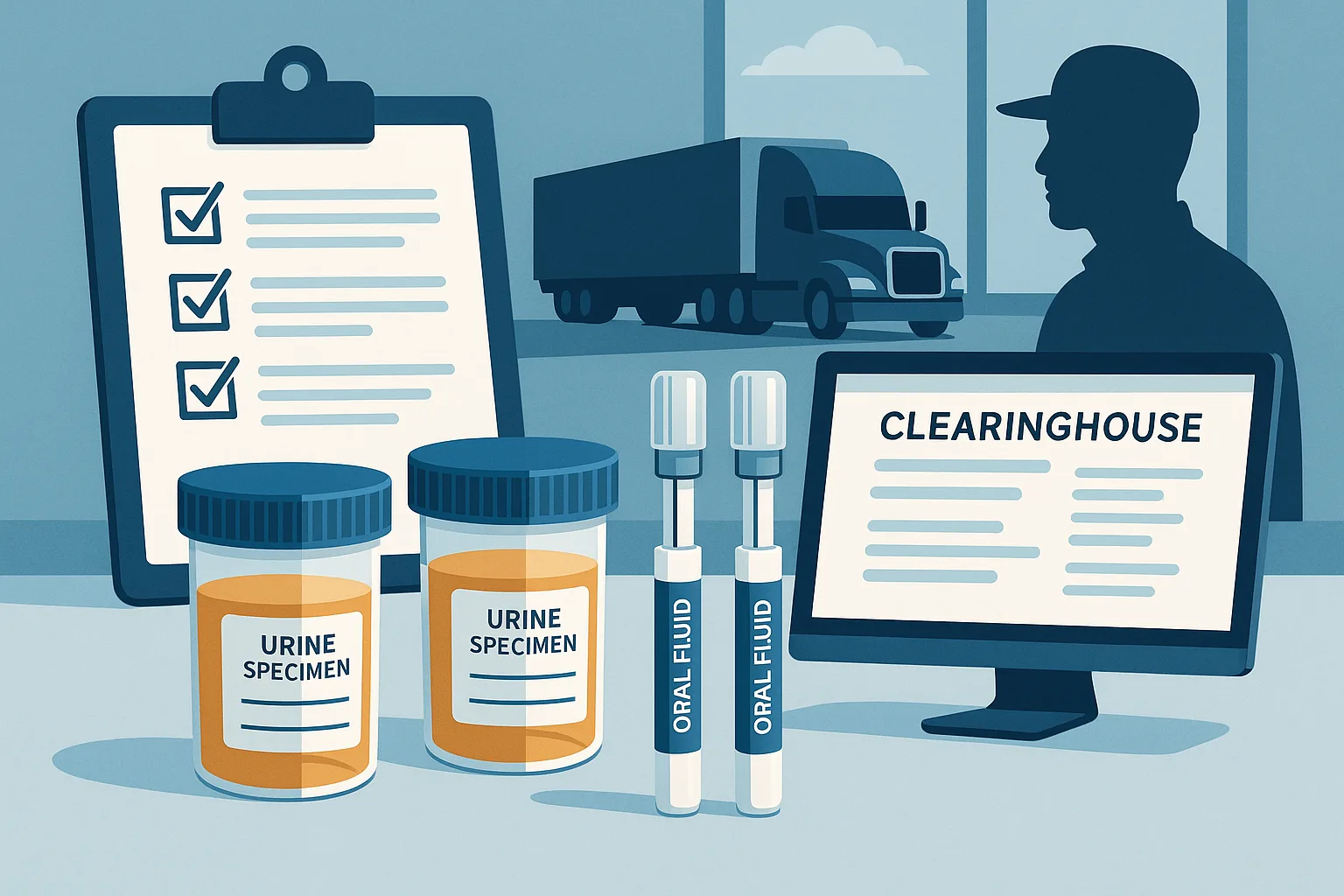

A cluster of significant regulatory changes is reshaping how DOT-regulated employers manage drug and alcohol testing in 2026. The Department of Transportation is moving toward adding fentanyl to its testing panel for the first time. FMCSA Clearinghouse Phase II is already stripping CDLs from thousands of prohibited-status drivers. Oral fluid testing is authorized but not yet operational. And a March 2026 final rule has updated Substance Abuse Professional and return-to-duty procedures under 49 CFR Part 40.
For trucking companies, bus operators, and any employer with CDL-licensed drivers, the window to get ahead of these changes is now.
Fentanyl Is Coming to the DOT Drug Testing Panel
The most significant upcoming change to DOT drug testing is the addition of fentanyl and its primary metabolite, norfentanyl, to the federally mandated testing panel.
The DOT published a Notice of Proposed Rulemaking (NPRM) on September 2, 2025, in the Federal Register (90 FR 42363), proposing amendments to 49 CFR Part 40 to add both substances to the required urine and oral fluid panels. The public comment period closed October 17, 2025. Update, September 22, 2026: no final rule has been published, and the 2026 Unified Agenda lists the rulemaking (RIN 2105-AF26) as a long-term action, so no implementation date is set.
The rationale is straightforward. The current DOT 5-panel test covers marijuana, cocaine, amphetamines, phencyclidine (PCP), and a limited group of opioids — but it does not detect synthetic opioids like fentanyl unless specifically tested. According to CDC data cited in the NPRM, fentanyl-involved overdose deaths increased approximately 279% between 2016 and 2021, and synthetic opioids now account for roughly 70% of all U.S. overdose fatalities. Given that fentanyl is extraordinarily potent even in trace amounts, the current testing gap represents a real safety risk on the road.
The proposed cutoff levels mirror the HHS Mandatory Guidelines for Federal Workplace Drug Testing Programs, which added fentanyl to the federal-agency testing panels in a January 16, 2025 notice (90 FR 4662):
- Urine: initial test 1 ng/mL for fentanyl; confirmatory test 1 ng/mL for fentanyl and 1 ng/mL for norfentanyl
- Oral fluid: initial test 4 ng/mL for fentanyl; confirmatory test 1 ng/mL for fentanyl (norfentanyl is not tested in oral fluid)
The rule would also make technical amendments including revised terminology for test results, raising the confirmatory cutoff for morphine from 2,000 to 4,000 ng/mL, and clarifications to Medical Review Officer (MRO) reporting obligations for opioid results.
If a final rule takes effect, fentanyl and norfentanyl screening will apply to all DOT-mandated testing circumstances: pre-employment, random, post-accident, reasonable suspicion, return-to-duty, and follow-up testing — for all DOT modal agencies including FMCSA, FAA, FRA, FTA, PHMSA, and USCG. (Federal Register NPRM, 90 FR 42363)
Note that DOT's May 11, 2026 final rule (91 FR 25507, effective June 10, 2026) is a separate action on directly observed urine collections and terminology; it does not add fentanyl to the panel.
What Employers Should Do Now
The final rule is not yet in effect, but employers should not wait to prepare:
- Review your drug testing policy to understand how it handles opioid results and what changes the fentanyl addition will require
- Communicate proactively with drivers — employees may have questions about fentanyl exposure from contaminated surfaces, and MRO guidance will clarify legitimate medical explanations
- Consult your C/TPA or testing vendor to understand how the panel expansion will affect collection, lab analysis, and MRO processing timelines
- Monitor the Federal Register and the DOT Office of Drug & Alcohol Policy and Compliance (ODAPC) for any final rule publication date and effective date
FMCSA Clearinghouse Phase II: CDL Downgrades Are Happening Now
While the fentanyl rule is still pending, FMCSA Clearinghouse Phase II (Clearinghouse-II) is already in full effect — and its impact is substantial.
Effective November 18, 2024, the Clearinghouse-II rule requires all State Driver Licensing Agencies (SDLAs) to remove the commercial driving privileges of any driver listed in the Clearinghouse as "prohibited" due to an unresolved drug or alcohol violation, completing the downgrade within 60 days of notification. Drivers cannot legally operate commercial motor vehicles until they complete the full return-to-duty (RTD) process — including evaluation by a Substance Abuse Professional (SAP), completion of any required education or treatment, and a negative return-to-duty test followed by FMCSA-required follow-up testing. (FMCSA Clearinghouse, Clearinghouse-II Announcement)
The scale of the enforcement impact has been notable. FMCSA's January 2026 monthly summary report (data as of February 1, 2026) shows roughly 210,000 CDL and CLP holders in prohibited status, with about 167,000 of those not having started the RTD process at all. That represents tens of thousands of drivers who may still be presenting valid-looking credentials to employers while unable to legally operate a commercial vehicle.
What This Means for Hiring and Compliance
Clearinghouse-II has changed the risk calculation for employers in several important ways:
-
Pre-employment queries are not optional. Employers must conduct a full Clearinghouse query before allowing any CDL driver to perform safety-sensitive functions. A driver in prohibited status may hold a CDL that appears valid on a motor vehicle record — the Clearinghouse is now the authoritative source.
-
Annual queries are mandatory. Employers must conduct at least a limited Clearinghouse query for each CDL driver in their fleet annually (49 CFR 382.701(b)). If a limited query returns a record, a full query must follow within 24 hours and the driver must be immediately removed from safety-sensitive duties until the matter is resolved (49 CFR 382.701(c)).
-
Reporting is your responsibility. Employers are required to report drug and alcohol violations — alcohol results of 0.04 or greater, refusals to test, and actual knowledge of use — to the Clearinghouse by the close of the third business day after learning of them (49 CFR 382.705); MROs report verified positives within two business days. Delegation to a third-party administrator (C/TPA) does not remove employer liability. Violations of the Clearinghouse rules carry civil penalties of up to $7,155 per violation under 49 CFR Part 386, Appendix B.
-
Penalties for employing prohibited drivers are real. Employers who allow a driver in prohibited status to perform safety-sensitive functions face civil penalties of up to $19,246 per violation under Appendix B. (49 CFR Part 382, Subpart G)
-
CDL downgrade affects your workforce immediately. Under Clearinghouse-II, state agencies are cross-checking prohibited status and downgrading licenses in real time. A driver may show up for work with a CDL that was downgraded since their last shift. Employers should have a process for verifying driver status at the start of assignments.
Oral Fluid Testing: Authorized but Not Yet Available
In a final rule published May 2, 2023 (88 FR 27596, effective June 1, 2023), the DOT authorized oral fluid (saliva) specimen collection as an alternative to urine for DOT-required drug tests. The change is part of a broader effort to modernize testing methods and reduce opportunities for specimen tampering and adulteration.
However, oral fluid testing under DOT authority cannot begin until HHS certifies at least two laboratories to perform the required oral fluid analyses. As of HHS's September 1, 2026 certified-laboratory notice, no laboratory had been certified for oral fluid. Employers and collection sites cannot implement oral fluid testing until DOT and HHS issue official guidance announcing that certified labs are available. In the meantime, DOT's May 11, 2026 rule requires a directly observed urine collection in situations where oral fluid would otherwise be required, and provides an 18-month grace period once a second laboratory is certified.
When oral fluid testing does become operational:
- Employers will have discretion to use oral fluid or urine collection for any DOT-required test type (with one exception: Federal Railroad Administration post-accident testing currently remains urine-only)
- Oral fluid collection will be available for directly observed collections, which is particularly relevant where alternative testing methods are needed for medical or privacy reasons
- Collectors will need updated training and procedures for oral fluid specimen handling
DOT's ODAPC website will publish notice when HHS-certified oral fluid labs are available and oral fluid testing can begin. Employers should be tracking this and have collection site vendors ready to implement quickly.
March 2026 Final Rule: SAP and Return-to-Duty Updates
In March 2026, DOT published a final rule (Federal Register document 2026-04337) addressing procedures for Substance Abuse Professionals and the return-to-duty process under 49 CFR Part 40. The rule reaffirms and clarifies the SAP's central role in the RTD framework and addresses how violations are documented, tracked, and communicated through the Clearinghouse during the evaluation and follow-up testing period. (Federal Register, March 4, 2026)
For employers, the SAP process is not discretionary — it is the only authorized pathway for a driver with a DOT drug or alcohol violation to return to safety-sensitive duties. Key points:
- The employer is responsible for ensuring that any driver they are considering for RTD has completed the full SAP evaluation and treatment process and has a negative return-to-duty test documented in the Clearinghouse
- SAPs must be qualified under DOT standards and cannot be the same person who provided initial counseling or treatment to the driver
- Follow-up testing requirements are set by the SAP, but must meet minimum DOT standards: at least six tests in the first 12 months following return to duty
- Violation records remain in the Clearinghouse for five years or until the RTD process is fully completed, whichever is longer
2026 Random Testing Rates: Unchanged
For employers wondering whether random testing rates have changed: they have not.
For 2026, the FMCSA random drug testing rate remains at 50% of the average number of driver positions, and the random alcohol testing rate remains at 10%. These rates have been steady since 2020, when the drug testing rate was raised from 25% to 50% in response to elevated industry-wide positive rates. (DOT, Random Testing Rates; 49 CFR §382.305)
FMCSA only publishes a Federal Register notice if rates are changing. No notice was published for 2026, confirming the rates are stable.
Employers should ensure their random selection pool is properly maintained, testing is spread evenly throughout the calendar year (not clustered into a single quarter), and selection methodology meets DOT's scientifically valid random selection requirements. Smaller carriers that lack the in-house bandwidth to run those selection draws often outsource managing the random testing pool to a qualified third-party administrator, which keeps selection timing, notifications, and recordkeeping defensible if FMCSA audits the program.
What Employers Should Do Now
With several simultaneous changes in the DOT drug testing landscape, employers need a structured compliance review. Here is a practical checklist:
FMCSA Clearinghouse
- Confirm your company is registered in the Clearinghouse and all designated employer representatives (DERs) have active accounts
- Run a full pre-employment Clearinghouse query on every new CDL driver before they operate a commercial vehicle
- Conduct annual limited queries on all active CDL drivers — no exceptions
- Verify your C/TPA is reporting violations to the Clearinghouse within required timelines
- Establish a process to pull drivers from safety-sensitive duties immediately if a Clearinghouse query returns a record
Fentanyl Rule Preparation
- Review your drug testing policy and identify sections that will require updates when the fentanyl final rule is published
- Notify your testing vendor or C/TPA to ensure their MRO and lab partners are prepared to handle the expanded panel
- Prepare a driver communication plan for when the rule takes effect
Oral Fluid Testing
- Monitor DOT ODAPC for HHS laboratory certification announcements
- Confirm with your collection site vendor whether they are prepared to offer oral fluid collection once certified labs are available
- Update your testing policy to reflect oral fluid as an available specimen type once DOT authorizes its use
SAP and Return-to-Duty
- Audit any driver who had a violation in the past 12 months to confirm their Clearinghouse RTD status is fully documented
- Ensure your DER knows the process for managing a driver through the SAP referral, evaluation, and follow-up testing cycle
- Verify SAP referrals are being directed to DOT-qualified SAPs who meet 49 CFR Part 40 requirements
Why This Matters for the Transportation Industry
The combination of Clearinghouse Phase II enforcement, the pending fentanyl panel expansion, and the ongoing rollout of oral fluid testing represents the most significant overhaul of DOT drug testing requirements in years. Employers who are still treating compliance as a back-office function are exposing themselves to regulatory risk at precisely the moment when enforcement is becoming more automated and more consequential.
More than 180,000 CDL holders are currently prohibited from operating commercial motor vehicles. Drivers with undetected fentanyl use are moving through a testing system that was not designed to catch them. And a new testing method that changes the landscape for specimen integrity is on the near-term horizon.
The employers best positioned for this environment are those who treat compliance as an operational priority — updating policies proactively, training their DERs and supervisors, and maintaining clean Clearinghouse records before an audit or incident creates urgency.
Sources
- Federal Register, NPRM: Addition of Fentanyl to DOT Drug Testing Panels (90 FR 42363, September 2, 2025)
- Federal Register, Final Rule: SAP and Return-to-Duty Procedures (March 4, 2026)
- DOT Final Rule: Addition of Oral Fluid Specimen Testing (88 FR 27596, May 2, 2023)
- FMCSA Clearinghouse Monthly Summary Report — January 2026
- 49 CFR Part 386, Appendix B — Civil Penalty Schedule
- DOT, Random Testing Rates
- FMCSA Drug & Alcohol Testing Program
- FMCSA Clearinghouse, Clearinghouse-II CDL Downgrade Enforcement Begins
- FMCSA, Drug and Alcohol Clearinghouse
- 49 CFR §382.701 — Drug and Alcohol Clearinghouse Queries
- 49 CFR Part 382, Subpart G — Requirements and Procedures for Testing
- 49 CFR §382.305 — Random Testing
- 49 CFR Part 40 — Procedures for Transportation Workplace Drug and Alcohol Testing Programs
Tags
Frequently Asked Questions
Not yet. The DOT published a Notice of Proposed Rulemaking on September 2, 2025 (90 FR 42363) to add fentanyl and norfentanyl to all DOT-mandated testing panels, and the comment period closed October 17, 2025. As of September 2026 no final rule has been issued and the 2026 Unified Agenda lists the rulemaking as a long-term action, so employers should prepare but not change their panels until DOT acts.
Clearinghouse Phase II, which took effect November 18, 2024, requires State Driver Licensing Agencies to remove the commercial driving privileges of any driver listed as 'prohibited' in the FMCSA Drug & Alcohol Clearinghouse. Drivers cannot legally operate commercial motor vehicles until they complete the return-to-duty process. FMCSA's January 2026 monthly report shows roughly 210,000 CDL/CLP holders in prohibited status.
The DOT authorized oral fluid testing in a May 2, 2023 final rule, but employers cannot use it until HHS certifies at least two laboratories to perform oral fluid analyses. As of September 2026 no laboratory had been certified. Employers should monitor DOT announcements and prepare collection procedures in advance.
The FMCSA random drug testing rate remains at 50% of the average number of driver positions, and the random alcohol testing rate remains at 10%. These rates have been unchanged since 2020 and apply to all employers subject to 49 CFR Part 382.
Employers that fail to report violations face civil penalties under 49 CFR Part 386, Appendix B: violations of the Clearinghouse rules in Part 382 subpart G carry penalties of up to $7,155 per violation, and other non-recordkeeping violations of Part 382 — such as using a driver in prohibited status — up to $19,246. Employers remain liable even when using a third-party administrator.