Federal Agencies Launch Historic CDL Fraud Crackdown: What Employers and Carriers Must Know
DOT, DHS, and DOJ announced emergency removal of 110-plus CDL training providers, 160-plus proposed removals, and a 23-state enforcement sweep targeting fraudulent commercial driver licensing. Here is what motor carriers and DOT-regulated employers need to do now.
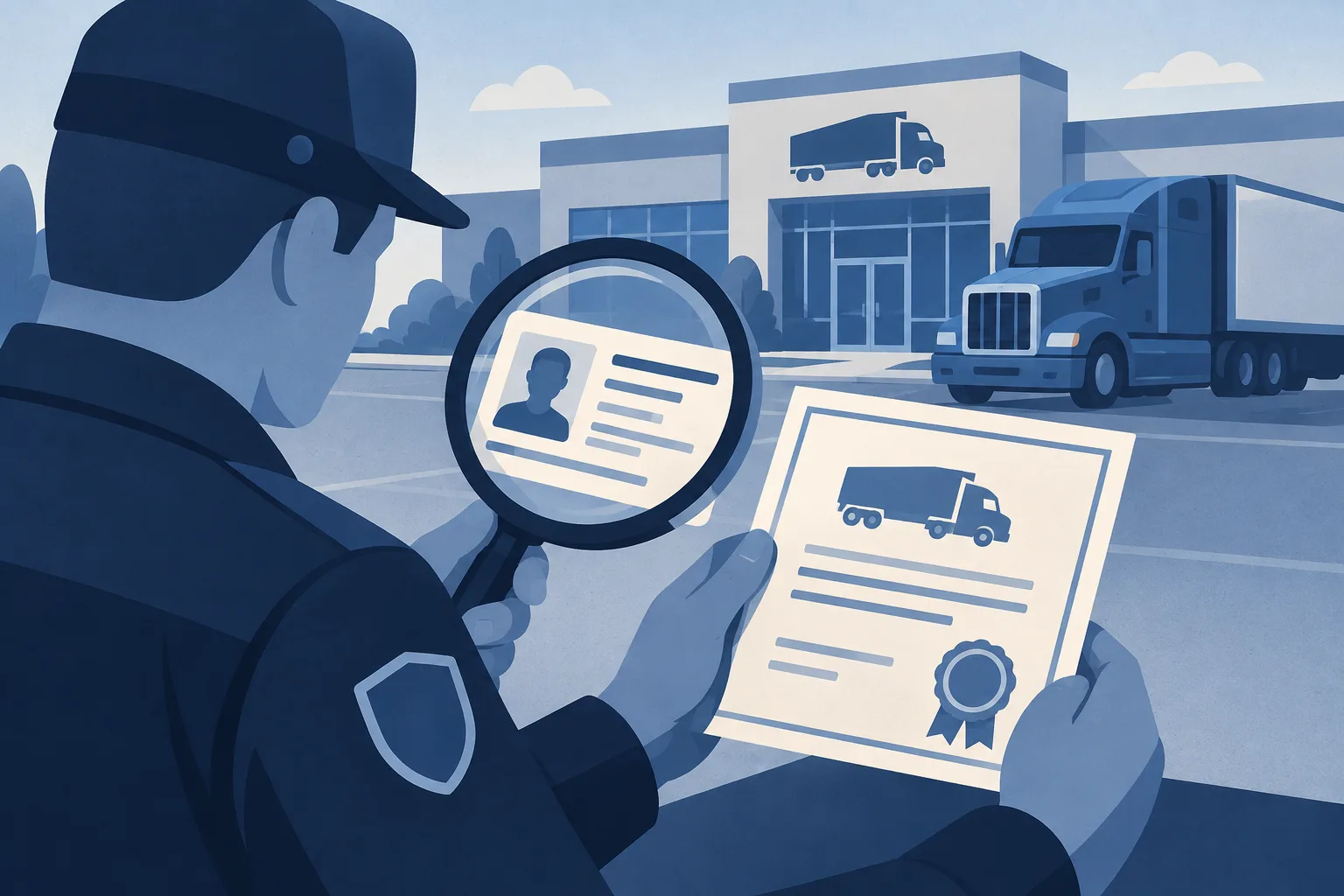

On August 31, 2026, the U.S. Department of Transportation (DOT), Department of Homeland Security (DHS), and Department of Justice (DOJ) announced a coordinated crackdown on commercial driver's license fraud that the agencies describe as the administration's most aggressive effort yet against fraud in trucking. The Federal Motor Carrier Safety Administration (FMCSA) said it would execute the emergency removal of more than 110 CDL training providers from the Training Provider Registry, issued more than 160 notices of proposed removal to additional providers, and DHS coordinated a single-day surge at more than 200 training schools across 23 states.
For motor carriers, fleet operators, and every DOT-regulated employer, this is not just a headline — it is a compliance event that demands attention. DOT says drivers certified by the 160-plus providers facing proposed removal are linked to 239 commercial motor vehicle fatalities, and the federal government has made clear that it intends to scrutinize every link in the chain from training school to carrier. This article builds on our July guide to the initial DHS/DOT investigation, which covers ELDT applicability and a credential-verification workflow in detail.
What Happened: The Scope of the Crackdown
110-Plus Emergency Removals
FMCSA's August 31 release describes three enforcement actions. In the first, the agency reviewed roadside inspection records for drivers cited for failing English language proficiency (ELP) requirements, matched them against the Training Provider Registry, and identified providers that repeatedly certified drivers who did not meet federal standards. It announced the emergency removal of more than 110 Entry-Level Driver Training (ELDT) providers associated with more than 5,000 such drivers. Removed providers must immediately stop all training operations.
160-Plus Proposed Removals From a 40-State Investigation
In the second action, FMCSA reported the results of a July sweep in which 175 investigators conducted nearly 400 investigations of ELDT providers in 40 states. The findings the agency cited include:
- Inadequate range space to complete required maneuvers
- Unlicensed instructors without the correct license to conduct training
- Missing documentation — facilities that kept no records of any assessments
- Fraudulent classrooms — one provider claimed its classroom was inside a school bus in the back of a trailer
Those investigations produced more than 160 notices of proposed removal. FMCSA says drivers certified by these 160-plus providers are linked to 239 commercial motor vehicle-related fatalities.
A Nationwide Audit of Third-Party Skills Testers
The third action is new and separate from the training-provider findings: FMCSA is launching a nationwide audit of third-party CDL skills testers and of states' oversight of those testers. CDL skills tests must be administered in English, and the agency says the more than 28,000 ELP out-of-service orders since June 2025 point to compliance failures among testers. States found non-compliant face FMCSA's CDL program review process, which can lead to withholding of federal highway funds or decertification of a state's CDL program.
Coordinated 23-State Enforcement Sweep
Simultaneously, Homeland Security Investigations (HSI) conducted a synchronized surge at more than 200 driving schools and associated businesses across 23 states, serving Notices of Inspection and pursuing investigations into CDL fraud, unauthorized employment, identity-document fraud, financial crime, and possible links to human smuggling and drug trafficking.
Joint Task Force Crossroads of America
DOJ announced the formation of the Joint Task Force Crossroads of America, which teams the U.S. Attorney's Offices in Illinois, Indiana, Michigan, and Ohio with state and local law enforcement and federal partners including DOT, FMCSA, FBI, DEA, HSI, ICE, and ATF. Its stated goals are to reduce fatalities and criminal activity on the highway system, deter illegal trucking practices, and hold accountable those who exploit the industry.
The Numbers Behind the Enforcement Wave
The August 31 action is the most visible part of a campaign that DOT says has been building for a year and a half:
- 28,000+ drivers placed out of service for failing English language proficiency requirements since June 2025
- 30,000+ improperly issued commercial licenses that states were forced to cancel
- 8,000+ training providers purged from the FMCSA registry (FMCSA's July 16 release had put the figure at nearly 10,000; the August 31 releases say "over 8,000")
- 239 fatalities linked to drivers certified by the 160-plus providers facing proposed removal
The Training Provider Registry's removed-providers list has continued to grow since August 31, so the counts above are already a floor.
Why This Matters for Motor Carriers and DOT-Regulated Employers
Driver Qualification Files: What They Do and Don't Cover
Under 49 CFR Part 391, motor carriers must maintain a driver qualification (DQ) file for every driver and confirm that each holds a valid CDL and meets the qualification standards — including the requirement in 391.11(b)(2) that the driver can read and speak English sufficiently to converse with the public, understand highway signs, respond to officials, and complete records.
Part 391 does not require an ELDT certificate in the DQ file. ELDT completion is verified by the state driver licensing agency against the Training Provider Registry before the driver takes the skills test. That distinction matters: if a driver's training provider has since been removed from the registry, the driver's CDL does not automatically become invalid, and FMCSA has not announced a requirement to retrain affected drivers. Carriers should treat provider removal as a reason to review the file and, if the CDL's status is in question, to seek confirmation from the licensing authority — not as grounds to assume the credential is void.
FMCSA Audit and Compliance Review Risk
As enforcement resources shift toward the training-to-licensing pipeline, carriers should expect compliance reviews and new entrant audits to scrutinize:
- English language proficiency — whether the carrier assessed and can document each driver's ability to meet 391.11(b)(2)
- CDL validity — whether any drivers hold licenses that states have canceled or downgraded, including through the Drug & Alcohol Clearinghouse downgrade process
- Pre-employment and annual Clearinghouse queries — full pre-employment queries have been mandatory since January 6, 2020, and annual queries are required for every CDL driver
- Medical certification — FMCSA's exemption allowing paper medical examiner's certificates during the National Registry II transition runs through October 11, 2026
Potential Consequences
Carriers with non-compliant DQ files or unqualified drivers risk:
- Out-of-service orders for individual drivers who cannot meet the ELP requirement
- Civil penalties under 49 CFR Part 386, Appendix B — up to $19,246 per non-recordkeeping violation, and $1,584 per day (up to $15,846) for recordkeeping violations
- Conditional or unsatisfactory safety ratings that can shut down operations
The highway-fund withholding described in the releases applies to states with non-compliant CDL programs, not to carriers, but it is likely to translate into tighter state-level licensing enforcement.
What Employers Should Do Now
1. Identify Which Drivers Were Subject to ELDT
ELDT applies to drivers who obtained a first Class A or Class B CDL, upgraded from B to A, or obtained a first school-bus, passenger, or hazardous-materials endorsement on or after February 7, 2022. Experienced drivers licensed before that date were not subject to it. Our July guide walks through the applicability test.
2. Check Provider Status and Document It
For drivers who were subject to ELDT, check the FMCSA Training Provider Registry and the removed providers list. Record the provider, the check date, and the result in the driver's file. If a provider has been removed, note it, confirm the driver's current CDL status with the state, and seek FMCSA guidance before taking adverse action.
3. Assess and Document English Language Proficiency
ELP is the thread running through every one of these enforcement actions. Make sure your hiring process includes a documented assessment that the driver can meet 391.11(b)(2), and keep that documentation in the DQ file.
4. Review Driver Qualification Files
Audit every DQ file for a valid CDL, current medical certification (and readiness for the October 11 end of the paper-certificate exemption), completed pre-employment and annual Clearinghouse queries, and the ELP documentation above.
5. Watch the Skills-Tester Audit
FMCSA has not published findings from its third-party tester audit. When it does, be prepared to identify which of your drivers tested with any flagged organization and to document your review.
6. Document Everything
FMCSA auditors look for documentation gaps. Every verification step, query result, and status check should be recorded with dates, reviewer names, and outcomes. Carriers that can demonstrate a proactive compliance posture will fare significantly better in audits than those caught flat-footed.
Connecting the Dots: CDL Fraud and Broader DOT Compliance
This crackdown coincides with other DOT compliance developments carriers should be tracking:
- Clearinghouse enforcement — roughly 210,000 drivers are in prohibited status, and Clearinghouse-II downgrades mean prohibited drivers lose commercial privileges at the state level
- Drug-testing panel changes still pending — DOT's proposal to add fentanyl to the Part 40 panel remains a proposed rule with no implementation date, and oral fluid testing, authorized in 2023, still awaits HHS laboratory certification
- ELD revocations — FMCSA's August 6 revocations carry an October 6, 2026 replacement deadline
As BlueHive's 2026 Workplace Compliance Outlook white paper notes, treating compliance as an ongoing process rather than a one-time checkbox exercise is essential for DOT-regulated employers navigating this enforcement landscape.
Looking Ahead
Secretary Duffy said in the announcement that "from states failing to follow the law to shady training schools and illicit companies, together we will tackle every link in the chain." Carriers should expect:
- Continued training provider removals as proposed removals become final and investigations continue
- Results from the third-party tester audit, with potential consequences for state CDL programs
- Sustained roadside emphasis on English language proficiency
- State-level CDL enforcement actions driven by federal pressure on licensing agencies
The message from the federal government is unmistakable: unqualified drivers are a safety problem, and every link in the chain — from training schools to testing organizations to the carriers who hire and dispatch drivers — will face scrutiny.
Motor carriers that act now to audit their DQ files, verify training-provider status, and document English proficiency will be positioned to weather this enforcement wave. Those that wait may find themselves on the wrong side of an FMCSA compliance review.
Sources
- DHS Press Release: Historic Interagency Effort to Crack Down on Fraud in Trucking Industry (August 31, 2026)
- DOT Briefing Room: Historic Interagency Effort to Crack Down on Fraud in Trucking Industry (August 31, 2026)
- FMCSA Newsroom: Historic Interagency Effort to Crack Down on Fraud in Trucking Industry (August 31, 2026)
- FMCSA Newsroom: Departments of Transportation & Homeland Security Team Up to Crack Down on Fraud in CDL Schools (July 16, 2026)
- FMCSA Training Provider Registry — Removed Providers
- 49 CFR Part 391 — Qualifications of Drivers
- 49 CFR Part 386, Appendix B — Civil Penalty Schedule
- FMCSA Drug & Alcohol Clearinghouse
- BlueHive: 2026 Workplace Compliance Outlook (White Paper)
Frequently Asked Questions
FMCSA compared roadside inspection records of drivers cited for failing English language proficiency (ELP) requirements against the Training Provider Registry and identified providers that repeatedly certified drivers who did not meet federal standards. On August 31, 2026 it announced the emergency removal of more than 110 Entry-Level Driver Training providers associated with more than 5,000 such drivers, according to the DOT and DHS releases.
DOT says more than 28,000 drivers have been placed out of service for English language proficiency violations since June 2025, states have been forced to cancel more than 30,000 improperly issued licenses, and more than 8,000 training providers have been purged from the FMCSA registry, according to the August 31, 2026 releases.
It is a Department of Justice task force announced August 31, 2026 that teams the U.S. Attorney's Offices in Illinois, Indiana, Michigan, and Ohio with state and local law enforcement and federal partners including DOT, FMCSA, FBI, DEA, HSI, ICE, and ATF to prosecute trucking-industry fraud and reduce highway fatalities.
Identify which drivers were subject to ELDT (first Class A or B CDL, Class B-to-A upgrade, or first S, P, or H endorsement on or after February 7, 2022), check the FMCSA Training Provider Registry for the status of their providers, and document what you find. Provider removal does not by itself invalidate a driver's CDL, so seek clarification from FMCSA or the state licensing agency rather than assuming a credential is void.
Carriers remain responsible under 49 CFR Part 391 for confirming each driver holds a valid CDL and meets qualification requirements, including English language proficiency under 391.11(b)(2). Part 391 does not require an ELDT certificate in the driver qualification file; that verification happens at the state licensing agency before the skills test. Exposure arises if a carrier uses a driver whose CDL has been canceled or downgraded, or who cannot meet the ELP requirement, with civil penalties under 49 CFR Part 386 Appendix B of up to $19,246 per violation.