FMCSA Autonomous Truck Safety NPRM: What Fleet Operators Need to Know in 2026
FMCSA has signaled a landmark NPRM on autonomous truck safety for 2026, and the BUILD America 250 Act would create the first federal framework for ADS-equipped CMVs. Here is what motor carriers and fleet operators should know and how to prepare.
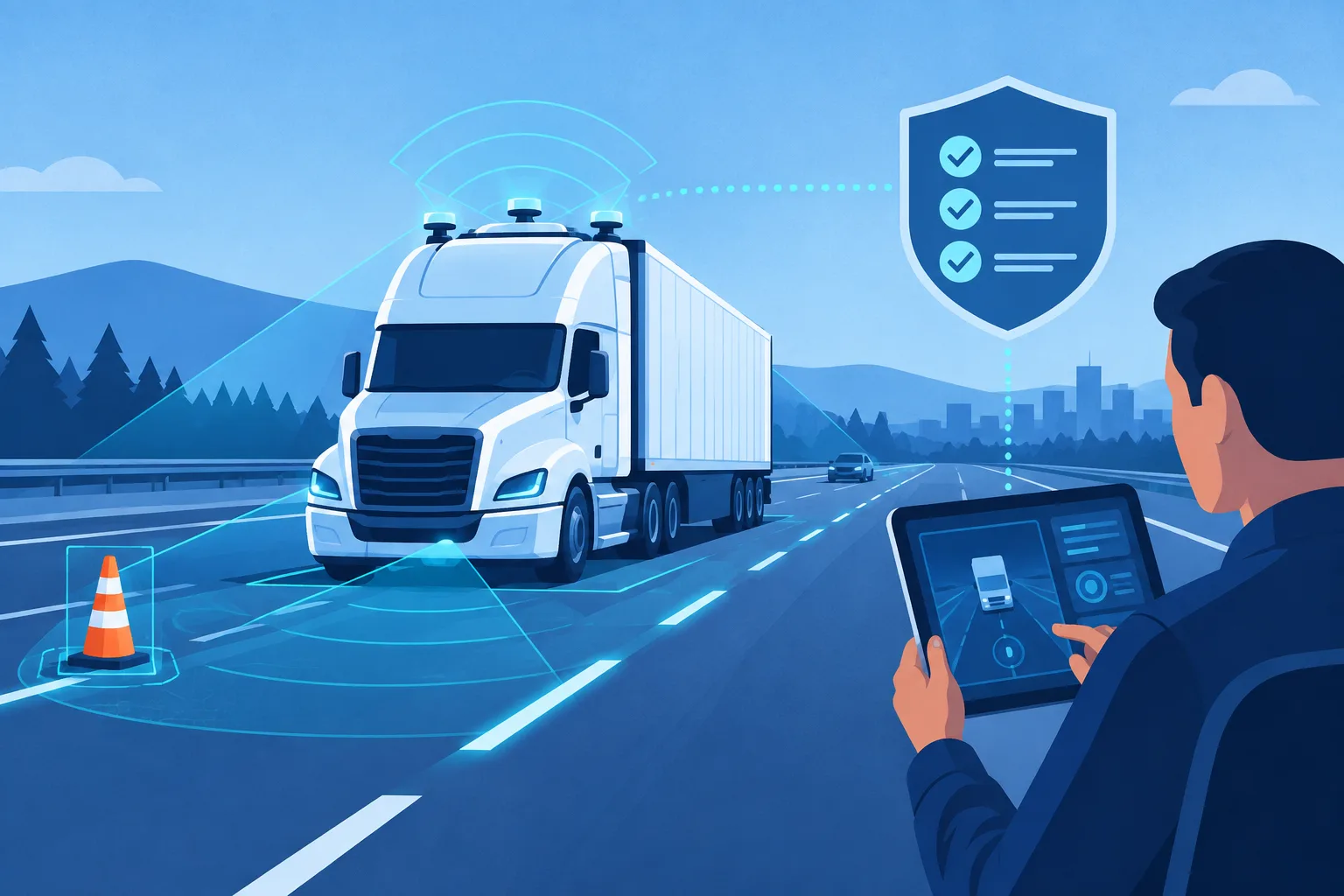

The autonomous trucking revolution is no longer a distant concept. The Federal Motor Carrier Safety Administration (FMCSA) has signaled a Notice of Proposed Rulemaking (NPRM) on the safe integration of Automated Driving Systems (ADS) in commercial motor vehicles (CMVs), with trade press reporting an August 2026 target, and fleet operators, motor carriers, and transportation safety professionals face a regulatory landscape that is shifting rapidly.
Update, September 22, 2026: The NPRM had not been published as of this update. The 2026 Unified Agenda still lists the rulemaking (RIN 2126-AC17, docket FMCSA-2018-0037) at the Proposed Rule Stage, and the most recent document on the docket remains the February 2023 supplemental advance notice. The preparation steps below stand regardless of the publication date.
At the same time, the BUILD America 250 Act (H.R. 8870) — which the House Transportation and Infrastructure Committee ordered reported on May 22, 2026 by a 62–2 vote and which now awaits a House floor vote — proposes the first-ever federal statutory framework for autonomous CMVs. Together, these developments will reshape how the industry thinks about CDL requirements, drug testing, hours of service, vehicle inspection, and employer liability.
Here is what you need to know.
The FMCSA Autonomous Truck NPRM: What to Expect
FMCSA's anticipated NPRM would propose amendments to the Federal Motor Carrier Safety Regulations (FMCSRs) to address the unique operational realities of ADS-equipped commercial vehicles. The rulemaking — which began with a 2019 advance notice and a 2023 supplemental advance notice — has been on the DOT's 2026 regulatory agenda as a high priority and is expected to target several key areas:
- Operational safety requirements for ADS-equipped CMVs operating in interstate commerce
- Inspection, repair, and maintenance protocols tailored for autonomous vehicles
- Incident reporting and data collection standards for ADS operations
- Emergency response procedures, including how autonomous trucks interact with first responders and vulnerable road users
Current FMCSRs were written with the assumption that a human driver occupies the cab. Concepts like CDL licensing, pre-trip inspections, roadside warning device placement, and hours-of-service compliance all presuppose a physical operator. The NPRM is expected to propose ADS-specific alternatives for each of these areas.
Why This Matters Now
The rulemaking comes at a critical juncture. FMCSA has been navigating autonomous truck regulation through a patchwork of individual exemption requests and temporary waivers rather than through a comprehensive national framework. In December 2024, FMCSA denied a broad exemption request from Aurora and Waymo that sought to replace traditional roadside warning triangles with cab-mounted beacons for Level 4 ADS trucks—citing insufficient safety data.
However, in July 2026, FMCSA issued Aurora a temporary waiver of the warning-device requirements dated July 9, 2026 for its Level 4 trucks — waivers under 49 U.S.C. 31315(a) are capped at three months — signaling a willingness to advance through controlled pilots while the broader rulemaking proceeds.
The BUILD America 250 Act: A Federal Framework Takes Shape
Running parallel to the FMCSA rulemaking, the BUILD America 250 Act includes the first-ever federal statutory framework for autonomous CMVs. As reported by the committee, key provisions include:
Safety Standards and Self-Certification
- The DOT must establish a performance-based safety standard within two years for CMVs equipped with SAE Level 3, 4, or 5 ADS
- Manufacturers must self-certify compliance by submitting a structured safety case covering system design, operational domain, cybersecurity, and engineering evidence
- The safety case must demonstrate that the ADS-equipped vehicle is at least as safe as a human-driven truck
Operator Requirements
- Level 3 ADS vehicles must have a human fallback driver physically present in the driver's seat
- Level 4 and 5 ADS vehicles do not generally require a human driver, but a human operator must be present when transporting hazardous materials or primarily children
- All remote operators and fallback drivers must hold a valid CDL and be physically located in the United States
- According to Holland & Knight's summary, remote monitoring and operation time would count toward hours-of-service limits under 49 CFR Part 395 — although the bill's sponsor describes the framework as exempting fully autonomous trucks from human-specific requirements, so the final text bears watching
Federal Preemption
The Act creates limited federal preemption over state and local laws regarding requirements for a human driver in Level 4 and 5 ADS-equipped CMVs. This is designed to replace the current patchwork of state-by-state regulations with a unified national approach.
What This Means for Drug Testing and DOT Compliance
For transportation employers subject to 49 CFR Part 382 and Part 40, the autonomous truck framework raises critical compliance questions.
Drug and Alcohol Testing: Settled for Fallback Drivers, Open for Remote Operators
A fallback driver seated in a Level 3 truck is a CDL driver operating a CMV and remains a safety-sensitive employee under Part 382, subject to the full scope of DOT drug and alcohol testing requirements:
- Pre-employment testing
- Random testing (50% rate for drugs, 10% for alcohol in 2026)
- Post-accident testing
- Reasonable suspicion testing
- Return-to-duty and follow-up testing
Remote operators are a harder case. Part 382 applies to drivers who operate CMVs requiring a CDL; the BUILD America 250 Act would require remote operators to hold a CDL, but Rep. Vince Fong's release describes the bill as exempting fully autonomous trucks from human-specific requirements such as hours of service and drug testing. Until the NPRM or enacted legislation resolves the question, the conservative course for carriers is to treat remote operators as safety-sensitive employees.
The FMCSA Drug and Alcohol Clearinghouse will continue to apply to CDL holders. As of the January 2026 monthly report, roughly 210,000 CDL holders are in prohibited status and cannot legally operate CMVs.
Employers deploying ADS-equipped trucks should ensure that every fallback driver — and, under a conservative reading, every remote operator — is registered and queried in the Clearinghouse, just as they would for a traditional behind-the-wheel driver.
Hours of Service for Remote Operators
One of the most significant compliance implications is how hours-of-service (HOS) rules under 49 CFR Part 395 would apply to remote operators. If, as Holland & Knight summarizes, time spent monitoring or remotely operating an ADS-equipped CMV counts toward the operator's HOS limits, fleet operators will need systems to track remote duty time with the same rigor as in-cab driving time.
Aurora's Limited Waiver: A Compliance Case Study
The July 2026 waiver issued to Aurora provides an instructive look at how FMCSA is approaching autonomous truck compliance on a case-by-case basis:
- Duration: Waivers are limited by statute to three months, so the relief expires in early October 2026 unless FMCSA acts again
- Scope: Allows use of cab-mounted warning beacons instead of traditional warning triangles for Level 4 ADS trucks
- Conditions: The waiver's published terms and conditions bind Aurora and participating carriers
- Precedent: After denying the broader Aurora/Waymo exemption request in 2024, FMCSA's willingness to issue a limited, data-driven waiver signals its preferred approach — small-scale pilots with strict oversight before broader rulemaking
This approach means fleet operators should expect phased regulatory changes rather than sweeping overnight shifts.
What Fleet Operators Should Do Now
Even though the NPRM is still forthcoming, motor carriers and fleet operators should begin preparing now:
-
Audit your compliance program. Review your drug and alcohol testing procedures, Clearinghouse query processes, and HOS tracking systems. These will apply to fallback drivers and, under the conservative reading, remote operators under the emerging framework.
-
Understand CDL requirements for remote operators. If you are deploying or planning to deploy ADS-equipped CMVs, ensure that all remote operators hold valid CDLs and meet all DOT safety-sensitive employee requirements.
-
Prepare for ADS-specific maintenance protocols. The NPRM is expected to address inspection, repair, and maintenance requirements tailored for autonomous vehicles. Begin documenting your current ADS maintenance procedures so you can adapt quickly.
-
Monitor the FMCSA rulemaking process. When the NPRM is published, there will be a public comment period. Participating in this process is the most direct way to influence the final rule. Watch docket FMCSA-2018-0037 and FMCSA's regulatory guidance page.
-
Plan for workforce transitions. The BUILD America 250 Act includes references to workforce training programs. Consider how autonomous technology may change job functions and invest in training for remote monitoring, ADS maintenance, and compliance management roles.
-
Review your testing program logistics. As BlueHive's white paper Scheduled Is Not Cleared emphasizes, having a testing appointment is not the same as being cleared for work. With remote operators potentially located across multiple states, ensuring timely and compliant drug testing and medical certification will require careful logistical planning.
Looking Ahead
The convergence of the FMCSA rulemaking and the BUILD America 250 Act marks a turning point for the trucking industry. If both advance, autonomous CMVs would for the first time operate under a coherent national safety framework rather than a patchwork of state rules and individual exemptions.
But the compliance burden for fleet operators is not going away—it is evolving. Drug testing, Clearinghouse queries, HOS tracking, and vehicle inspection requirements will all continue to apply in some form to every entity operating ADS-equipped trucks, whether the "driver" is in the cab or monitoring remotely from hundreds of miles away.
The carriers that begin preparing now will be best positioned to integrate autonomous technology safely, compliantly, and competitively.
Sources
- FMCSA's 2026 regulatory agenda: Top trucking rules to watch — Fleet Owner
- Running empty? FMCSA to issue proposal for driverless trucks — Land Line Media
- The Department of Transportation's 2026 Regulatory Agenda — Sidley
- House Passes Autonomous Vehicles Framework for Commercial Motor Vehicles — Holland & Knight (note: the bill was ordered reported by committee; it has not passed the full House)
- H.R. 8870 — BUILD America 250 Act: All Actions — Congress.gov
- Docket FMCSA-2018-0037 — Safe Integration of ADS-Equipped CMVs — Regulations.gov
- What BUILD America 250 Means for Autonomous Trucking — TT News
- The BUILD America 250 Act: Creating a Federal Framework for Autonomous Commercial Vehicles — Sidley
- Fong Autonomous Trucking Framework Provisions Pass Committee — Rep. Vince Fong
- FMCSA Denial of Aurora/Waymo Warning Device Exemption (Federal Register) — Federal Register
- Aurora Warning Device Waiver Terms and Conditions (July 2026) — FMCSA
- 49 CFR Part 395 — Hours of Service of Drivers — eCFR
- 49 CFR Part 382 — Controlled Substances and Alcohol Use and Testing — eCFR
- FMCSA Drug and Alcohol Clearinghouse — FMCSA
- Hours of Service (HOS) — FMCSA
- Part 40 — Procedures for Transportation Workplace Drug and Alcohol Testing Programs — DOT ODAPC
- Scheduled Is Not Cleared: The Last Mile of Workforce Compliance — BlueHive
Frequently Asked Questions
FMCSA had reportedly targeted August 2026 for the Notice of Proposed Rulemaking on ADS-equipped commercial motor vehicles (RIN 2126-AC17), but as of September 22, 2026 the proposal had not been published; the 2026 Unified Agenda lists it at the Proposed Rule Stage. Fleet operators should watch the Federal Register and docket FMCSA-2018-0037.
For Level 4 and 5 ADS trucks, the bill does not require a human driver in general. However, a human operator must be physically present when transporting hazardous materials or primarily children. Level 3 ADS vehicles must have a fallback driver in the driver's seat. The bill was ordered reported by the House Transportation and Infrastructure Committee on May 22, 2026, and awaits a House floor vote.
Fallback drivers in the cab are CDL drivers operating a CMV and remain subject to 49 CFR Part 382. For remote operators, the bill requires a CDL and U.S. location, but whether Part 382 testing applies to remote operation is not settled — the bill's sponsor describes it as exempting fully autonomous trucks from human-specific requirements such as hours of service and drug testing, while other summaries say monitoring time counts toward HOS. Expect the NPRM or final legislation to resolve this.
FMCSA denied a broad exemption request from Aurora and Waymo in December 2024 for roadside warning devices but issued Aurora a temporary waiver of the warning-device requirements in July 2026 for cab-mounted warning beacons on Level 4 trucks; waivers are limited by statute to three months.
Operators should audit current compliance programs, plan for ADS-specific maintenance and inspection protocols, ensure remote operators meet CDL and drug testing requirements, and monitor FMCSA rulemaking announcements for public comment opportunities.