National Safety Month 2026: Why Holistic Worker Health Is This Year's Defining Theme
June is National Safety Month, and the 2026 focus on holistic worker health challenges employers to integrate mental, physical, and emotional wellness into their safety programs. Here's what you need to know.
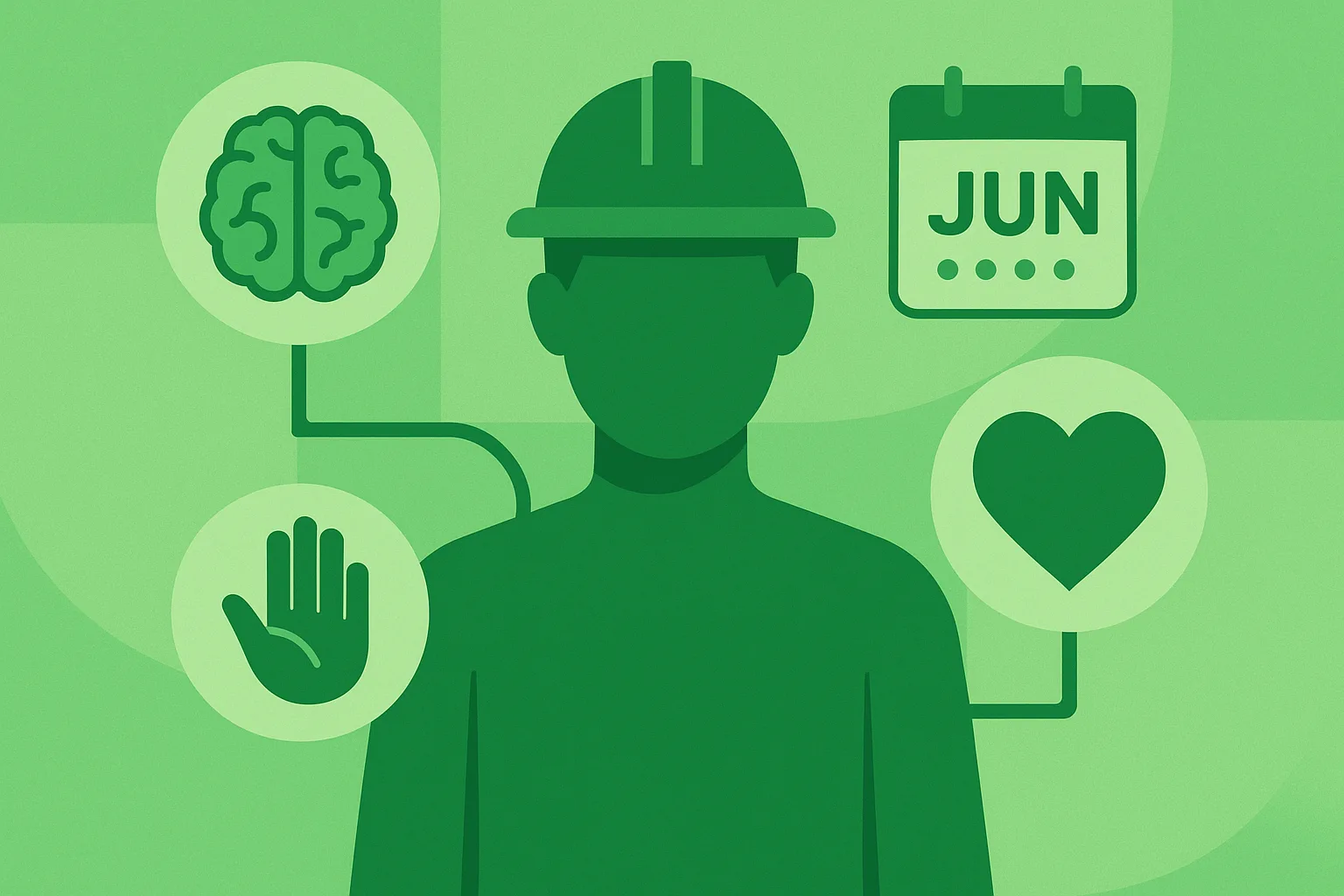

Every June, the National Safety Council designates National Safety Month as an opportunity for employers to recommit to protecting their workforce. In 2026, the campaign's Week 3 theme — Promoting Holistic Worker Health — signals a fundamental shift in how safety professionals are being asked to think about risk: not just as physical hazards on the job, but as the full spectrum of mental, emotional, and musculoskeletal factors that determine whether workers go home healthy at the end of each shift.
This shift isn't theoretical. It's backed by new NIOSH research, mounting economic data, and a growing recognition that burnout, fatigue, and chronic disease are occupational health problems — not just personal ones. For employers navigating National Safety Month 2026, here's what holistic worker health means in practice and what you should be doing right now.
The Business Case for Holistic Worker Health
The numbers paint a stark picture. According to the Occupational Safety and Health Administration, 83% of U.S. workers report experiencing work-related stress, with an estimated 120,000 deaths per year attributable to workplace stress. The financial toll is equally severe: poor workplace mental health costs U.S. employers an estimated $193 billion annually in lost productivity, and burnout alone costs between $3,999 and $20,683 per employee per year — primarily through presenteeism rather than absenteeism.
Meanwhile, NIOSH's February 2026 science bulletin on Total Worker Health and Chronic Disease revealed that over 52% of U.S. adults now have at least one major chronic disease, with 42% experiencing two or more conditions simultaneously. When these chronic conditions interact with physically demanding work, the risk of musculoskeletal disorders, cardiovascular events, and mental health crises compounds significantly.
The bottom line: employers who treat safety as purely a hard-hat-and-harness issue are leaving their greatest risks unaddressed.
What National Safety Month 2026 Is Asking Employers to Do
The National Safety Council structured its 2026 campaign around four weekly themes:
- Week 1 (June 1–6): Moving Safety Forward — Advancing a proactive safety culture with forward-thinking strategies
- Week 2 (June 7–13): Staying Safe on the Roads — Preventing road-related injuries for drivers and fleet operators
- Week 3 (June 14–20): Promoting Holistic Worker Health — Supporting total worker wellbeing across mental, physical, and emotional dimensions
- Week 4 (June 21–30): Preventing Slips, Trips, and Falls — Reducing common injuries through hazard awareness
Week 3's holistic health focus is particularly significant because it explicitly connects mental health, fatigue management, ergonomics, substance use awareness, and emotional resilience under a single occupational health umbrella. This mirrors the direction NIOSH's Total Worker Health® program has been pushing for years — and that the agency doubled down on in its 2026 chronic disease bulletin.
The Three Pillars of Holistic Worker Health
Mental Health and Psychosocial Safety
Workplace mental health has moved from a "nice to have" benefit to a core safety concern. The CDC/NIOSH bulletin on supporting mental health in the workplace emphasizes that managers influence workers' mental health more than their doctors or therapists — making leadership training and organizational culture critical safety interventions.
Key statistics that should concern every employer:
- 1 in 5 U.S. adults experience a mental health condition annually
- 60% of employees hide their mental health struggles at work due to stigma
- Employees with untreated mental health conditions are 60% more likely to have a workplace accident
- Only 12% of employees use employer-sponsored mental health benefits despite 71% of companies offering them
The gap between offering benefits and having workers actually use them represents a massive failure point. It suggests that programmatic investments alone aren't sufficient — cultural change around psychological safety and destigmatization is equally critical.
Fatigue and Work Scheduling
The CDC's Center for Work and Fatigue Research reports that 13% of workplace injuries are directly attributable to fatigue, with 97% of workers having at least one fatigue risk factor and over 80% having two or more. Approximately 30% of U.S. workers maintain nonstandard schedules, and 25% work more than 40 hours weekly.
Fatigue impairs reaction times, attention, memory, and judgment — mimicking the cognitive effects of alcohol impairment. The National Safety Council's fatigue research has consistently shown that fatigued workers pose risks comparable to impaired workers, yet few organizations have formal fatigue risk management systems in place.
Musculoskeletal Health and Chronic Disease Interaction
NIOSH's 2026 research highlights a critical finding: the interaction between chronic diseases and occupational physical demands creates compounded musculoskeletal disorder risk that exceeds either factor alone. With over half of working adults managing at least one chronic condition, this isn't an edge case — it's the workforce baseline.
Employers must recognize that ergonomic interventions, job rotation, and physical task accommodations aren't just injury prevention measures. They're chronic disease management tools that keep workers healthy, productive, and employed longer.
What Employers Should Do: A Practical Action Plan
Immediate Actions (National Safety Month)
-
Conduct a holistic health assessment. Use NIOSH's Worker Well-Being Questionnaire (WellBQ) to establish a baseline understanding of your workforce's physical, mental, and emotional health status.
-
Host Week 3 toolbox talks. The NSC provides free downloadable materials including 5-minute safety talks, fact sheets, and campaign posters specifically addressing holistic worker health.
-
Review EAP utilization data. If your Employee Assistance Program usage is below 15%, your workforce likely doesn't know about it, doesn't trust it, or doesn't find it accessible. Address barriers to use.
-
Assess fatigue risks. Identify roles with nonstandard schedules, extended shifts, or high physical/cognitive demands. Document existing controls and gaps.
-
Communicate leadership commitment. Have senior leaders visibly participate in Safety Month activities and explicitly acknowledge mental health as a workplace safety issue.
Sustained Program Changes
-
Integrate mental health into safety management systems. Mental health shouldn't live exclusively in HR benefits — it belongs in your safety program alongside fall protection and lockout/tagout. Train supervisors to recognize signs of distress as they would recognize signs of heat illness.
-
Implement a fatigue risk management system (FRMS). Establish policies around maximum shift lengths, minimum rest periods between shifts, and workload distribution. Screen for sleep disorders among workers in safety-sensitive roles.
-
Adopt the Total Worker Health framework. Move beyond siloed programs by integrating occupational safety, health promotion, and well-being initiatives under a unified strategy that addresses both work conditions and health behaviors.
-
Update ergonomic programs for chronic disease prevalence. Recognize that a workforce where 52% have at least one chronic disease requires more aggressive proactive ergonomic interventions, not just reactive ones after injuries occur.
-
Establish psychological safety metrics. Track not just injury rates but also engagement scores, voluntary turnover, EAP utilization, and workers' compensation claims related to stress or mental health. What gets measured gets managed.
The NIOSH Total Worker Health Connection
The NIOSH Total Worker Health® program provides the scientific and strategic framework underlying the National Safety Month holistic health theme. Its core principle is straightforward: working conditions and worker well-being are inseparable. You cannot meaningfully improve one without addressing the other.
The program's 2026 priorities include:
- Chronic disease and work interactions — understanding how occupational exposures exacerbate personal health conditions and vice versa
- Psychosocial hazard management — aligning with international standards like ISO 45003 for psychological health and safety at work
- Heat, fatigue, and physical demands — addressing the combined toll of environmental and schedule-related stressors
- Workforce resilience — supporting workers through economic uncertainty, AI-driven job changes, and midlife career transitions
For employers looking to build evidence-based programs, the Total Worker Health Centers of Excellence network and the WellBQ assessment tool offer practical starting points grounded in peer-reviewed research.
Connecting the Dots: Why This Matters Now
National Safety Month 2026 arrives at a moment when occupational health faces converging pressures. OSHA's Heat National Emphasis Program was updated in April 2026 with expanded industry coverage. The agency continues to enforce heat protections under the General Duty Clause while the permanent heat standard remains in rulemaking. Mental health-related workers' compensation claims are rising. And the workforce is older, more chronically ill, and more stressed than at any point in recent memory.
Employers who treat holistic worker health as a June awareness campaign and nothing more will find themselves increasingly exposed — to enforcement risk, to talent loss, and to preventable tragedies. Those who use National Safety Month as a catalyst for genuine program integration will build healthier, more resilient, and more productive organizations.
The shift from compliance-only safety programs to comprehensive well-being strategies isn't optional anymore. As BlueHive's Beyond Compliance white paper emphasizes, meeting basic regulatory requirements is only the starting point — true workforce resilience comes from making employee well-being a strategic priority.
Sources
- National Safety Council — National Safety Month 2026
- OSHA — Workplace Stress
- NIOSH Total Worker Health® Program — CDC
- NIOSH Science Bulletin: Total Worker Health and Chronic Disease at Work (2026)
- NIOSH Science Bulletin: Supporting Mental Health in the Workplace
- CDC Center for Work and Fatigue Research
- National Safety Council — Fatigue Reports
- National Safety Council — National Safety Month Materials
- OSHA Heat National Emphasis Program (CPL 03-00-024)
- Beyond Compliance: How Prioritizing Employee Well-Being Builds Stronger Workforces — BlueHive
Tags
Frequently Asked Questions
National Safety Month is observed every June and is organized by the National Safety Council. In 2026, the four weekly themes are Moving Safety Forward, Staying Safe on the Roads, Promoting Holistic Worker Health, and Preventing Slips, Trips, and Falls. Week 3's holistic health focus emphasizes integrating mental, physical, and emotional wellness into workplace safety programs.
Total Worker Health® is a CDC/NIOSH program that integrates traditional occupational safety with broader worker well-being — covering physical health, mental health, chronic disease prevention, and organizational culture. Its core principle is that working conditions and worker well-being are inseparable and must be addressed together.
According to OSHA, 83% of U.S. workers report work-related stress, contributing to approximately 120,000 stress-related deaths annually. Burnout costs employers between $3,999 and $20,683 per employee per year, primarily through presenteeism — working while unwell with reduced productivity.
According to CDC/NIOSH research, 13% of workplace injuries are directly attributable to fatigue. Additionally, 97% of workers have at least one workplace fatigue risk factor, and over 80% have two or more risk factors such as nonstandard schedules, extended shifts, or high physical demands.
Employers should conduct a holistic health assessment using tools like NIOSH's Worker Well-Being Questionnaire, host toolbox talks using free NSC materials, review Employee Assistance Program utilization, assess fatigue risks across their workforce, and have senior leaders visibly participate in and communicate about holistic worker health initiatives.