OSHA's Proposed $3.5 Million Channelview Penalties: HAZWOPER Lessons for Employers
OSHA proposed $3,520,703 in penalties after the Channelview sulfuric acid spill cleanup. Learn how HAZWOPER scope, role-specific training, respiratory protection, and contractor coordination affect employer compliance.
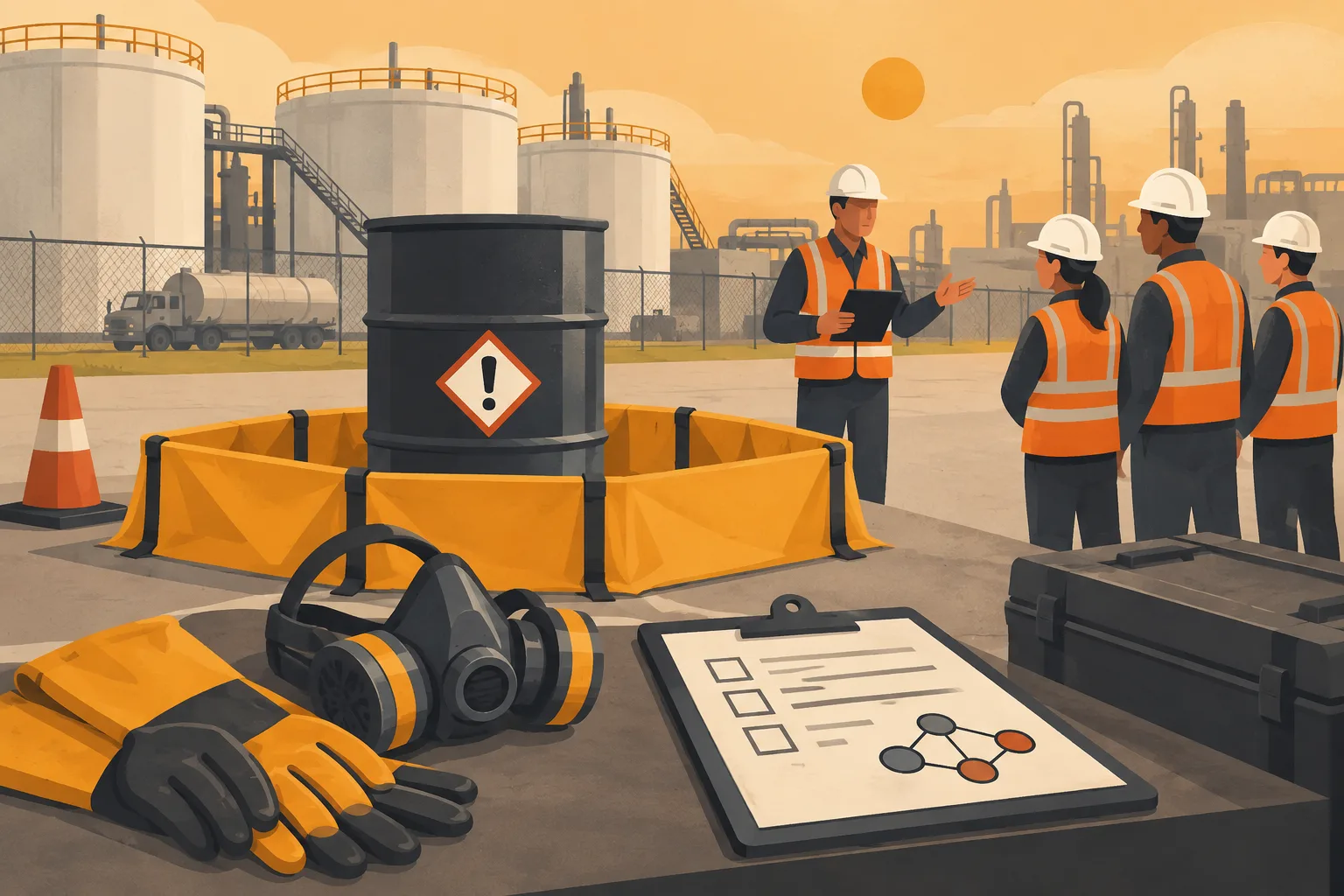

On June 26, 2026, OSHA announced $3,520,703 in proposed penalties against three employers following post-emergency cleanup of a sulfuric acid spill at BWC Terminals in Channelview, Texas. The agency reported failures involving worker training, respiratory protection, and safety programs across the facility operator, cleanup contractor, and labor subcontractor.
This article examines the findings and proposed penalties in that announcement, not a later final resolution of the cases. For employers, the practical lesson is to determine the applicable safety requirements before assigning work. Hazardous-waste cleanup and emergency response have related but distinct requirements; not every spill calls for the same training or medical program.
What Happened: The BWC Terminals Sulfuric Acid Spill
According to OSHA's release, BWC Terminals mixed fresh and spent sulfuric acid despite safety warnings on December 27, 2025. Tank overpressure ruptured a supply line, releasing approximately 1 million gallons of sulfuric acid and causing multiple employee injuries.
BWC hired Coastal Environmental Solutions to handle hazardous-waste cleanup. Coastal then hired One Way Environmental Services to supply laborers for cleanup and remediation. OSHA's announcement focuses on how those workers were protected during the post-emergency phase.
What OSHA Reported
The agency opened three inspections following the spill and reported the following citations. These are OSHA's stated findings accompanying proposed penalties, not a statement that the employers' contest rights had been exhausted.
One Way Environmental Services LLC — $3,045,452 in Proposed Penalties
The subcontractor responsible for sending cleanup crews to the site received the heaviest penalties. OSHA cited the company for 18 willful egregious violations and 5 serious violations, finding that One Way:
- Deployed workers to clean up hazardous materials without adequate training
- Failed to conduct respirator fit testing before sending workers into an acid-contaminated environment
- Failed to provide required safety measures
The release reports 18 willful egregious violation items and five serious violations. It does not establish that each item corresponds to a different worker, and the $3,045,452 proposal includes both categories.
Coastal Environmental Solutions Inc. — $392,501 in Proposed Penalties
The primary contractor was cited for 2 willful and 5 serious violations, including:
- No emergency response plan for hazardous waste operations
- Failure to provide HAZWOPER training to workers involved in the response
- Deficiencies in respirator use and oversight
- Absence of a comprehensive safety and health program
BWC Terminals LLC — $82,750 in Proposed Penalties
The facility operator received 6 serious citations for:
- Exposing workers to chemical burns
- Failing to provide hazardous materials training
- Respirator use deficiencies
Understanding the HAZWOPER Standard
OSHA's Hazardous Waste Operations and Emergency Response (HAZWOPER) standard, 29 CFR 1910.120, applies to specified cleanup operations, covered hazardous-waste treatment/storage/disposal operations, and emergency response. Start with paragraph (a), not the assumption that the presence of any chemical automatically triggers every requirement.
Paragraph (a)(3) excludes qualifying incidental releases from its emergency-response definition. Paragraph (q)(1) also provides an exception for employers that evacuate employees, do not permit them to assist with the emergency, and maintain an emergency action plan complying with 29 CFR 1910.38. An evacuation policy must match actual practice; employees should not improvise response activities outside their assigned role.
Key HAZWOPER Requirements for Employers
Written plans: Covered emergency-response operations require the plan described in (q), subject to its exceptions. Covered cleanup operations have their own safety and health program and site-plan requirements. Under (q)(11), post-emergency cleanup must meet paragraphs (b) through (o) or the specified alternative for cleanup on plant property using plant or workplace employees.
Cleanup-worker training: Paragraph (e)(3) generally requires 40 hours of off-site instruction and three days of supervised field experience for general site workers. It provides 24-hour/one-day categories for qualifying limited tasks or characterized low-exposure work. On-site supervisors have additional requirements under (e)(4). Do not assign a training category solely from a course's marketing name.
Emergency-responder training: Paragraph (q)(6) assigns different requirements by function:
- Awareness-level responders need sufficient training or experience to demonstrate the specified competencies and initiate notification, not control the release.
- Operations-level responders need at least eight hours of training or sufficient experience to demonstrate the specified competencies, with employer certification.
- Technicians need at least 24 hours equivalent to operations-level training plus the specified competencies; specialists need at least 24 hours equivalent to technician-level training plus their specified competencies.
- Incident commanders need at least 24 hours equivalent to operations-level training plus the command competencies.
Refresher requirements: Paragraph (e)(8) specifies eight annual refresher hours for covered cleanup workers and supervisors. Paragraph (q)(8) instead requires sufficient annual refresher training or documented annual competency, including for awareness-level responders. It does not set a universal eight-hour minimum for emergency responders.
Medical surveillance and consultation: Apply the criteria in (f)(2) and (q)(9). For covered hazardous-waste operations, criteria include certain exposure or respirator-use conditions for 30 or more days per year, as well as other specified circumstances. Organized, designated HAZMAT team members and hazardous-materials specialists have baseline and surveillance requirements under (q)(9); symptomatic emergency-response employees must receive the specified medical consultation. Required respirator medical evaluations must also be considered separately.
Protective equipment: Select equipment for the hazards and comply with the applicable Respiratory Protection standard, 29 CFR 1910.134. That standard requires medical evaluation before fit testing or required respirator use, and fit testing for tight-fitting respirators, not every loose-fitting device.
Put the Penalties in Context
OSHA's May 21, 2026 penalty memo explicitly states there was no inflation adjustment for 2026. The 2025 maximums remain in effect: $16,550 for serious violations and $165,514 for willful or repeated violations. The memo also addresses revised minimums and penalty-reduction policies.
The Channelview proposals demonstrate that multiple citation items can produce substantial totals even without an annual rate increase. Do not equate a proposed total with a final amount collected, or assume that every cited item automatically carries the maximum.
What This Means for Employers
The Channelview case highlights several critical lessons for any employer that handles, stores, transports, or could be called upon to respond to releases of hazardous substances.
1. Emergency Response Training Cannot Wait Until the Emergency
OSHA reported inadequate training among the cleanup failures. Establish each worker's authorized tasks and the applicable training pathway before deployment. The standard has specific provisions for different personnel, including temporary skilled support personnel under (q)(4); an exception for one role is not permission to send an untrained cleanup crew into a hazardous site.
2. Coordinate Across the Contractor Chain
OSHA cited each employer for its reported failures, rather than treating a cleanup contract as a substitute for safety obligations. HAZWOPER (b)(1)(iv) requires an employer retaining contractors for covered hazardous-waste operations to inform them of identified hazards and site emergency procedures. Verify roles, qualifications, and program responsibilities before work begins.
3. Respiratory Protection Requires Advance Preparation
Check the actual respirator and task. For required tight-fitting respirators, medical evaluation and fit testing must precede the relevant use; fit testing is also required at least annually and under specified change conditions. A loose-fitting respirator's different fit-testing requirements do not eliminate the need for appropriate selection, required medical evaluation, and training.
4. Written Plans Are Not Optional
For operations that require written programs, ensure the documents describe the actual work, hazards, equipment, and assigned responsibilities. OSHA specifically reported missing safety/health and emergency-response programs in Coastal's citations. Keep worker instructions consistent with the applicable program and any evacuation-only arrangement.
5. Unchanged Rates Still Create Significant Exposure
The proposed amounts show why prevention matters, but the worker-protection decisions should begin with the hazards and applicable standards, not only a comparison with possible fines. Training, suitable protective equipment, and coordinated planning need to be in place before the work begins.
Employer Action Steps
To avoid the failures that led to the Channelview citations, employers should take the following steps immediately:
-
Determine covered operations and roles. Distinguish incidental release control, emergency response, and post-emergency cleanup. Document whether employees respond or evacuate.
-
Verify the applicable training records. Check initial training, field experience where required, and either the applicable refresher requirement or permitted documented competency demonstration.
-
Review respiratory protection. Confirm appropriate selection, required medical evaluations, tight-fitting respirator fit tests, and employee training.
-
Coordinate contractors. Exchange relevant hazards and emergency procedures, identify program owners, and verify the qualifications needed for the assigned work.
-
Test the planned response. Use exercises appropriate to your operations to identify communication and coordination gaps before an incident.
-
Review medical requirements with qualified personnel. Apply the specific surveillance and consultation criteria rather than assuming every chemical exposure has the same medical follow-up requirement.
OSHA's announcement noted the employers' opportunity to comply, request an informal conference, or contest the citations within 15 business days of receipt. This is a description of the announced enforcement process, not a new deadline created by this article. The enduring employer lesson is to identify the right requirements and verify implementation before deploying workers.
Sources
Tags
Frequently Asked Questions
OSHA proposed a total of $3,520,703 in penalties against three employers — One Way Environmental Services ($3,045,452), Coastal Environmental Solutions ($392,501), and BWC Terminals ($82,750) — for willful, egregious, and serious violations related to the December 2025 sulfuric acid spill cleanup in Channelview, Texas.
HAZWOPER, 29 CFR 1910.120, covers specified hazardous-waste and emergency-response operations. Its emergency-response definition excludes qualifying incidental releases, and paragraph (q)(1) provides an exception for employers that evacuate workers, prohibit their participation in the emergency, and have a compliant emergency action plan.
No. OSHA's May 21, 2026 memo says the 2025 maximums remain in effect for 2026: $16,550 for a serious violation and $165,514 for a willful or repeated violation. The memo also updates certain minimum penalties to reflect penalty-reduction policies.
Training depends on the operation and assigned role: paragraph (e) governs covered cleanup-worker training, while paragraph (q)(6) sets emergency-responder levels. Paragraph (q)(8) requires annual refresher training or documented annual competency for those responders, including awareness-level personnel; it does not impose a universal eight-hour refresher on them.
First determine which HAZWOPER provisions apply and whether employees will respond or evacuate. Then verify the applicable written plans, role-specific training, protective equipment, contractor coordination, and medical requirements; fit testing under 29 CFR 1910.134 applies to tight-fitting respirators.