OSHA HazCom Deadline Arrives May 19: What Employers Must Do Before GHS Revision 7 Takes Effect
The first major compliance deadline for OSHA's updated Hazard Communication Standard lands May 19, 2026. Here's what changed, who's affected, and how employers should prepare for GHS Revision 7.
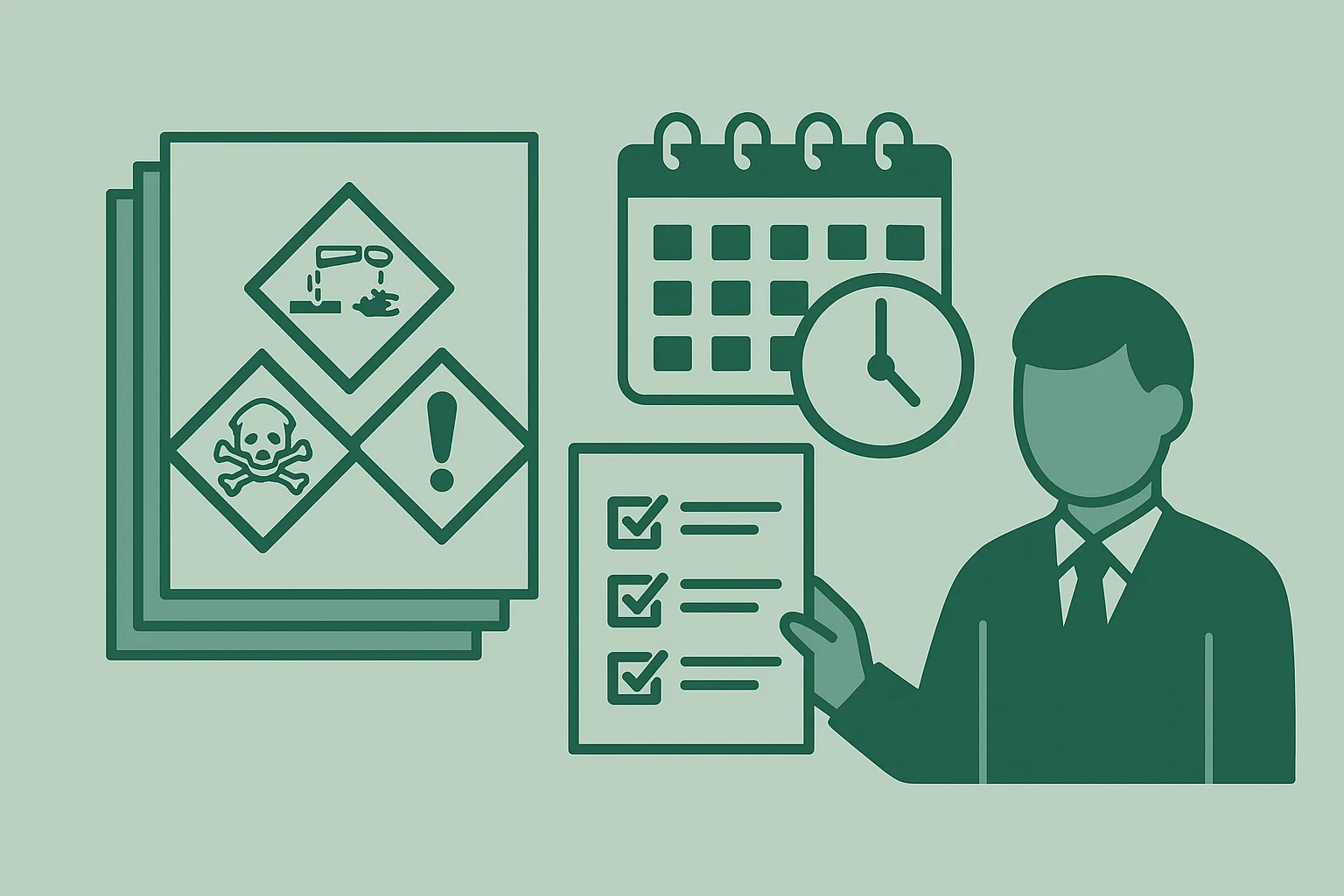
In less than three weeks, the first major compliance deadline for OSHA's revised Hazard Communication Standard (HCS) takes effect. On May 19, 2026, chemical manufacturers, importers, and distributors must have their substances classified, labeled, and documented under the updated standard — which aligns U.S. chemical hazard communication with Revision 7 of the Globally Harmonized System of Classification and Labelling of Chemicals (GHS).
For employers who use hazardous chemicals in the workplace — which includes the vast majority of manufacturing, construction, healthcare, and maintenance operations — the downstream deadline of November 20, 2026 follows shortly after. That's when updated workplace labels, revised written programs, and retrained workers must all be in place.
This is not a minor paperwork exercise. Hazard Communication violations are consistently among OSHA's top 10 most-cited standards, and the updated rule introduces new hazard categories, revised Safety Data Sheet (SDS) requirements, and label changes that will affect virtually every employer with chemicals on-site. Here's what you need to know.
Background: Why the Standard Changed
OSHA first aligned its Hazard Communication Standard with the GHS in 2012, adopting GHS Revision 3. That update introduced the now-familiar red-bordered pictograms, signal words, and standardized SDS format that replaced the old Material Safety Data Sheet (MSDS) system.
On May 20, 2024, OSHA published its final rule updating the HCS to align with GHS Revision 7 (89 FR 44144). The rule became effective July 19, 2024, with a phased compliance timeline. The Department of Labor announced that the update was necessary to keep pace with international standards, improve worker protection, and address implementation challenges from the 2012 revision.
Then, on January 15, 2026, OSHA published a Federal Register notice extending all compliance deadlines by four months, acknowledging that additional guidance materials were still in development and that the regulated community needed more time to prepare. The original January 19, 2026 deadline shifted to May 19, 2026.
What Changed: Key Updates in HCS 2024
The updated standard introduces several substantive changes that go beyond simple label formatting:
New Hazard Classes and Categories
- Desensitized explosives — A new hazard class for chemicals that have been diluted or phlegmatized to reduce explosive properties
- Pressurized chemicals — Chemicals in pressurized containers not currently covered under compressed gas or aerosol classifications
- Unstable gases — A new sub-category addressing gases that may decompose or polymerize under certain conditions
Updated Safety Data Sheet Requirements
- Section 9 (Physical and Chemical Properties): Properties must now be listed in a specified order for consistency
- Section 11 (Toxicological Information): Must include information on interactive effects between chemicals and clearly address when data is not available rather than leaving sections blank
- Non-animal testing data is now explicitly permitted for skin corrosion and serious eye damage classifications
Revised Labeling Rules
- Small containers: New provisions allow reduced labeling on containers that are too small for full GHS labels, with complete information on outer packaging
- Label update triggers: Clarified requirements for when labels must be revised after reclassification
- Precautionary statements: Updated language and organization for clarity
Trade Secret Provisions
- Manufacturers may now use concentration ranges rather than exact percentages when claiming trade secret ingredient information, provided the range is narrow enough to allow appropriate hazard assessment
The Compliance Timeline
The phased deadlines — as extended in January 2026 — are:
| Who | What | Deadline |
|---|---|---|
| Chemical manufacturers, importers, distributors | Classify substances, update SDSs and labels | May 19, 2026 |
| Employers | Update workplace labels, written HazCom programs, and employee training for substances | November 20, 2026 |
| Chemical manufacturers, importers, distributors | Classify mixtures, update SDSs and labels | November 19, 2027 |
| Employers | Update workplace labels, programs, and training for mixtures | May 19, 2028 |
Until each respective deadline, entities may comply with either the previous (2012) or the updated (2024) version of the standard. After the deadline passes, only compliance with the 2024 HCS is acceptable.
Why This Matters: Enforcement Reality
Hazard Communication is not a low-priority standard for OSHA. It has appeared on the agency's Top 10 Most Frequently Cited Standards list for over a decade. Common citations include:
- Missing or outdated Safety Data Sheets
- Unlabeled or improperly labeled chemical containers
- No written Hazard Communication program
- Inadequate or absent employee training
Under OSHA's 2026 penalty structure, a single serious HazCom violation can carry a fine of up to $16,550. Willful or repeat violations can reach $165,514 per violation. For employers with multiple chemicals and multiple work areas, violations can multiply quickly.
The enforcement risk is especially acute during the transition period. OSHA compliance officers conducting inspections for any reason — a complaint, a referral, a programmed inspection — will check HazCom compliance as a matter of course. Employers who have not begun their transition work will have no grace period once May 19 passes for upstream suppliers, and once November 20 arrives for their own operations.
What Employers Should Do Now
Even though the first May 19 deadline applies primarily to chemical manufacturers and distributors, downstream employers cannot afford to wait. Here's a practical action plan:
1. Conduct a Chemical Inventory
- Identify every hazardous chemical present in your workplace
- Document which chemicals are substances (single compounds) versus mixtures
- Note which suppliers provide each chemical and their current SDS versions
2. Contact Your Suppliers
- Confirm that your chemical suppliers are on track to deliver updated SDSs by May 19, 2026
- Request timelines for when updated SDSs and labels will be available
- Flag any suppliers who have not communicated their HazCom transition plans
3. Review Your Written Program
- Pull your current written Hazard Communication program and compare it against the updated regulatory text at 29 CFR 1910.1200
- Ensure the program addresses new hazard classes (desensitized explosives, pressurized chemicals)
- Update the program to reflect any changes in how you manage SDSs and label containers
4. Plan Workplace Label Updates
- Assess which workplace labels (secondary containers, pipes, tanks) will need revision
- Develop a label replacement schedule that can be completed before November 20, 2026
- Consider whether small-container labeling changes affect your operations
5. Schedule Employee Training
- Plan training sessions to cover new hazard classes, revised pictograms or statements, and any changes to your chemical inventory
- Training must be completed before employees are exposed to chemicals under the new classification system
- Document all training with dates, attendees, and content covered
6. Build in Lead Time
- Do not wait until November 2026 to begin your updates — SDSs from suppliers may arrive in waves, and label printing and training scheduling require lead time
- Assign a responsible person or team to manage the transition and track progress
Resources for Compliance
OSHA has published several resources to assist with the transition:
- OSHA HazCom Rulemaking Page — Full regulatory text, fact sheets, and FAQs
- HCS 2024 Compliance Date Extension Notice — Official notice of the four-month deadline extension
- OSHA Fact Sheet: Final Rule on HCS 2024 — Summary of major changes
- Federal Register Notice (89 FR 44144) — Full text of the 2024 final rule
For a broader overview of 2026 OSHA changes including HazCom, heat safety enforcement, and injury reporting requirements, BlueHive's white paper "2026 OSHA Changes: What Has Taken Effect, What is Coming, What Employers Should Do Now" provides a consolidated compliance guide organized by deadline and industry.
The Bottom Line
The May 19, 2026 HazCom deadline is not the end of the compliance timeline — it's the beginning. Once chemical manufacturers and importers update their classifications and SDSs, the responsibility shifts to employers to absorb those changes into their workplace programs, labels, and training. Employers who start now will have an orderly transition. Those who wait will face compressed timelines, rushed training, and the risk of citations from an agency that already treats HazCom as a priority enforcement target.
The standard has not changed its fundamental purpose: every worker has the right to know what chemicals they're exposed to and how to protect themselves. What has changed is the precision and scope of the information that must be communicated. The May 19 deadline is the signal that the transition period is no longer hypothetical — it's operational.
Sources
- OSHA Final Rule: Hazard Communication Standard (89 FR 44144) — Federal Register, May 20, 2024
- OSHA HCS 2024 Compliance Date Extension Notice — OSHA, January 15, 2026
- Federal Register Extension Notice (91 FR 1695) — GovInfo, January 15, 2026
- DOL News Release: Final Rule Updating Hazard Communication Standard — U.S. Department of Labor, May 20, 2024
- OSHA Fact Sheet: HCS 2024 Final Rule (OSHA 4437) — OSHA Publications
- OSHA HazCom Rulemaking Page — OSHA
- 29 CFR 1910.1200 — Hazard Communication — OSHA Regulations
- OSHA Top 10 Most Frequently Cited Standards — OSHA
- 2026 OSHA Changes: What Has Taken Effect, What is Coming, What Employers Should Do Now — BlueHive White Paper
Tags
Frequently Asked Questions
The first deadline is May 19, 2026, by which chemical manufacturers, importers, and distributors must classify substances and update Safety Data Sheets and labels to align with GHS Revision 7. Employers must update workplace labels, written programs, and training by November 20, 2026.
The 2024 final rule aligns OSHA's HazCom standard with GHS Revision 7, adding new hazard classes for desensitized explosives and pressurized chemicals, updating SDS content requirements for Sections 9 and 11, revising small-container labeling rules, and permitting concentration ranges for trade secret ingredients.
OSHA can impose fines of up to $16,550 per serious violation and up to $165,514 per willful or repeat violation. Hazard Communication consistently ranks among OSHA's top 10 most-cited standards each year.
Yes. On January 15, 2026, OSHA published a Federal Register notice extending all HazCom compliance deadlines by four months. The original January 19, 2026 deadline moved to May 19, 2026, giving manufacturers, importers, and distributors additional time to prepare.
Employers should inventory all hazardous chemicals on-site, contact suppliers about updated Safety Data Sheets, review and revise their written Hazard Communication program, update workplace container labels, and schedule employee training on new hazard classes and label elements before the November 20, 2026 deadline.