OSHA's May 19 HazCom Deadline Is Days Away: What Employers Need to Know About the Updated Chemical Safety Standard
The first major compliance deadline for OSHA's revised Hazard Communication Standard arrives May 19, 2026. Here's what changed, who must act, and how to protect workers from chemical health hazards under the new GHS Revision 7 requirements.
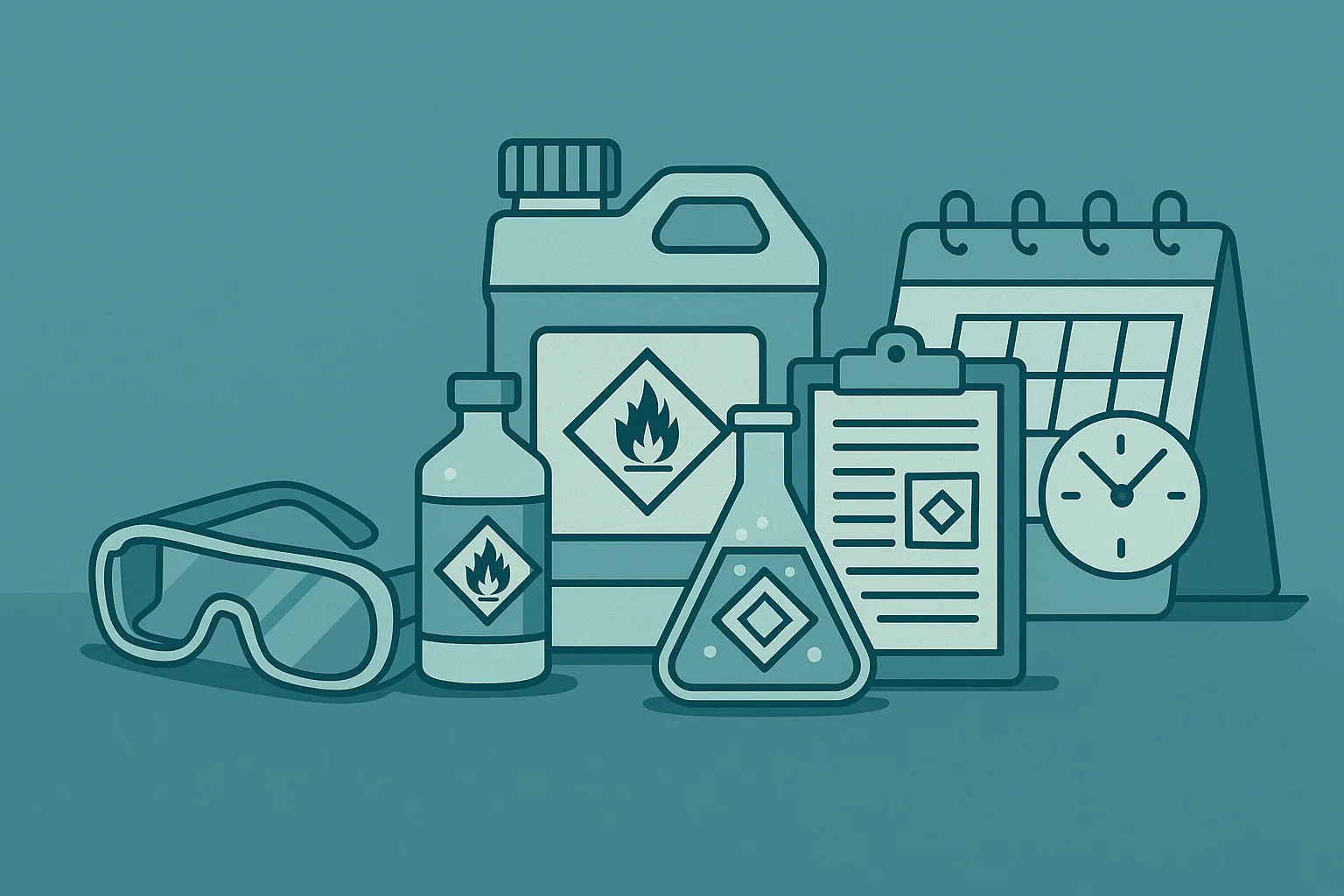
The clock is ticking. On May 19, 2026, the first major compliance deadline for OSHA's revised Hazard Communication Standard (HCS) takes effect — requiring chemical manufacturers, importers, and distributors to reclassify hazardous substances and ship updated Safety Data Sheets (SDS) and labels that meet the Globally Harmonized System (GHS) Revision 7 criteria.
For the millions of employers and tens of millions of workers who handle hazardous chemicals every day, this deadline marks the beginning of a cascading set of compliance obligations that will reshape how chemical health hazards are communicated in American workplaces through the end of 2028.
If your workers interact with any chemical products — from industrial solvents and cleaning agents to paints, adhesives, and pesticides — you need to understand what is changing, what is expected of you, and why these updates matter for occupational health.
Why This Update Matters for Worker Health
Chemical exposures remain a persistent source of workplace illness and injury. According to the Bureau of Labor Statistics, there were approximately 224,450 cases involving days away from work, restricted activity, or job transfer caused by exposure to harmful substances or environments in the 2023–2024 reporting period. In 2024 alone, 687 workers died from exposure to harmful substances or environments on the job.
OSHA's Hazard Communication Standard is the agency's primary tool for ensuring that workers understand the chemicals they encounter and how to protect themselves. The standard applies to more than 43 million workers across virtually every industry where hazardous chemicals are present. It is also consistently among OSHA's most-cited standards year after year — an indication that many employers still struggle with full compliance.
The 2024 update, published as a final rule on May 20, 2024 (89 FR 44144), was designed to improve how chemical hazards are classified and communicated. By aligning with GHS Revision 7 — and incorporating select elements from Revision 8 — the updated standard ensures that labels and Safety Data Sheets contain more accurate, actionable health information for workers and first responders.
What Changed in the 2024 HazCom Update
OSHA's rulemaking page and the Department of Labor's announcement outline the key changes. Here is what employers need to understand:
New and Revised Hazard Classifications
The updated standard introduces several new hazard classes and categories that did not exist under the prior version:
- Desensitized explosives — a new hazard class for chemicals that are stabilized by the addition of desensitizing agents
- Chemicals under pressure — a new class for liquefied or dissolved gases that do not meet existing compressed gas criteria
- New flammable gas subcategories — including pyrophoric gases and chemically unstable gases
For health hazards specifically, the rule updates classification criteria for skin corrosion, skin irritation, and serious eye damage. It also incorporates non-animal testing methods from GHS Revision 8 for determining skin effects — a significant update that reflects current toxicological science.
Improved Labels and Safety Data Sheets
Labels must now include updated precautionary statements for handling, storage, and disposal. The rule also introduces:
- New labeling provisions for small containers (≤100 mL and ≤3 mL), making labels more practical while still conveying essential hazard information
- Clearer requirements for label updates when a chemical is reclassified
- Updated SDS content requirements, including more detailed information on particle characteristics for solid chemicals, concentration ranges for trade secret ingredients, and hazards from foreseeable emergency conditions
Strengthened Worker Access to Information
The rule limits the ability of chemical manufacturers to withhold hazard information as trade secrets, ensuring that workers and first responders can access critical data about chemical exposures when they need it most. This is particularly important in emergency situations where rapid identification of chemical health hazards can be lifesaving.
The Compliance Timeline
OSHA originally set aggressive compliance deadlines when the rule was published in 2024. However, on January 15, 2026, OSHA issued a final rule extending the deadlines (91 FR 1695) by four months to give the regulated community additional time to review guidance materials. The current timeline is:
| Deadline | Who Must Comply | Requirement |
|---|---|---|
| May 19, 2026 | Chemical manufacturers, importers, distributors | Classify substances under GHS Rev 7; update SDS and labels |
| November 20, 2026 | All employers using hazardous chemicals | Update workplace labels, written HazCom programs, and retrain workers |
| November 19, 2027 | Chemical manufacturers, importers, distributors | Classify mixtures under GHS Rev 7; update SDS and labels |
| May 19, 2028 | All employers using hazardous chemicals | Update workplace labels, programs, and training for mixtures |
Important: Until each deadline arrives, employers may comply with either the prior 2012 version of the standard, the updated 2024 version, or both. After the deadline passes, only the updated standard will be accepted.
What This Means for Employers
The May 19 deadline applies directly to chemical manufacturers, importers, and distributors — but it has immediate downstream consequences for every employer with hazardous chemicals in the workplace. Here's why:
Once suppliers begin shipping products with updated labels and new-format SDS, employers must be prepared to:
-
Receive and file updated SDS — Your existing SDS library will begin to include sheets in the new format. Workers and safety personnel need to be able to read and interpret the updated information.
-
Understand new hazard classifications — If a chemical you use is reclassified under the updated criteria, that may change how you store it, what personal protective equipment (PPE) is required, or what emergency procedures apply.
-
Plan for your own November 2026 deadline — Employers have until November 20, 2026, to update workplace container labels, revise written hazard communication programs, and retrain workers. That timeline is tighter than it sounds for organizations with large chemical inventories.
Immediate Steps Employers Should Take
Even if your formal deadline is in November, occupational health best practices call for starting now:
- Audit your chemical inventory. Identify all hazardous chemicals present in the workplace and verify that you have current SDS for each one.
- Contact your suppliers. Confirm that your chemical vendors are on track to meet the May 19 deadline and will provide updated SDS and labels on schedule.
- Review your written HazCom program. Does your current program reference the old GHS Revision 3 criteria? Plan the updates needed to reflect the new hazard classes and labeling requirements.
- Assess training needs. Workers will need to understand new pictograms, signal words, hazard statements, and precautionary statements. Build this into your Q3 2026 training calendar.
- Evaluate health monitoring. If any chemicals you use are being reclassified to a higher hazard category, consider whether your occupational health surveillance or exposure monitoring programs need to be updated.
The Occupational Health Connection
From a worker health perspective, the updated HazCom standard represents a meaningful improvement in how chemical hazards are communicated. Better labeling and more detailed SDS content mean that:
- Workers can make better-informed decisions about personal protective equipment and safe handling practices
- Occupational health professionals will have access to more detailed toxicological data and particle characteristic information when evaluating potential exposures
- First responders can more quickly identify hazards during chemical spills or workplace emergencies
- Physicians and licensed health care professionals (PLHCPs) can access chemical identity information in medical emergencies, even when that information was previously claimed as a trade secret
The rule's inclusion of non-animal testing data for skin effects also means that hazard classifications will more accurately reflect real-world exposure risks, rather than relying solely on older toxicological methods.
Enforcement Context
Employers should not underestimate OSHA's commitment to enforcing the Hazard Communication Standard. HazCom violations have appeared on OSHA's Top 10 Most Cited Standards for years. Common violations include:
- Failure to maintain a written hazard communication program
- Missing or incomplete Safety Data Sheets
- Lack of employee training on chemical hazards
- Improperly labeled secondary containers
As noted in a BlueHive white paper on 2026 OSHA changes, OSHA's enforcement posture in 2026 is intensifying across multiple areas, with data-driven targeting, the Severe Violator Enforcement Program, and instance-by-instance citation practices leading to penalties that can reach six and seven figures for repeat or willful offenders.
With the HazCom deadline now imminent, employers who have not yet begun their transition planning face elevated compliance risk.
Looking Ahead
The May 19, 2026 deadline is just the first milestone. Employers should treat this year as the beginning of a multi-phase transition:
- May–November 2026: Receive updated SDS from suppliers, begin updating workplace labels and training materials for substances
- November 2026: Complete all employer obligations for substances (labels, written program, worker training)
- 2027–2028: Repeat the process for chemical mixtures as those deadlines arrive
Organizations that invest in a systematic approach now — auditing inventories, updating programs, and scheduling phased training — will be better positioned to maintain compliance while protecting workers from chemical health hazards.
Sources
- OSHA Hazard Communication Overview — Occupational Safety and Health Administration
- Hazard Communication Standard; Final Rule (89 FR 44144) — Federal Register, May 20, 2024
- OSHA's Final Rule to Amend the Hazard Communication Standard — OSHA Rulemaking Page
- Department of Labor Announces Final Rule Updating the Hazard Communication Standard — U.S. Department of Labor, May 20, 2024
- Hazard Communication Standard; Extension of Compliance Dates (91 FR 1695) — Federal Register, January 15, 2026
- Employer-Reported Workplace Injuries and Illnesses, 2023–2024 — U.S. Bureau of Labor Statistics
- OSHA's Top 10 Most Cited Standards — Occupational Safety and Health Administration
- Chemical Hazards and Toxic Substances — OSHA
- 2026 OSHA Changes: What Has Taken Effect, What Is Coming — BlueHive Health
Tags
Frequently Asked Questions
By May 19, 2026, chemical manufacturers, importers, and distributors must classify chemical substances under the updated GHS Revision 7 criteria and provide updated Safety Data Sheets and labels to downstream employers. This deadline was extended from the original January 19, 2026 date by OSHA's final rule published at 91 FR 1695.
By November 20, 2026, all employers who use hazardous chemicals in their workplaces must update workplace container labels, revise their written hazard communication programs, and retrain workers on any new hazard classifications, pictograms, and label elements introduced by GHS Revision 7.
The 2024 HazCom update adds new hazard classes including desensitized explosives, chemicals under pressure, and new subcategories for flammable gases such as chemically unstable gases and pyrophoric gases. These new classifications require corresponding label updates and SDS revisions.
OSHA estimates the Hazard Communication Standard protects more than 43 million workers across all industries who may be exposed to hazardous chemicals in the workplace. It is one of the most broadly applicable OSHA standards.
Hazard Communication violations are consistently among OSHA's most-cited standards. Penalties for serious violations can exceed $16,000 per instance, and willful or repeated violations can reach over $160,000 per instance. Non-compliance also exposes employers to increased liability for chemical injury claims.