OSHA Updates Heat Hazard National Emphasis Program: What Employers Need to Know for 2026
OSHA revised its National Emphasis Program for indoor and outdoor heat-related hazards on April 10, 2026, targeting 55 high-risk industries with updated inspection priorities and clearer citation guidance. Here's what changed and how employers should prepare.
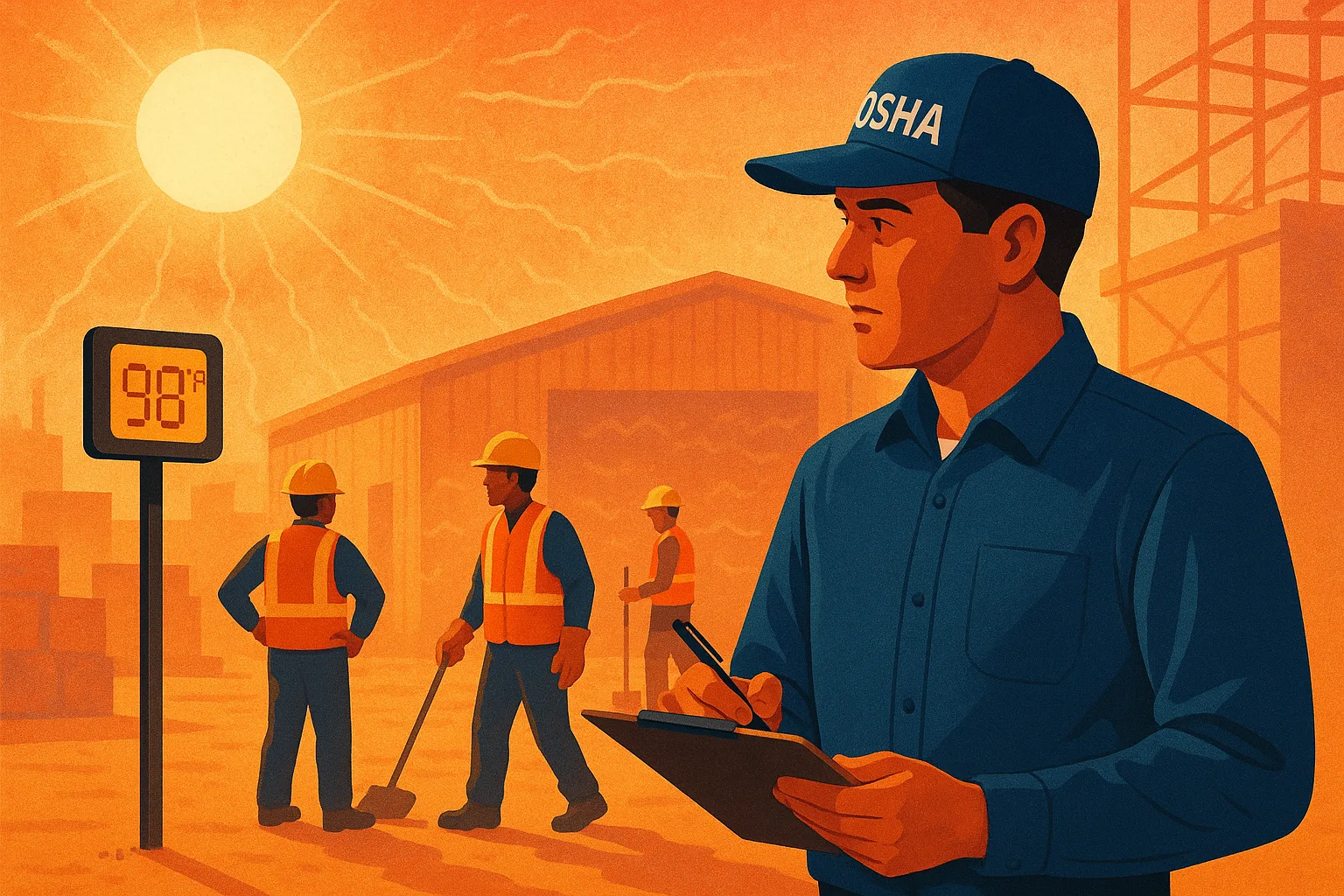

On April 10, 2026, OSHA updated its National Emphasis Program for outdoor and indoor heat-related hazards, sharpening the agency's enforcement focus on industries where heat stress is most likely to injure or kill workers. The revised directive — effective immediately and in place for five years — uses data from 2022 through 2025 to identify 55 high-risk industries for targeted inspections and outreach.
For employers in construction, agriculture, warehousing, manufacturing, and other physically demanding sectors, this update means OSHA's heat enforcement is more data-driven and more focused than ever. With summer approaching, now is the time to evaluate your heat illness prevention program — before an OSHA compliance officer does it for you.
What the National Emphasis Program Is
A National Emphasis Program (NEP) is an OSHA directive that focuses the agency's inspection and outreach resources on specific hazards or industries where data shows workers are at elevated risk. NEPs operate alongside regular enforcement — they don't replace existing inspection authority, but they add a layer of targeted activity.
OSHA first issued the Heat NEP (CPL 03-00-024) in April 2022, establishing a framework for heat-focused inspections and compliance assistance. The April 2026 revision builds on that foundation with updated data and streamlined procedures.
What Changed in the April 2026 Update
The revised NEP makes several meaningful changes that employers should understand:
Updated Industry Targeting
The most significant change is the use of OSHA and Bureau of Labor Statistics data from calendar years 2022–2025 to identify 55 high-risk industries in both indoor and outdoor work settings. OSHA identified these industries based on high rates of heat-related illness and employers that have received heat-related citations or hazard alert letters during that period.
Removal of Numerical Inspection Goals
The original 2022 NEP included a specific numerical inspection target. The revised version eliminates that goal, instead directing resources based on risk data and real-time conditions. This change gives OSHA field offices more flexibility to respond to actual heat events rather than chasing a fixed number.
Reorganized Appendices
The update introduces two reorganized appendices — one for evaluating employer heat programs and another providing citation guidance for compliance officers. These appendices give OSHA inspectors a more structured framework for assessing whether an employer's heat prevention efforts meet expectations.
Clearer Tracking and Implementation
The revised directive includes improved guidance on tracking inspections and implementing the program, making it easier for OSHA area offices to coordinate enforcement and outreach activities consistently across regions.
How OSHA Enforces Heat Hazards
There is currently no federal OSHA standard specific to heat illness. Instead, OSHA relies on the General Duty Clause, Section 5(a)(1) of the Occupational Safety and Health Act of 1970, which requires employers to provide a workplace "free from recognized hazards that are causing or likely to cause death or serious physical harm."
Under the Heat NEP, enforcement works through two primary mechanisms:
- Expansion of ongoing inspections: Compliance officers will expand any active inspection where they find evidence of heat-related hazards on heat priority days, regardless of the inspection's original purpose.
- Random targeted inspections: On days when the National Weather Service issues a heat advisory or warning, OSHA will conduct random inspections focused specifically on heat hazards in the 55 identified high-risk industries.
Current OSHA penalty levels make heat violations costly:
- Serious violations: Up to $16,550 per violation
- Willful or repeat violations: Up to $165,514 per violation
- Failure to abate: Up to $16,550 per day beyond the abatement date
Why This Update Matters
The Data Behind the Decision
Heat illness remains one of the most preventable causes of worker death. According to the Bureau of Labor Statistics, exposure to environmental heat killed 999 U.S. workers from 1992 to 2021, averaging 33 fatalities per year. From 2011 to 2020, BLS estimated an average of 3,389 heat-related work injuries and illnesses per year that were serious enough to require days away from work. A 2025 study published by George Washington University researchers estimated that nearly 28,000 workplace injuries annually are linked to extreme heat — a figure that suggests massive underreporting in official data.
Those numbers have been trending upward. Heat-related worker fatalities have increased roughly 70 percent over the past decade, with construction workers particularly vulnerable — accounting for over one-third of heat-related fatal injuries in recent years.
New Workers Face the Greatest Risk
OSHA's own data reveals a pattern that every employer should take seriously: almost half of heat-related worker deaths occur on the first day of work, and over 70 percent occur during the first week. This means that acclimatization — gradually increasing a new worker's exposure to heat — is not optional. It is a direct life-safety measure.
A Potential Heat Standard Is Still in Development
OSHA has been working toward a heat-specific workplace standard since publishing an Advance Notice of Proposed Rulemaking in October 2021. The agency convened a Small Business Advocacy Review Panel in August 2023 and received input from industries ranging from agriculture and construction to commercial kitchens and fire protection. While no final rule has been issued, the updated NEP signals that OSHA is not waiting for a formal standard to intensify enforcement.
State Heat Standards to Know
Five states have adopted heat-specific workplace standards that go beyond federal OSHA requirements. Employers in these states must comply with both state and federal requirements:
- California: The Heat Illness Prevention Standard requires employers to provide training, water, shade, and planning when temperatures reach 80°F.
- Oregon: Has adopted heat illness prevention rules covering general industry, construction, and agriculture.
- Washington: Maintains an Outdoor Heat Exposure Rule with specific temperature triggers and required protections.
- Colorado: Has Agricultural Labor Conditions Rules addressing heat exposure for agricultural workers.
- Minnesota: Maintains an indoor heat standard applicable to indoor workplaces.
Employers operating in multiple states should map their heat prevention programs against the most protective applicable standard.
What Employers Should Do Now
With the updated NEP in effect immediately and summer on the horizon, employers should take the following steps:
1. Develop or Update a Written Heat Illness Prevention Plan
OSHA expects employers to have a documented plan that addresses how they will protect workers from heat hazards. Your plan should cover:
- Who is responsible for daily oversight and monitoring
- How environmental heat will be measured (OSHA recommends wet bulb globe temperature monitors over heat index alone)
- Procedures for adjusting work when temperatures rise
- Emergency response protocols for heat illness events
- How the plan applies to both indoor and outdoor work settings
2. Implement Water, Rest, and Shade
OSHA's core prevention framework remains water, rest, and shade:
- Water: Provide cool, potable water accessible near the work area. Workers should drink at least one cup every 20 minutes while working in heat — not just when thirsty. For shifts longer than two hours, provide electrolyte-containing beverages.
- Rest: Require mandatory breaks that increase in frequency and duration as heat stress rises. Skipping breaks in hot conditions is not safe.
- Shade: Provide cool rest areas — shaded outdoor areas, air-conditioned vehicles or buildings, or areas with fans and misting devices.
3. Build an Acclimatization Program
Given that the majority of heat deaths occur in a worker's first week, acclimatization is critical. OSHA and NIOSH recommend the "Rule of 20 Percent":
- New workers should work only 20 percent of normal duration on their first day in heat
- Increase work duration by 20 percent each subsequent day
- Maintain these protections for one to two weeks until the worker is fully acclimatized
This applies to new hires, temporary workers, employees returning from extended leave (one week or more), and all workers during seasonal temperature transitions in spring and early summer.
4. Train Workers and Supervisors
All employees and supervisors exposed to heat hazards should receive training that covers:
- Types of heat-related illness and how to recognize signs and symptoms
- Importance of immediate first aid — when in doubt, cool the worker and call 911
- Fluid replacement guidelines and the importance of not waiting until thirsty to drink
- How to protect new and unacclimatized workers
- Appropriate work/rest cycles based on heat conditions
- How to report heat-related symptoms without fear of retaliation
5. Monitor Conditions Daily
Assign a qualified person at each worksite to monitor heat conditions throughout the workday. OSHA recommends using a WBGT meter for the most accurate readings, as it accounts for temperature, humidity, radiant heat, and wind — unlike the heat index, which only measures temperature and humidity in the shade.
The OSHA-NIOSH Heat Safety Tool app, available for iPhone and Android, can supplement on-site monitoring with location-based heat risk information.
6. Document Everything
Under the updated NEP, OSHA compliance officers have reorganized tools for evaluating employer heat programs. Thorough documentation strengthens your position if inspected:
- Written heat illness prevention plan
- Training records with dates, content, and attendance
- Acclimatization schedules for new workers
- Daily heat monitoring logs
- Incident reports and investigation records
- Records of corrective actions taken
7. Use OSHA's Free Resources
OSHA's On-Site Consultation Program provides free, confidential safety assessments for small and medium-sized businesses. Consultation visits are separate from enforcement and do not result in citations. This is an especially valuable resource for employers who need help developing or evaluating their heat prevention programs.
Looking Ahead
The updated Heat NEP is effective immediately and will remain in place for five years. Combined with OSHA's ongoing work toward a heat-specific workplace standard, this update makes clear that heat enforcement is an agency priority that will only intensify.
With each passing summer bringing record-breaking temperatures across much of the country, the business case for heat illness prevention is as strong as the compliance case. Heat-related incidents result in worker injuries, OSHA citations, operational disruptions, and workers' compensation claims — all of which are preventable with a well-designed heat safety program.
The employers who will be best positioned when OSHA knocks on the door during a heat advisory are those who build their programs now — before the thermometer starts climbing.
Sources
- US Department of Labor updates national emphasis program to protect workers from indoor, outdoor heat hazards (OSHA News Release, April 10, 2026)
- National Emphasis Program – Outdoor and Indoor Heat-Related Hazards (CPL 03-00-024, Revised April 2026) (PDF)
- OSHA Heat Illness Prevention Campaign
- OSHA: Addressing Heat Hazards — Employer Responsibility
- OSHA: Heat Hazard Recognition
- OSHA: Water, Rest, and Shade
- OSHA: Protecting New Workers from Heat Illness
- OSHA: Heat Illness Prevention Planning and Supervision
- OSHA: Heat-Related Illnesses and First Aid
- OSHA: Heat-Related Training
- OSHA: Engineering Controls, Work Practices, and PPE for Heat
- OSHA Heat Injury and Illness Prevention Rulemaking (SBREFA)
- OSHA: General Duty Clause, Section 5(a)(1)
- OSHA: Heat-Related Standards
- OSHA Penalties
- OSHA On-Site Consultation Program
- Nearly 28,000 Work Injuries Every Year Are Linked to Hot Weather (George Washington University, 2025)
- California Heat Illness Prevention Standard (Cal/OSHA)
- Oregon Heat Illness Prevention (Oregon OSHA)
- Washington Outdoor Heat Exposure Rule
- Minnesota Indoor Heat Standard (5205.0110)
Tags
Frequently Asked Questions
OSHA's April 2026 revision uses 2022–2025 data from OSHA and BLS to identify 55 high-risk industries for targeted inspections. It removes the previous numerical inspection goal, reorganizes appendices for heat program evaluation and citation guidance, and adds clearer tracking and implementation procedures.
No. There is currently no federal OSHA standard specific to heat illness. OSHA enforces heat-related protections under the General Duty Clause, Section 5(a)(1) of the OSH Act. A heat-specific rulemaking process is underway but no final rule has been issued. Five states — California, Oregon, Washington, Colorado, and Minnesota — have adopted their own heat-specific standards.
The updated NEP identifies 55 high-risk industries based on BLS and OSHA data from 2022–2025. While OSHA has not published the full list publicly, historically targeted industries include construction, agriculture, landscaping, warehousing, manufacturing, roofing, oil and gas, and food services.
OSHA compliance officers can expand any ongoing inspection when they find evidence of heat-related hazards on heat priority days. They can also conduct random inspections focused on heat hazards in high-risk industries on days when the National Weather Service issues a heat advisory or warning.
Employers should develop a written heat illness prevention plan, provide water, rest breaks, and shade or cooling areas, implement acclimatization schedules for new workers, train all employees and supervisors on heat illness symptoms and first aid, monitor weather conditions, and document all prevention activities.