Wildfire Smoke and Outdoor Workers: What Employers Must Do Before Fire Season 2026
As wildfire seasons grow longer and more intense, employers with outdoor workers face growing obligations to monitor air quality and protect employees from hazardous smoke exposure. Here's what the latest federal guidance and state rules require.
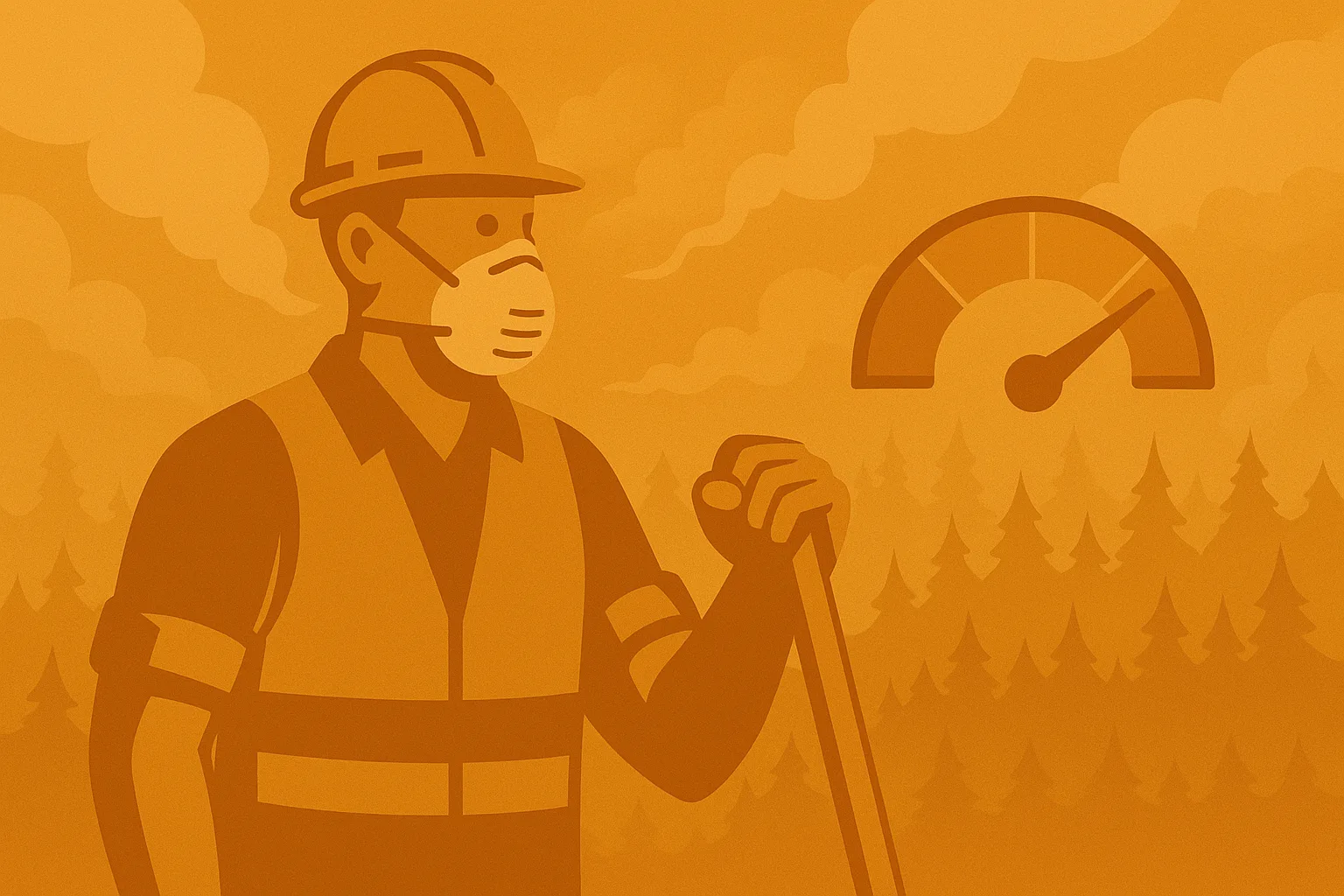

With wildfire season approaching and smoke events becoming more frequent, longer-lasting, and geographically widespread, employers with outdoor workforces face an urgent occupational health challenge. A landmark 2025 study published in Nature found that wildfire smoke now kills over 41,000 Americans annually — and that number is projected to rise sharply in the coming decades. For outdoor workers in construction, agriculture, utilities, landscaping, and transportation, the risk is even higher.
Despite the growing threat, there is still no finalized federal OSHA standard specifically addressing wildfire smoke. However, NIOSH's draft Hazard Review on wildland fire smoke exposure, combined with enforceable state rules in California, Oregon, and Washington, has created a clear roadmap for employer obligations. And with OSHA's General Duty Clause available as an enforcement backstop, employers cannot afford to wait for a federal rule before acting.
Here's what occupational health professionals and HR leaders need to know heading into summer 2026.
Why Wildfire Smoke Is an Occupational Health Crisis
Wildfire smoke is not simply a nuisance. It is a complex mixture of fine particulate matter (PM2.5), carbon monoxide, volatile organic compounds, polycyclic aromatic hydrocarbons (PAHs), and other hazardous air pollutants. The EPA notes that wildfire smoke exposure is linked to respiratory disease, cardiovascular events, and increased mortality — and that the health burden is growing as fire seasons intensify.
The PM2.5 Problem
The primary health hazard in wildfire smoke is fine particulate matter, or PM2.5 — particles small enough to penetrate deep into the lungs and enter the bloodstream. Research increasingly shows that PM2.5 from wildfire smoke may be more toxic than PM2.5 from other pollution sources, with stronger associations to respiratory hospitalizations and premature death.
For outdoor workers, the exposure equation is straightforward: more time outside during smoke events equals more inhaled particulate. Workers performing physically demanding tasks breathe at higher rates, pulling more contaminated air deep into their lungs. Unlike the general public, outdoor workers often cannot simply go indoors when air quality deteriorates.
A Growing and Unpredictable Threat
Wildfire smoke is no longer a regional problem confined to the Western United States. The 2023 Canadian wildfire season sent smoke plumes across the Eastern Seaboard, triggering hazardous air quality alerts from New York to Washington, D.C. The EPA reports that the number of days with unhealthy air from wildfire smoke has increased significantly over the past two decades, and climate projections suggest this trend will continue.
For employers, this means that wildfire smoke preparedness is no longer optional — even for those outside traditional fire-prone regions.
The Federal Landscape: NIOSH Hazard Review and OSHA's General Duty Clause
NIOSH Draft Hazard Review
In late 2024, NIOSH published a draft Hazard Review on wildland fire smoke exposure among outdoor workers — the first comprehensive federal document to address the occupational health risks of wildfire smoke for non-firefighter workers, including farmworkers, construction crews, and utility personnel. The review:
- Identifies PM2.5 as the primary health hazard and recommends using the EPA's Air Quality Index as the key decision-making metric
- Recommends a tiered approach to controls based on AQI thresholds
- Emphasizes the hierarchy of controls: engineering controls first, then administrative controls, then PPE
- Calls for employer preparedness programs established before smoke events occur
- Recommends medical surveillance for workers with repeated exposures
While not yet a binding standard, the NIOSH Hazard Review represents the scientific foundation for what a future federal rule is likely to require — and it signals what OSHA inspectors may look for when evaluating employer responses during smoke events.
OSHA's General Duty Clause
Even without a specific wildfire smoke standard, OSHA can cite employers under Section 5(a)(1) of the OSH Act — the General Duty Clause — if they fail to protect workers from recognized hazards, including hazardous air quality from wildfire smoke. This means employers cannot rely on the absence of a specific federal standard as a defense for inaction.
State Rules: California, Oregon, and Washington Lead the Way
Three states have enacted specific wildfire smoke protection rules that serve as models for employers nationwide — and as minimum compliance requirements for those operating within their borders.
California (Cal/OSHA Section 5141.1)
California's Protection from Wildfire Smoke regulation is the most comprehensive state rule. Key requirements include:
- AQI for PM2.5 above 150: Employers must monitor air quality, inform and train employees, implement feasible engineering and administrative controls, and provide N95 respirators for voluntary use
- AQI for PM2.5 above 500: Respirator use becomes mandatory, requiring a full respiratory protection program with fit testing and medical evaluations
- Training: Required for all employees on wildfire smoke hazards, respirator use, and how to monitor air quality
- Anti-retaliation protections: Workers cannot face adverse action for reporting smoke concerns or refusing unsafe work in evacuation zones
Oregon (Oregon OSHA)
Oregon's permanent wildfire smoke rules, effective since July 2022, set PM2.5-based action triggers:
- PM2.5 above 35.5 µg/m³ (AQI 101): Employers must take initial protective actions including schedule adjustments and access to filtered air spaces
- PM2.5 above 55.5 µg/m³ (AQI 151): Employers must provide NIOSH-approved N95 respirators for voluntary use
- Higher concentrations trigger progressively more stringent requirements
Washington State
Washington's Department of Labor & Industries wildfire smoke guidance requires employers to monitor air quality, limit worker exposure, provide rest breaks, and supply N95 respirators when smoke levels reach unhealthy thresholds.
What Employers Should Do Now
Regardless of whether you operate in a state with specific wildfire smoke rules, NIOSH guidance and OSHA's General Duty Clause create a clear framework for responsible action. Here is what occupational health programs should include heading into fire season 2026:
1. Develop a Written Wildfire Smoke Response Plan
Before smoke arrives, establish a plan that includes:
- Designated responsibility for air quality monitoring
- Clear AQI thresholds that trigger specific actions (e.g., voluntary PPE at AQI 151, mandatory PPE at higher levels)
- Communication protocols for notifying workers of changing conditions
- Procedures for relocating work, modifying schedules, or halting outdoor operations
- Documentation requirements for all actions taken
2. Monitor Air Quality in Real Time
- Use the EPA AirNow system or local air monitoring stations to track PM2.5 levels
- Assign a specific person or team to monitor conditions during wildfire season
- Establish a system for alerting supervisors and workers when thresholds are reached
- Consider portable air quality monitors for remote worksites without nearby monitoring stations
3. Implement the Hierarchy of Controls
Follow the standard hierarchy:
- Engineering controls: Provide enclosed, filtered-air environments where feasible (e.g., air-conditioned buildings, vehicles with cabin air filtration, portable HEPA units in break areas)
- Administrative controls: Reschedule heavy outdoor work to early morning or evening hours when smoke may dissipate, rotate workers to limit individual exposure time, provide additional rest breaks in clean-air spaces, and reduce physically demanding tasks during high-smoke periods
- PPE: Provide NIOSH-approved N95 or P100 respirators. Ensure proper fit through training (and fit testing where mandated). Cloth masks, surgical masks, and bandanas do not protect against PM2.5
4. Train Workers and Supervisors
Training should cover:
- Health effects of wildfire smoke exposure
- How to recognize symptoms of smoke-related illness (coughing, shortness of breath, chest tightness, dizziness)
- Proper use, fit, and limitations of N95 respirators
- How to check air quality and understand AQI readings
- Workers' rights to report unsafe conditions without retaliation
5. Protect Vulnerable Workers
Some employees face elevated risk from smoke exposure, including:
- Workers with pre-existing respiratory conditions (asthma, COPD)
- Workers with cardiovascular disease
- Pregnant workers
- Older workers
- New or unacclimatized workers
Establish procedures for identifying and accommodating high-risk employees, including modified duties or temporary reassignment during smoke events.
6. Document Everything
Maintain records of:
- Daily AQI readings during smoke events
- Actions taken at each threshold (controls implemented, PPE distributed, work modifications)
- Worker training dates and content
- Any reported symptoms or health complaints
- Respirator fit testing results (where applicable)
Documentation protects both workers and employers in the event of an OSHA inspection or workers' compensation claim.
The Business Case for Preparedness
Beyond regulatory compliance, proactive wildfire smoke programs deliver tangible business benefits:
- Reduced absenteeism: Workers who are protected from smoke exposure are less likely to develop respiratory illness that keeps them off the job
- Lower workers' compensation costs: Smoke-related health claims can be costly, particularly for chronic conditions that develop after repeated exposure
- Improved retention: Employees who feel their employer takes their health seriously are more likely to stay
- Operational continuity: Having a plan in place allows work to continue safely during moderate smoke events rather than shutting down entirely
Looking Ahead: A Federal Standard on the Horizon
While no federal wildfire smoke standard exists today, the regulatory trajectory is clear. NIOSH's Hazard Review, combined with the success of state programs in California, Oregon, and Washington, makes a future OSHA rulemaking increasingly likely. Employers who establish protective programs now will be well-positioned when federal requirements arrive — and in the meantime, they will be meeting their General Duty Clause obligations and protecting their workers from a growing occupational health threat.
As the BlueHive 2026 Occupational Health Compliance Timeline notes, staying ahead of emerging regulatory requirements is far more cost-effective than scrambling to comply after enforcement begins. Wildfire smoke protection should be on every employer's compliance radar for summer 2026 and beyond.
Sources
- U.S. News & World Report. "Wildfire Smoke Now Kills 41,000 Americans a Year, Study Finds." https://www.usnews.com/news/health-news/articles/2025-09-19/wildfire-smoke-now-kills-41-000-americans-a-year-study-finds
- Stanford Sustainability. "U.S. Faces Rising Death Toll from Wildfire Smoke, Study Finds." https://sustainability.stanford.edu/news/us-faces-rising-death-toll-wildfire-smoke-study-finds
- U.S. EPA. "Increasing Impacts of Wildfire Smoke." https://www.epa.gov/wildfire-smoke-course/increasing-impacts-wildfire-smoke
- NIOSH/CDC. Draft Hazard Review: Wildland Fire Smoke Exposure (Docket CDC-2024-0065). https://www.regulations.gov/document/CDC-2024-0065-0001
- OSHA. "OSH Act of 1970, Section 5 — Duties." https://www.osha.gov/laws/oshact/section5
- Cal/OSHA. "Worker Protection from Wildfire Smoke." https://www.dir.ca.gov/dosh/wildfire/worker-protection-from-wildfire-smoke.html
- Oregon OSHA. "Wildfires." https://osha.oregon.gov/Pages/topics/wildfires.aspx
- Washington State Department of Labor & Industries. "Wildfire Smoke." https://www.lni.wa.gov/safety-health/safety-topics/topics/wildfire-smoke
- U.S. EPA. AirNow. https://www.airnow.gov/
- BlueHive. "2026 Occupational Health Compliance Timeline and Checklist." https://bluehive.com/white-papers/2026-occupational-health-compliance-timeline/
Tags
Frequently Asked Questions
No. As of mid-2026, there is no finalized federal OSHA standard specifically addressing wildfire smoke. However, NIOSH published a draft Hazard Review in 2024 outlining recommended protections for outdoor workers, and OSHA can cite employers under the General Duty Clause (Section 5(a)(1) of the OSH Act) for failing to protect workers from recognized wildfire smoke hazards.
Thresholds vary by state. In California, employers must provide N95 respirators for voluntary use when the AQI for PM2.5 exceeds 150, with mandatory use above 500. Oregon requires employers to provide respirators for voluntary use when PM2.5 exceeds 55.5 µg/m³ (AQI 151). Washington has similar requirements at unhealthy thresholds. Employers outside these states should follow NIOSH guidance using AQI 151 as a prudent action trigger.
Wildfire smoke exposure is linked to respiratory disease, cardiovascular events, and increased mortality. The primary hazard is fine particulate matter (PM2.5), which penetrates deep into the lungs and enters the bloodstream. Workers performing physically demanding outdoor tasks are at elevated risk because they breathe at higher rates, inhaling more contaminated air. A 2025 study found wildfire smoke now kills over 41,000 Americans annually.
California, Oregon, and Washington have enacted specific wildfire smoke protection rules for workers. California's Cal/OSHA Section 5141.1 is the most comprehensive, requiring air quality monitoring, training, engineering and administrative controls, and respirator provisions at defined AQI thresholds. Oregon and Washington have similar permanent rules with PM2.5-based action triggers.
A comprehensive plan should include designated responsibility for real-time air quality monitoring, clear AQI thresholds that trigger specific actions, communication protocols for notifying workers of changing conditions, procedures for relocating or rescheduling outdoor work, provisions for N95 or P100 respirators with training on proper use, accommodations for vulnerable workers with pre-existing conditions, and documentation of all protective measures taken.