CVSA International Roadcheck 2026: ELD Tampering and Cargo Securement Under the Spotlight
The 2026 CVSA International Roadcheck runs May 12–14 with a focus on ELD tampering and cargo securement. Here is what motor carriers need to know and how to prepare your fleet before the 72-hour inspection blitz begins.
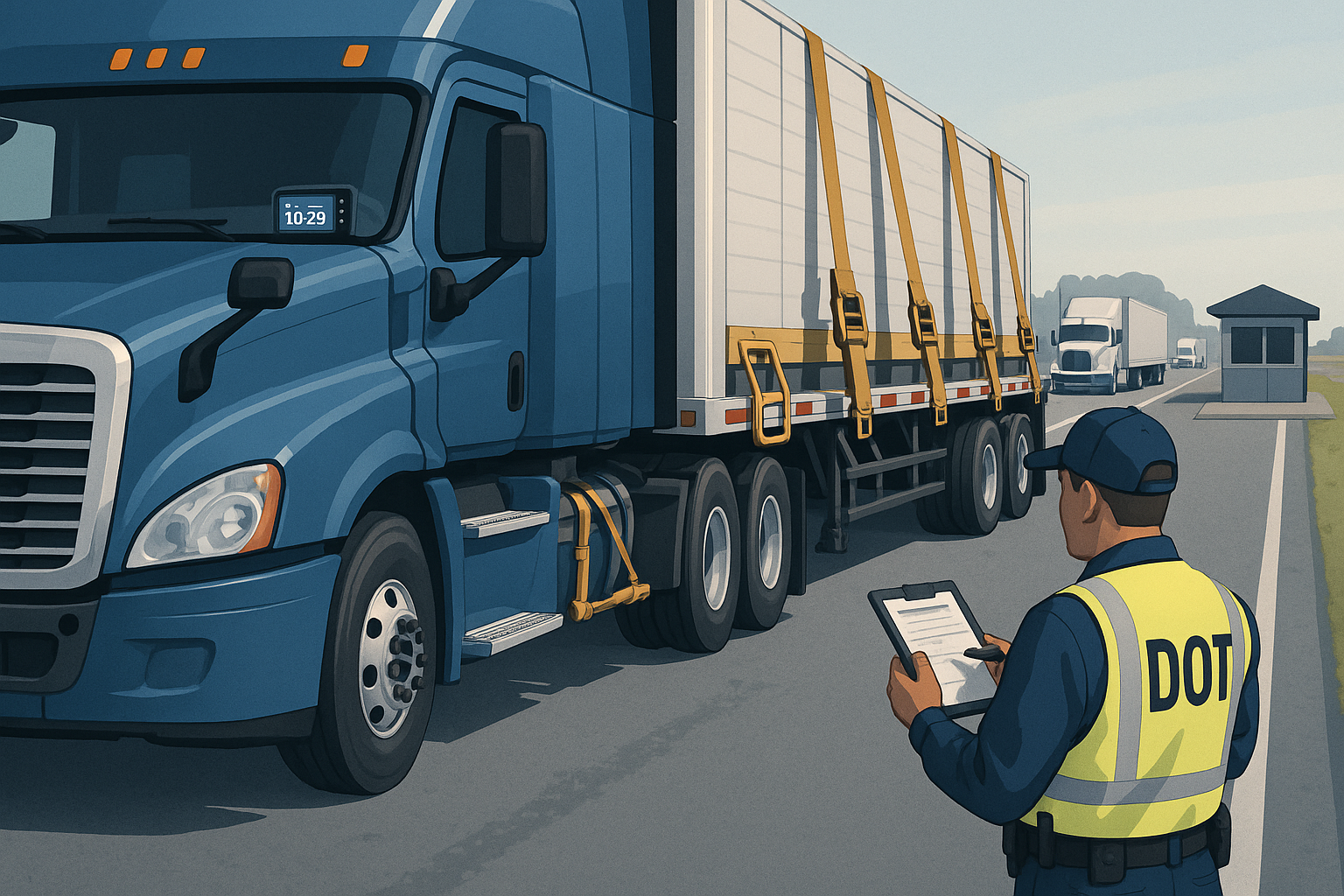
The Commercial Vehicle Safety Alliance's annual International Roadcheck is one of the most consequential enforcement events on the trucking calendar, and the 2026 edition — scheduled for May 12–14 — is shaping up to be one of the most aggressive yet. This year's 72-hour inspection blitz will zero in on two of the most frequently cited violation categories in commercial motor vehicle enforcement: electronic logging device (ELD) tampering on the driver side and cargo securement on the vehicle side.
For motor carriers, fleet managers, and safety directors, the time to prepare is now — not in May.
What Is International Roadcheck?
International Roadcheck is CVSA's signature enforcement and data-collection initiative, conducted annually across the United States, Canada, and Mexico. Over a continuous 72-hour period, inspectors at weigh stations, inspection sites, and mobile patrols perform thousands of North American Standard Level I Inspections — a rigorous 37-step procedure that examines both driver operating requirements and vehicle mechanical fitness.
During the 2025 International Roadcheck, inspectors conducted 56,178 inspections, placing 10,148 vehicles and 3,342 drivers out of service. That translated to an 18.1% vehicle out-of-service (OOS) rate and a 5.9% driver OOS rate. Vehicles that pass a Level I or Level V Inspection without critical violations may receive a CVSA decal valid for up to three months, signaling recent compliance to future inspectors.
Every year, CVSA designates specific focus areas — one for driver violations and one for vehicle violations — to spotlight during the event. This year's choices reflect two persistent compliance gaps that cost the industry millions of dollars in fines, downtime, and preventable crashes.
2026 Driver Focus: ELD Tampering, Falsification, and Manipulation
The driver enforcement emphasis for International Roadcheck 2026 is ELD tampering, falsification, and manipulation. Inspectors will review each driver's record of duty status and specifically look for false or manipulated entries, with an intensified focus on ELD interference.
Why ELD Tampering Is in the Crosshairs
The data makes the case clearly. According to FMCSA inspection data, falsification of record of duty status was the second most-cited driver violation nationwide in 2025, with 58,382 violations recorded across the year. Five of the top 10 driver violations were related to hours of service or ELDs.
During the 2025 International Roadcheck itself, 332 out-of-service violations were issued for false logs or RODS falsification — roughly 10% of all driver OOS violations during the event. Hours-of-service violations accounted for 1,076 driver OOS violations, or 32.4% of the driver total.
ELD tampering goes beyond simple log errors. FMCSA defines tampering as any deliberate action that results in erroneous data or unauthorized changes to ELD records — including disabling, deactivating, jamming, or otherwise interfering with an ELD so that it does not accurately record required data. Some drivers use devices or software to mask driving time, while others manipulate records with no required indication of the edit, both of which violate 49 CFR Part 395 Subpart B.
Updated Out-of-Service Criteria for 2026
A critical change took effect on April 1, 2026: CVSA updated its Out-of-Service Criteria to specifically distinguish ELD tampering violations from traditional "false log" violations. When an inspector determines that an ELD has been tampered with — as opposed to a driver merely making a log error — the enforcement response is now more severe and immediate.
Drivers found to have tampered with or manipulated their ELD face:
- Immediate out-of-service orders — the driver cannot operate until compliance is restored, typically a minimum 10-hour period
- Civil penalties up to $16,000 for willful non-compliance with ELD regulations
- CSA score impact — violations contribute to the carrier's Safety Measurement System scores, increasing the risk of future interventions, audits, and higher insurance costs
- Potential carrier-level consequences — repeated ELD tampering across a fleet can trigger compliance reviews and threaten operating authority
Enforcement Context: Operation SafeDRIVE
The Roadcheck emphasis on ELD enforcement arrives in a broader environment of stepped-up FMCSA scrutiny. In January 2026, the agency partnered with state law enforcement for Operation SafeDRIVE, a multi-state enforcement blitz that conducted 8,215 inspections across 26 states in just three days. That operation resulted in 704 drivers placed out of service and 1,231 vehicles placed out of service, along with 56 arrests. FMCSA has indicated that additional waves of enforcement are planned throughout 2026.
2026 Vehicle Focus: Cargo Securement
The vehicle enforcement emphasis for this year's Roadcheck is cargo securement, governed primarily by 49 CFR Part 393 Subpart I.
The Scale of the Problem
Cargo securement violations remain stubbornly common. In 2025, FMCSA recorded 18,108 violations for cargo not properly secured to prevent leaking, spilling, blowing, or falling — and an additional 16,054 violations for vehicle components or dunnage not being secured. During the 2025 Roadcheck, cargo securement accounted for 1,549 vehicle OOS violations, representing 11.4% of all vehicle out-of-service orders.
Improperly secured cargo creates hazards on multiple fronts. Shifting loads can affect vehicle maneuverability and increase rollover risk. Loose cargo that falls onto roadways creates crash hazards for all motorists. And spilled hazardous materials can trigger evacuations and environmental response costs.
What Inspectors Will Check
During a Level I Inspection, the cargo securement review covers:
- Load bars, straps, chains, and other tiedown devices — inspectors verify that all securement equipment is in good working order and properly rated
- Working load limit (WLL) compliance — the total WLL of all tiedowns must be at least 50% of the weight of the cargo
- Cargo placement and blocking — cargo must be positioned and blocked to prevent shifting under braking (0.8g forward), acceleration (0.5g rearward), and lateral movement (0.5g)
- Commodity-specific requirements — certain cargo types such as logs, metal coils, paper rolls, concrete pipe, and automobiles have additional securement standards under 49 CFR 393.116–393.136
- Evidence of cargo leaking, spilling, blowing, or falling — any observable sign triggers a violation
Vehicles found with out-of-service cargo securement violations will be sidelined until all violations are corrected before the vehicle may move.
What Motor Carriers Should Do Now
With International Roadcheck just over a month away, carriers have a window to conduct targeted preparation. Here is a practical compliance checklist:
ELD and Driver Compliance
- Verify ELD registration status — confirm that every device in your fleet appears on the FMCSA Registered ELD list. Revoked or unregistered devices will trigger immediate out-of-service orders.
- Audit driver logs — review ELD records for anomalies, unassigned driving time, excessive personal conveyance use, or patterns that could suggest manipulation. Address discrepancies before inspectors find them.
- Train and retrain drivers on HOS rules — many ELD violations result from a lack of understanding rather than intentional tampering. Ensure drivers understand short-haul exemptions, the 30-minute break rule, and proper annotation of edits.
- Communicate the stakes clearly — drivers should understand that the CVSA OOS criteria now treat ELD tampering differently from accidental errors, and that the penalties are significantly higher.
- Check driver credentials — verify that every driver has a valid CDL, current medical examiner's certificate, and a clean status in the FMCSA Drug and Alcohol Clearinghouse.
Cargo Securement Compliance
- Inspect all securement equipment — check straps, chains, binders, edge protectors, and anchor points for wear, damage, and proper WLL ratings. Replace any defective equipment immediately.
- Conduct mock inspections — have safety staff or a qualified third party perform Level I–style vehicle inspections on a sample of your fleet to identify and correct issues before Roadcheck.
- Review commodity-specific procedures — if your fleet hauls specialized cargo (metal coils, lumber, heavy machinery, intermodal containers), review the applicable securement standards under 49 CFR 393 Subpart I and confirm your procedures match.
- Reinforce pre-trip and en-route inspections — drivers are required to inspect cargo securement at the beginning of a trip, within the first 50 miles, and at regular intervals thereafter. Verify that this practice is happening consistently.
- Document everything — in the event of a violation, having documentation of training, equipment inspections, and corrective actions can make a meaningful difference in enforcement outcomes and CSA score disputes.
General Fleet Preparation
- Brakes and lighting — brake systems and lighting defects remain the number one and number three vehicle violation categories. A general mechanical inspection sweep ahead of Roadcheck is essential.
- Tires — tire violations accounted for 2,899 OOS violations during the 2025 Roadcheck (21.4% of vehicle OOS orders). Check tread depth, sidewall integrity, and inflation pressure.
- Driver wellness — alert, rested drivers perform better during inspections and are less likely to make the kind of mistakes that lead to OOS orders. Encourage compliance with HOS limits as a safety measure, not just a regulatory checkbox.
The Bigger Picture
International Roadcheck 2026 does not exist in a vacuum. It comes at a time when FMCSA is demonstrating a clear appetite for enforcement — from Operation SafeDRIVE to the new ELD-specific OOS criteria to increased Clearinghouse scrutiny under Phase II. The agency is sending a consistent signal: compliance shortcuts will be caught and penalized.
For employers, the cost of a failed Roadcheck inspection extends well beyond the immediate fine or out-of-service order. CSA score impacts can persist for years, affecting insurance rates, contract eligibility, and the ability to attract qualified drivers. And the reputational damage from a fleet-wide compliance failure — or worse, a preventable crash linked to ELD manipulation or unsecured cargo — is incalculable.
The carriers that treat May 12–14 as a compliance milestone, not a surprise, will be the ones that come through it without disruption.
Sources
- CVSA International Roadcheck 2026 Announcement — Official CVSA announcement of dates, focus areas, and inspection procedures
- CVSA 2025 International Roadcheck Results — Official results including inspection counts and out-of-service rates
- 49 CFR Part 395 Subpart B — Electronic Logging Devices (ELDs) — Federal ELD regulations
- 49 CFR Part 393 Subpart I — Protection Against Shifting and Falling Cargo — Federal cargo securement regulations
- FMCSA Inspection Violation Data — National violation statistics for commercial motor vehicle inspections
- Operation SafeDRIVE Results — U.S. Department of Transportation — Official DOT press release on Operation SafeDRIVE enforcement results
- ELD-Tampering Out-of-Service Orders: New for CVSA's 2026 OOS Criteria — Overdrive — Industry reporting on updated OOS criteria for ELD tampering
- FMCSA Registered ELD List — Official list of registered electronic logging devices
- FMCSA Drug and Alcohol Clearinghouse — Driver query and reporting portal
Tags
Frequently Asked Questions
The 2026 CVSA International Roadcheck is scheduled for May 12–14, 2026. It is a 72-hour inspection blitz conducted across the United States, Canada, and Mexico, primarily using the North American Standard Level I Inspection.
The 2026 driver focus is electronic logging device (ELD) tampering, falsification, and manipulation. The vehicle focus is cargo securement. Inspectors will pay special attention to these categories during the 72-hour event, according to CVSA.
Beginning April 1, 2026, CVSA updated its Out-of-Service Criteria to specifically distinguish ELD tampering violations from traditional false log entries. Drivers found to have tampered with or manipulated their ELD face immediate out-of-service orders and civil penalties that can reach up to $16,000 for willful non-compliance under FMCSA rules.
During the 2025 International Roadcheck, inspectors conducted 56,178 inspections. The vehicle out-of-service rate was 18.1% and the driver out-of-service rate was 5.9%, according to CVSA's published results.
Carriers should audit ELD compliance and ensure all devices are on the FMCSA-approved list, train drivers on proper HOS recordkeeping, conduct thorough pre-trip cargo securement inspections, verify tiedown equipment meets working load limit requirements under 49 CFR 393, and check that all driver credentials and medical certificates are current.