DOL and NSF Launch $224M 'AI-Ready America' Initiative: What HR Teams Need to Know
The Department of Labor and National Science Foundation announced TechAccess: AI-Ready America, a $224 million initiative to create AI workforce training hubs in every U.S. state. Learn what it means for employers and how to align your training programs.
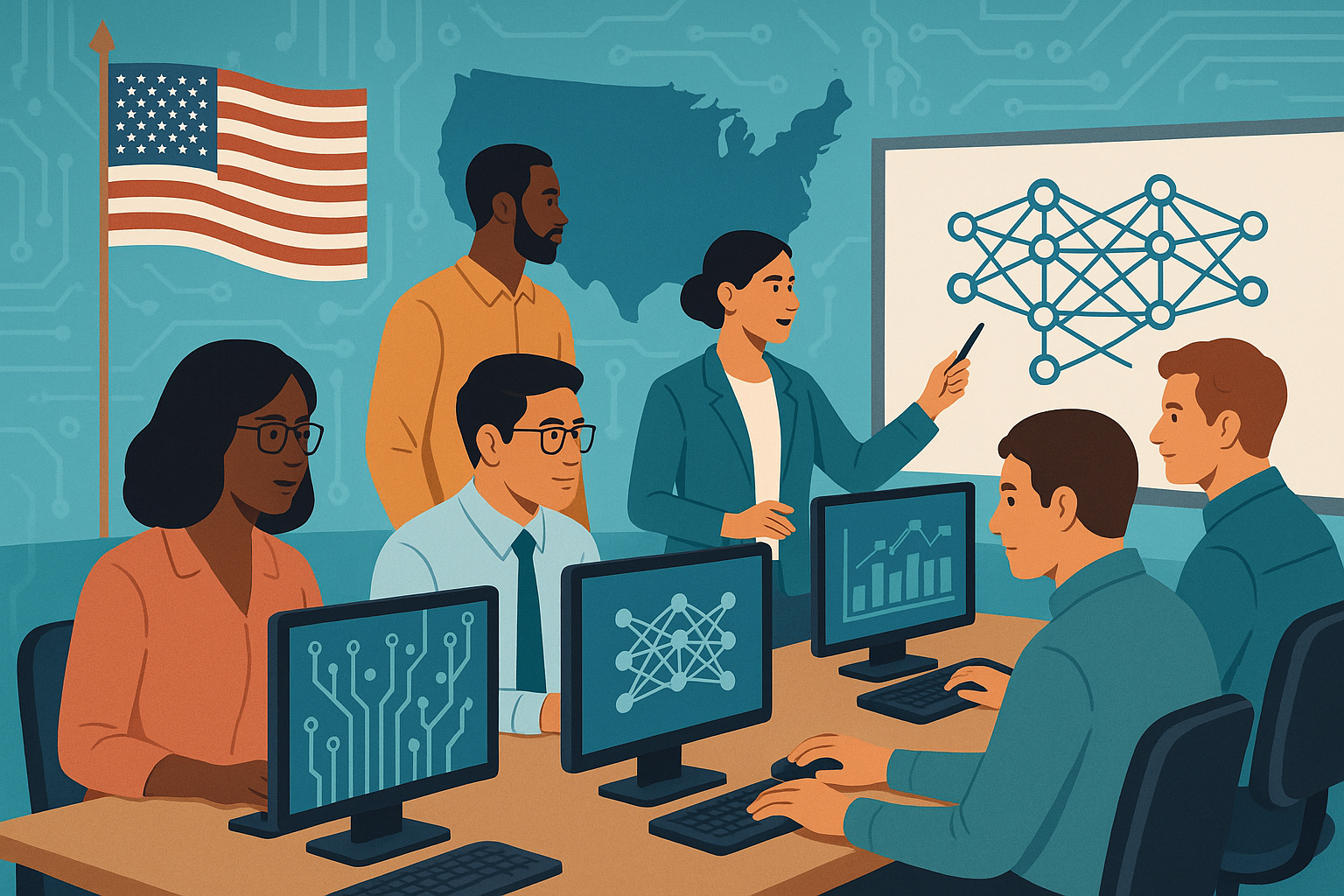
On April 2, 2026, the U.S. Department of Labor (DOL) and the National Science Foundation (NSF) announced the largest federal AI workforce development initiative to date: TechAccess: AI-Ready America. The program commits up to $224 million to establish AI training hubs in every U.S. state and territory — with an additional $145 million from the DOL for AI-focused apprenticeships and workforce programs.
For HR technology leaders and compliance teams, this isn't just another government grant announcement. It represents a fundamental shift in how the federal government expects employers to approach AI in the workplace: not as a compliance risk to mitigate, but as a workforce capability to build. Coming just weeks after the DOL released its AI Literacy Framework in February 2026, the TechAccess initiative gives employers a concrete, federally supported pathway to upskill their workforce for an AI-driven economy.
Here's what HR teams need to understand — and do — right now.
What TechAccess: AI-Ready America Actually Does
The TechAccess initiative is structured around three core components, each designed to address a different dimension of AI workforce readiness.
State and Territory Coordination Hubs
The centerpiece of the program is a network of up to 56 Coordination Hubs — one for every state, the District of Columbia, and U.S. territories. Each hub will receive approximately $1 million per year for three years, with the possibility of a fourth year for transition planning. These hubs will:
- Connect regional partners — universities, community colleges, workforce development boards, employers, and government agencies — to coordinate AI training
- Deliver hands-on AI upskilling through internships, project-based work, and apprenticeships
- Help small businesses and local governments adopt AI tools practically and responsibly
- Tailor training to local economic needs, ensuring AI literacy programs align with the industries and workforce in each state
The hubs are deliberately designed to reach beyond traditional K–16 education. They target working adults, career changers, public-sector employees, and underserved communities — the populations that corporate HR teams are most likely trying to upskill.
National Coordination Lead
A single National Coordination Lead will oversee the entire hub network, sharing best practices, coordinating priority industry sectors, and aligning state-level activities with the broader federal AI strategy. This entity will be funded through a separate Other Transaction Agreement.
AI-Ready Catalyst Award Competitions
A series of topic-driven competitions will fund innovative approaches to AI workforce challenges. These competitions will be announced over the program's lifetime and are designed to pilot and scale solutions that address critical national AI readiness gaps.
The DOL AI Literacy Framework: Five Competencies Every Worker Needs
The TechAccess initiative builds directly on the DOL's AI Literacy Framework, released on February 13, 2026. The framework defines AI literacy as "a foundational set of competencies that enable individuals to use and evaluate AI technologies responsibly, with a primary focus on generative AI." It identifies five core competencies every worker should develop:
-
Understand AI Principles — Workers need to grasp how AI operates at a conceptual level: that AI identifies statistical patterns rather than "thinking," can produce incorrect outputs (hallucinations), and reflects human design decisions. This isn't about technical mastery — it's about building enough understanding to use AI confidently and critically.
-
Explore AI Uses — Workers should understand practical applications across their specific workplace settings — from drafting documents and analyzing reports to supporting decision-making. The DOL emphasizes that AI use varies significantly by industry and role.
-
Direct AI Effectively — Because AI depends heavily on user input, workers must learn to provide clear instructions, include necessary context, and iterate to improve results. This includes prompt engineering techniques, supplying relevant data, and avoiding vague requests.
-
Evaluate AI Outputs — Workers need skills to assess whether AI-generated outputs are accurate, complete, and appropriate. This includes verifying facts, spotting logical errors, and applying human judgment rather than treating AI as a final authority.
-
Use AI Responsibly — Workers must understand the boundaries of appropriate use: protecting sensitive information, following workplace policies, avoiding misuse, and maintaining accountability for AI-assisted work.
The framework is voluntary — it does not create new legal requirements. But as Fisher Phillips noted, it "signals DOL's expectations for how employers should approach AI training" and provides a practical blueprint that employers can adopt immediately.
Seven Delivery Principles for Employer Training Programs
Beyond defining what workers should learn, the DOL framework provides seven principles for how employers should deliver AI training:
- Enable Experiential Learning — Training works best through hands-on use, not abstract reading. Embed AI tools into real work tasks and allow trial-and-error learning.
- Embed Learning in Context — Use industry-specific examples, align with actual workflows, and integrate AI literacy into existing training programs rather than creating standalone courses.
- Build Complementary Human Skills — Demonstrate how AI enhances critical thinking, creativity, and communication. Emphasize that AI's value depends on human judgment.
- Address Prerequisites to AI Literacy — Some workers may lack digital literacy, device access, or broadband connectivity. Identify and address these barriers before rolling out AI training.
- Create Pathways for Continued Learning — Foundational AI literacy is the starting point. Provide clear routes for workers to deepen skills, pursue specialized training, or transition into AI-related roles.
- Prepare Leadership to Lead — Train managers and team leaders separately so they can guide others, integrate AI into operations, and support workplace adoption.
- Design for Agility — Build training systems that can be updated regularly, use modular content that can be refreshed, and incorporate feedback to stay current as AI evolves.
For HR technology teams, these principles offer a clear checklist for evaluating whether your current learning management systems and training platforms can support the kind of AI literacy programs the DOL envisions.
Application Timeline and Funding Details
Employers, universities, workforce agencies, and nonprofit organizations interested in participating in or hosting a TechAccess hub should note the following timeline:
- Round 1 Letters of Intent: June 16, 2026
- Round 1 Full Proposals: July 16, 2026
- Round 1 Selection: Summer 2026 (10 hubs)
- Round 2: December 15, 2026 (LOI) / January 15, 2027 (proposals) — 20 hubs
- Round 3: June 1, 2027 (LOI) / July 1, 2027 (proposals) — remaining hubs
Eligible applicants include universities, research institutions, state and territory agencies, workforce development nonprofits, and public-private partnerships. Each hub award provides approximately $1 million per year for three years. Funding supports program staff, educational events, technology tools, internships, and capacity-building efforts.
The total federal investment across the TechAccess initiative and DOL's related apprenticeship programs reaches approximately $369 million — making this the most significant federal commitment to AI workforce development in U.S. history.
The Broader Federal AI Workforce Strategy
The TechAccess announcement does not exist in isolation. As HR Daily Advisor reported, the DOL's approach follows its historical pattern of preparing the workforce for technological shifts before introducing strict compliance frameworks — a strategy it has applied to previous waves of automation and digital transformation.
The DOL has also signaled that it will direct research through the initiative on how AI impacts labor market requirements, focusing on reskilling, upskilling, and new job pathways created by AI. This research will help inform both future policy decisions and employer best practices.
Notably, the framework deliberately avoids worker protection mandates, discrimination safeguards, or new regulatory requirements. This marks a departure from the prior administration's approach, which emphasized AI guardrails alongside worker training. For employers, this means the current emphasis is on opportunity and readiness rather than restriction — but it also means companies should proactively build responsible AI use policies rather than waiting for regulatory mandates.
What Employers Should Do Now
Whether or not your organization plans to apply for hub funding, the TechAccess initiative and AI Literacy Framework create immediate action items for HR technology teams:
1. Audit Current AI Usage
Identify where workers are already using AI tools — officially or unofficially. Survey employees about AI adoption, review workflows where AI could add value, and determine which roles need AI literacy most urgently. Shadow AI use (employees using personal AI tools for work without authorization) is a significant compliance risk that an audit can surface.
2. Align Training with the DOL Framework
Use the DOL's five core competencies as a benchmark for evaluating and updating your AI training programs. Many organizations already offer ad-hoc AI training, but few have structured programs that address all five competency areas — especially "Evaluate AI Outputs" and "Use AI Responsibly," which are critical for compliance.
3. Connect with State Workforce Development Resources
Contact your state's workforce development board to learn about upcoming TechAccess hub applications and activities. Early engagement positions your organization to benefit from hub resources — including subsidized training, apprenticeship partnerships, and research collaborations — as they become available.
4. Evaluate Your HR Technology Stack
Assess whether your learning management system (LMS), compliance tracking tools, and onboarding platforms can support modular, regularly updated AI literacy training. The DOL's delivery principles emphasize experiential learning, contextual content, and agile design — requirements that may exceed the capabilities of legacy training systems.
5. Explore AI-Focused Apprenticeships
The DOL is investing $145 million specifically in integrating AI training into Registered Apprenticeship programs. These earn-while-you-learn models can be particularly effective for upskilling existing employees in AI-adjacent roles without disrupting operations.
6. Train Managers First
The DOL framework specifically calls for preparing leadership before rolling out broader training. Equip managers with AI literacy so they can guide team adoption, address worker concerns, and model appropriate use. Managers who resist or misunderstand AI will undermine workforce training efforts.
7. Establish AI Use Policies
If you haven't already, create clear guidelines for appropriate AI use in your workplace. Address data protection, output verification requirements, prohibited uses, and accountability standards. A comprehensive AI use policy is the foundation on which all training and compliance efforts rest.
Looking Ahead
The TechAccess: AI-Ready America initiative signals that the federal government views AI workforce readiness as a national priority — not a temporary initiative. With $369 million in combined funding, hub infrastructure in every state, and a standardized literacy framework, the DOL and NSF are building the scaffolding for a permanent shift in how American workers interact with AI.
For HR technology leaders, this creates both an opportunity and an expectation. Organizations that align their training programs with federal standards, connect with emerging hub resources, and invest in scalable AI literacy infrastructure will be best positioned — not just for workforce productivity, but for whatever compliance requirements may follow in future regulatory cycles.
The window to get ahead of the curve is open now. The first TechAccess applications are due in June.
Sources
- DOL and NSF Announce TechAccess: AI-Ready America Initiative — U.S. Department of Labor
- TechAccess: AI-Ready America Solicitation (NSF 26-508) — National Science Foundation
- DOL Releases AI Literacy Framework — U.S. Department of Labor
- AI Literacy Framework Full Document (TEN 07-25) — U.S. Department of Labor (PDF)
- Labor Department Shows Employers How to Boost AI Literacy for Workers — Fisher Phillips
- DOL's Workplace AI Strategy Follows Historical Approach to Technology — HR Daily Advisor
- Artificial Intelligence — U.S. Department of Labor
- Registered Apprenticeship Programs — U.S. Department of Labor
Tags
Frequently Asked Questions
TechAccess: AI-Ready America is a joint initiative from the U.S. Department of Labor and the National Science Foundation that invests up to $224 million to create AI workforce training hubs in every U.S. state and territory. Announced on April 2, 2026, the program funds up to 56 State and Territory Coordination Hubs to deliver AI literacy training, apprenticeships, and hands-on upskilling programs.
The NSF is providing up to $224 million for up to 56 State and Territory Coordination Hubs, each receiving approximately $1 million per year for three years. The DOL is investing an additional $145 million in AI-focused Registered Apprenticeships and related workforce programs, bringing the combined federal commitment to up to approximately $369 million.
The DOL AI Literacy Framework, released February 13, 2026, defines five foundational competencies — understanding AI principles, exploring AI uses, directing AI effectively, evaluating AI outputs, and using AI responsibly. It is voluntary and does not create new legal requirements, but it signals DOL expectations for how employers should approach AI workforce training.
Letters of intent for the first round of TechAccess State/Territory Coordination Hubs are due June 16, 2026, with full proposals due July 16, 2026. The NSF plans to select 10 hubs in round one, 20 in round two, and the remainder in round three, according to the official NSF solicitation.
Employers should audit current AI usage across their workforce, align internal training programs with the DOL AI Literacy Framework's five competencies, connect with state workforce development boards about upcoming hub resources, and explore Registered Apprenticeship programs that integrate AI skills training.