OSHA's Data-Driven Enforcement Is Here: Why Compliance Technology Is No Longer Optional
OSHA's expanded electronic recordkeeping requirements and Site-Specific Targeting program use employer-submitted data to trigger inspections. Learn how compliance technology helps employers manage this new data-driven enforcement landscape.
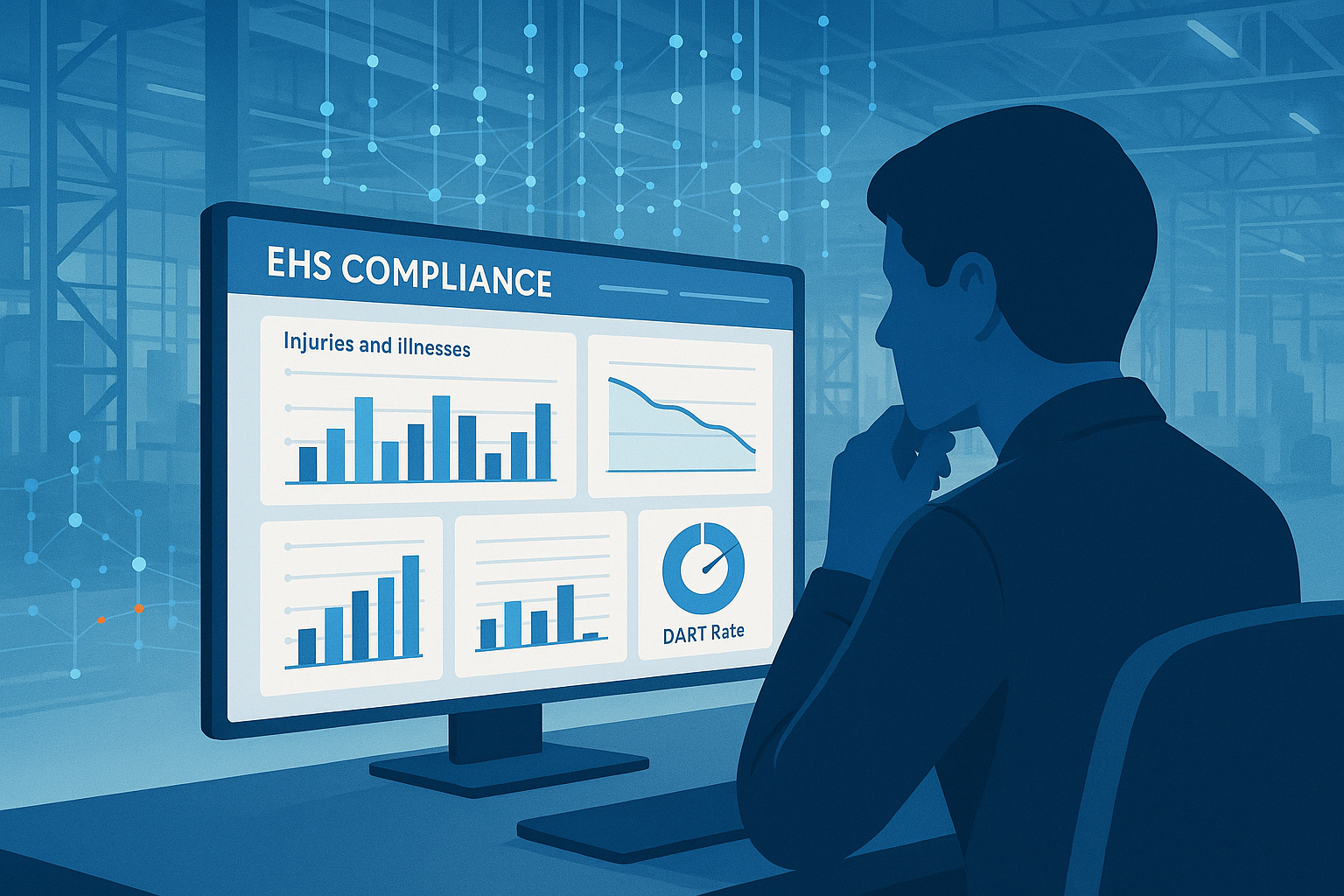
Every workplace injury your organization records — and every one it fails to record — is now part of a data set that OSHA uses to decide where to send inspectors. That is not a hypothetical future. It is the current enforcement reality.
OSHA's expanded electronic recordkeeping rule and its updated Site-Specific Targeting (SST) program have created a feedback loop: employers submit detailed injury and illness data electronically, and OSHA feeds that data into algorithms that identify which workplaces to inspect next. The March 2, 2026 filing deadline has passed, and the data your organization submitted — or didn't — is now shaping your inspection risk profile for the coming year.
For HR and EHS teams still managing OSHA recordkeeping with spreadsheets, paper logs, or disconnected systems, the message from OSHA's enforcement strategy is clear: the margin for error has narrowed, and the consequences of data problems have escalated. Compliance technology is no longer a nice-to-have efficiency tool. It is infrastructure.
The Expanded Electronic Recordkeeping Rule
The rule that set this transformation in motion is 29 CFR 1904.41, which OSHA updated with a final rule that took effect on January 1, 2024. The update significantly expanded which employers must submit data electronically — and how much data they must submit.
Who Must Submit, and What
The current requirements break down into three tiers:
-
Establishments with 100+ employees in high-hazard industries (listed in Appendix B to Subpart E of 29 CFR Part 1904) must electronically submit detailed data from Forms 300, 300A, and 301 — including the date and severity of each recordable injury or illness, details about the affected worker, and a description of how the incident occurred.
-
Establishments with 20–249 employees in designated industries (listed in Appendix A to Subpart E) must submit Form 300A summary data.
-
Establishments with 250+ employees that are required to keep OSHA injury and illness records must submit Form 300A summary data, regardless of industry.
All submissions go through OSHA's Injury Tracking Application (ITA), which accepts data via manual web entry, CSV file upload, or API transmission. The annual deadline is March 2.
Why the Expansion Matters
Before this rule, most employers only submitted the Form 300A summary — a single page with aggregate totals. The expanded requirement for Forms 300 and 301 means OSHA now receives case-level detail: what happened, to whom, where in the facility, and how severe the outcome was. OSHA estimates that approximately 52,092 additional establishments are now required to submit this detailed case data each year.
This is a qualitative shift in the data OSHA collects. Summary statistics tell OSHA how many injuries a workplace had. Case-level data tells OSHA what kind of injuries occurred, which jobs are affected, and what hazards are producing them — information that directly informs enforcement targeting.
Site-Specific Targeting: Your Data Drives Inspections
The most consequential way OSHA uses this electronic data is through its Site-Specific Targeting (SST) program. The current directive, CPL 02-01-067, was issued on April 8, 2025 and uses Form 300A data from calendar years 2021 through 2023 to select non-construction establishments with 20 or more employees for inspection.
The SST program has a proven track record of effectiveness. Under the previous directive cycle, the program resulted in 652 inspections from April 2023 to December 2024, with a higher rate of violations and noncompliance compared to other non-construction programmed inspections. The current directive builds on that success with updated data and refined targeting criteria.
How OSHA Selects Targets
OSHA generates four inspection lists from the submitted data:
-
High-rate establishments: Workplaces with 2023 DART (Days Away, Restricted, or Transferred) rates significantly above their industry average. OSHA applies separate thresholds for manufacturing (NAICS 31–33) and non-manufacturing sectors.
-
Upward-trending establishments: Workplaces where the DART rate was at or above twice the private-sector national average in 2022 and continued to increase through 2023 — signaling a deteriorating safety environment.
-
Low-rate establishments: A random sample of workplaces that reported unusually low injury rates. OSHA selects these to verify the accuracy of reported data — in other words, to check for underreporting.
-
Non-responders: A random sample of establishments that failed to submit their required 2023 Form 300A data at all.
The takeaway for employers is stark: both high and suspiciously low injury rates can trigger an inspection, and failing to submit data doesn't make you invisible — it puts you on a list.
What Inspectors Review
When an SST inspection occurs, compliance officers review OSHA 300 logs, 300A summaries, and 301 incident reports for the 2021–2023 period. They evaluate the adequacy of the employer's safety and health management system, investigate areas where injuries have occurred, and assess any hazards in plain view or reported by employees. These inspections are comprehensive in scope and may be expanded to include health hazards based on the establishment's industry classification or prior inspection history.
Public Disclosure: Your Safety Record Is Now Visible
The enforcement implications alone would be significant enough. But OSHA has also committed to publishing establishment-specific injury and illness data publicly. The agency's Establishment-Specific Injury and Illness Data page already provides Form 300A summary data by establishment — and beginning in 2024, case-level data from Forms 300 and 301 is also being made available for certain reporting years.
Company names are included in the published data. Employee names, addresses, and healthcare provider information are excluded. But anyone — prospective employees, customers, competitors, journalists, investors, and plaintiff's attorneys — can search for an establishment and see its injury and illness record.
OSHA has stated its rationale clearly: public access to this data allows employers, employees, potential employees, and the general public to make more informed decisions about workplace safety at a given establishment, and gives researchers better data to identify patterns of injuries and hazardous conditions.
For employers, this means safety performance is no longer a private metric. It is a public record that affects reputation, recruitment, customer relationships, and potentially even contract eligibility.
The Compliance Technology Imperative
This is where the technology story becomes critical. OSHA's data-driven enforcement strategy places unprecedented demands on the accuracy, consistency, and timeliness of employer recordkeeping. The data you submit shapes your inspection risk, your public safety profile, and your exposure to penalties — which in 2026 reach up to $16,131 per serious violation and $161,323 per willful or repeat violation.
Manual recordkeeping processes are poorly suited to this environment for several reasons:
-
Classification errors compound. A single misclassification — recording a DART case as a non-DART case, or failing to record an injury at all — can distort the metrics OSHA uses to target inspections. In manual systems, these errors often go undetected until an inspector reviews the logs.
-
Calculation mistakes are common. DART and Total Recordable Incident Rate (TRIR) calculations require accurate total hours worked across all employment categories (full-time, part-time, temporary, and seasonal workers). Spreadsheet errors in these calculations can produce rates that are misleadingly high (triggering a high-rate inspection) or misleadingly low (triggering a low-rate verification audit).
-
Submission logistics create risk. The ITA accepts data through manual entry, CSV upload, or API. Manual entry is error-prone at scale. CSV formatting issues can corrupt submissions. Only API integration allows for automated, validated data transfer — and building that integration requires a technology platform.
-
Multi-establishment coordination is complex. Reporting is at the establishment level, not the company level. Organizations with multiple facilities must track coverage thresholds, industry codes, and employee counts for each location independently. Missing one covered establishment means landing on the non-responder list.
What Compliance Technology Provides
Modern EHS (Environment, Health, and Safety) and compliance platforms address these challenges through several capabilities:
-
Automated incident capture. Digital incident reporting — via mobile apps, kiosk stations, or supervisor dashboards — ensures injuries and illnesses are recorded in real time with consistent classification data.
-
Built-in OSHA logic. Platforms with OSHA recordkeeping modules apply the agency's classification rules automatically, flagging whether a case is recordable, whether it involves days away or restricted duty, and which forms need to be completed.
-
Rate calculation and benchmarking. Automated DART and TRIR calculations using verified hours-worked data, with the ability to compare rates against industry averages and identify upward trends before OSHA does.
-
Submission integration. Direct integration with OSHA's ITA via API, eliminating manual data entry and CSV formatting issues. Some platforms validate data against OSHA's schema before submission, catching errors proactively.
-
Audit trails and documentation. Complete records of who entered data, when records were modified, and what supporting documentation exists — critical evidence if an OSHA inspector questions the accuracy of your submissions.
-
Multi-site management. Centralized dashboards that track coverage requirements, submission status, and injury rates across all establishments, ensuring no covered location is missed.
What Employers Should Do Now
Whether your organization has already submitted its 2026 ITA data or is still catching up, the following steps will help position you for compliance in this data-driven enforcement landscape:
1. Audit Your Most Recent Submission
If you submitted data by the March 2 deadline, review what you submitted:
- Are all covered establishments accounted for?
- Are hours-worked calculations accurate and inclusive of all worker categories?
- Do DART and TRIR rates look consistent with your actual injury experience? Unexpectedly low rates can be just as problematic as high ones.
- Were Forms 300 and 301 submitted where required, not just Form 300A?
If you missed the deadline, submit as soon as possible. OSHA's ITA page states explicitly that establishments that missed the deadline must still submit their data.
2. Evaluate Your Recordkeeping Technology
Assess whether your current systems can reliably support OSHA's electronic recordkeeping requirements:
- Can your system automatically classify injuries as OSHA-recordable, first aid, DART, or DAFW?
- Does it calculate TRIR and DART rates using verified hours-worked data?
- Can it submit data to the ITA via API, or are you relying on manual processes?
- Does it manage multi-establishment reporting requirements?
If the answer to any of these is no, it is time to evaluate EHS compliance platforms that can. The cost of a technology investment is substantially less than the cost of a targeted OSHA inspection — or a willful violation penalty.
3. Monitor Your Own Rates Quarterly
Don't wait until the annual submission to discover that your DART rate has spiked or that a particular facility is trending upward. Quarterly internal reviews of injury rates by establishment allow you to:
- Identify emerging hazards before they produce an inspection-triggering trend
- Verify that incidents are being recorded and classified correctly
- Intervene with targeted safety measures at specific locations
- Build a documented record of proactive safety management
4. Prepare for Public Scrutiny
With OSHA publishing establishment-specific data, treat your injury and illness records as public-facing documents:
- Ensure data accuracy — public errors are difficult to correct and reputationally damaging
- Develop messaging for stakeholders (employees, customers, investors) about your safety performance
- Use publicly available data to benchmark against industry peers and identify areas for improvement
5. Integrate Safety Data Into Broader HR Systems
The most effective compliance technology strategies connect safety recordkeeping with broader HR and workforce management systems. When incident data flows into the same platform that manages workers' compensation claims, return-to-work programs, and employee training records, the organization gains a unified view of workforce health and safety that supports both compliance and operational decision-making.
Looking Ahead
OSHA's trajectory is unmistakable: more data collection, more sophisticated analysis, and more targeted enforcement. The agency has built an infrastructure that transforms employer-submitted injury data into actionable intelligence — and it is using that intelligence to direct limited inspection resources where they will have the greatest impact.
For employers, this means the quality of your safety data has never mattered more. Every recordable injury that is correctly classified, every form that is accurately completed, and every submission that is filed on time contributes to a data profile that either keeps inspectors away or brings them to your door.
The organizations that thrive in this environment will be the ones that treat compliance technology not as an administrative convenience, but as a core component of their safety and risk management strategy. The data is flowing. OSHA is watching. And the tools to manage it well already exist.
Sources
- Injury Tracking Application (ITA) — OSHA
- Final Rule to Improve Tracking of Workplace Injuries and Illnesses — OSHA
- 29 CFR 1904.41 — Electronic Submission of Employer Identification Number and Injury and Illness Records — OSHA
- Establishment-Specific Injury and Illness Data — OSHA
- Site-Specific Targeting Directive CPL 02-01-067 — OSHA
- CPL 02-01-067 Directive Page — OSHA
- OSHA Updates SST Program: New Inspection Targeting Criteria — National Law Review
- OSHA's New Electronic Recordkeeping Rule Takes Effect: 6 Major Takeaways — Fisher Phillips
- OSHA Electronic Recordkeeping Obligations for 2026: Key Changes and Compliance Risks — Michael Best
- OSHA Penalties — OSHA
- Appendix B to Subpart E — High-Hazard Industries — OSHA
- ITA Coverage Application — OSHA
- Department of Labor Announces Rule Expanding Submission Requirements for Injury and Illness Records — DOL
Tags
Frequently Asked Questions
OSHA's electronic recordkeeping rule (29 CFR 1904.41) requires establishments with 100 or more employees in designated high-hazard industries to electronically submit detailed injury and illness data from Forms 300, 300A, and 301 through the Injury Tracking Application. Establishments with 20–249 employees in certain industries must submit Form 300A data, and those with 250 or more employees must also submit Form 300A summaries.
OSHA uses employer-submitted Form 300A data through its Site-Specific Targeting (SST) program (Directive CPL 02-01-067) to identify workplaces with high DART rates, upward-trending injury rates, suspiciously low rates that suggest underreporting, and establishments that failed to submit required data. These data-driven criteria determine which workplaces are prioritized for inspection.
The deadline for electronic submission of injury and illness data through the OSHA Injury Tracking Application was March 2, 2026, covering calendar year 2025 data. Establishments that missed the deadline are still required to submit their data as soon as possible.
Yes. OSHA publishes establishment-specific injury and illness data from Form 300A submissions — and beginning in 2024, certain case-level data from Forms 300 and 301 — on its public Establishment-Specific Injury and Illness Data page. Company names are included, though employee names and addresses are excluded.
EHS compliance platforms, incident management software, and HRIS systems with OSHA modules can automate injury and illness tracking, calculate DART and TRIR rates, flag data anomalies before submission, and integrate directly with OSHA's Injury Tracking Application API for electronic filing. These tools reduce errors and help employers avoid the data problems that trigger SST inspections.