FMCSA Withholds $73 Million from New York Over CDL Noncompliance: What Motor Carriers Need to Know
FMCSA is withholding over $73 million from New York after a federal audit found 53% of non-domiciled CDLs were illegally issued. Here is what the non-domiciled CDL crackdown means for motor carriers, fleet operators, and employer compliance programs.
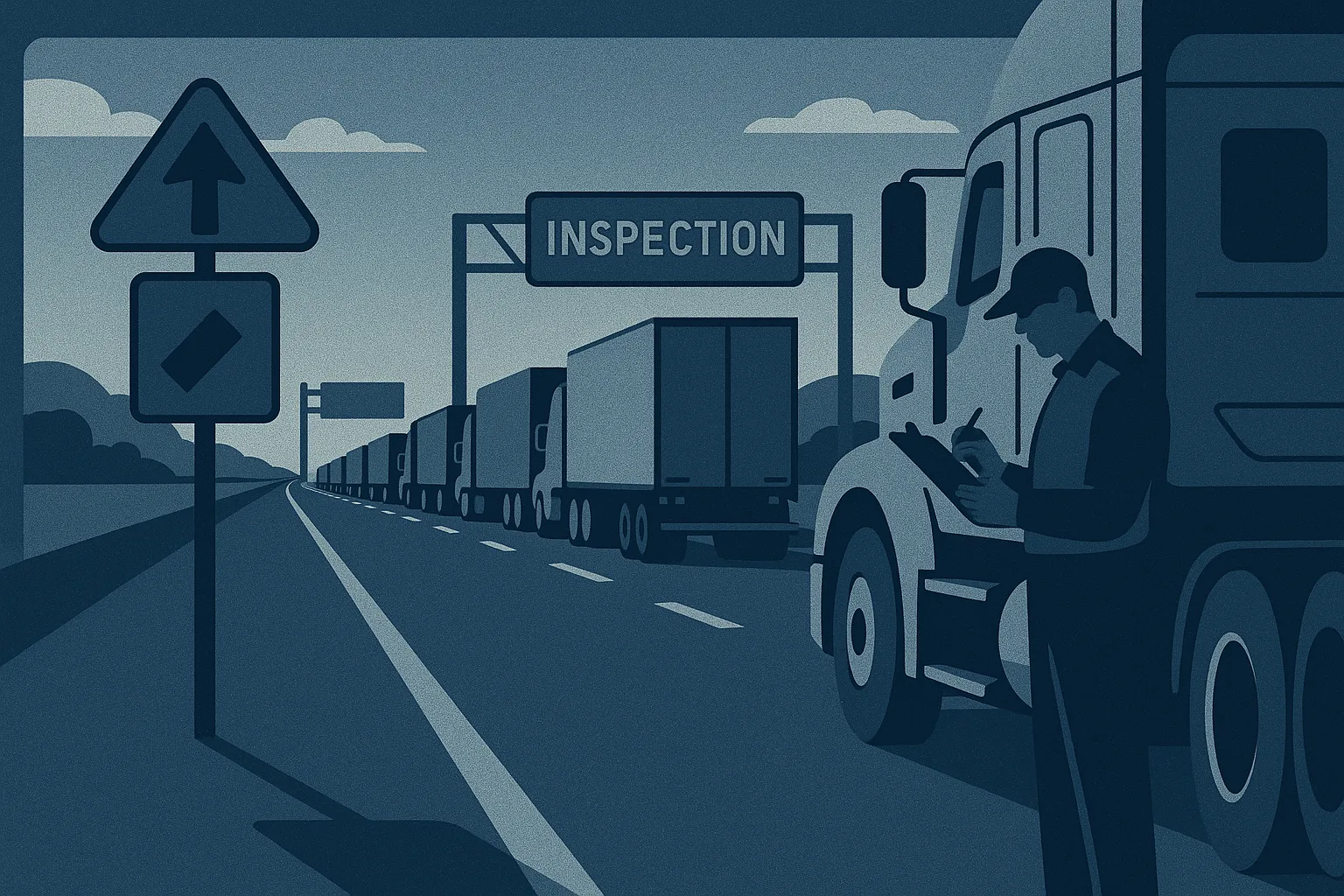

On April 16, 2026, the Federal Motor Carrier Safety Administration (FMCSA) announced it is withholding $73,502,543 in federal highway funds from New York after the state failed to revoke illegally issued non-domiciled commercial learner's permits (CLPs) and commercial driver's licenses (CDLs). The enforcement action — one of the most significant federal funding penalties imposed on a state in recent FMCSA history — follows months of escalating tension between federal regulators and New York over the integrity of the state's CDL issuance program.
For motor carriers, fleet managers, and employer compliance teams, this is not just a state-level dispute. It is the most visible consequence yet of a federal crackdown on non-domiciled CDL practices that is reshaping driver eligibility nationwide, and every employer with CDL-licensed drivers needs to understand what is happening and what it means for their operations.
The Audit That Triggered the Crackdown
The current enforcement action stems from a nationwide audit of non-domiciled CDL issuance practices completed in late 2025. FMCSA examined how State Driver Licensing Agencies (SDLAs) were issuing CDLs and CLPs to foreign nationals — specifically, drivers who are not domiciled in any U.S. state and hold licenses under a "non-domiciled" classification.
The results in New York were striking:
- Out of 200 sampled records, 107 were issued in violation of federal law — a failure rate of over 53%
- The New York DMV's systems defaulted to issuing 8-year licenses to foreign drivers for non-REAL ID licenses, regardless of when the driver's legal immigration status expired
- In many cases, licenses were issued based on expired documentation or without adequate verification of legal presence
FMCSA issued a formal order directing New York to immediately revoke all noncompliant non-domiciled CLPs and CDLs. When the state failed to complete the required corrective actions, FMCSA issued a final determination of substantial noncompliance on April 16 and moved to withhold 4% of New York's National Highway Performance Program and Surface Transportation Program Block Grant funds.
New York was not the only state flagged. The FMCSA's nationwide audit also identified compliance issues in other states including California, which subsequently canceled approximately 17,000 non-domiciled CDLs.
The Non-Domiciled CDL Final Rule: What Changed on March 16
The New York enforcement action is the culmination of a regulatory overhaul that began in September 2025 and was finalized in February 2026. The Non-Domiciled CDL Final Rule (91 FR 7044), effective March 16, 2026, fundamentally narrows who is eligible for a non-domiciled CDL or CLP.
Eligible Visa Categories
Under the revised 49 CFR Part 383, only foreign nationals in one of three employment-based nonimmigrant visa categories may obtain a non-domiciled CLP or CDL:
- H-2A — Temporary Agricultural Workers
- H-2B — Temporary Non-Agricultural Workers
- E-2 — Treaty Investors
All other immigration statuses — including Employment Authorization Document (EAD) holders, DACA recipients, asylum seekers, refugees, and Temporary Protected Status (TPS) holders — are no longer eligible for a non-domiciled CDL.
Key Compliance Requirements
The final rule imposes several additional requirements on state licensing agencies and, by extension, affects the drivers that motor carriers employ:
-
SAVE system verification is mandatory. States must verify every applicant's immigration status through the Systematic Alien Verification for Entitlements (SAVE) system for every licensing transaction — issuance, renewal, transfer, or upgrade.
-
Maximum one-year license validity. Non-domiciled CDLs and CLPs cannot be issued for longer than one year or beyond the expiration of the driver's lawful immigration status, whichever is sooner.
-
"Non-domiciled" must appear on the credential. The word "non-domiciled" must be conspicuously and unmistakably displayed on the face of the CLP or CDL, replacing previous practices where some states used "limited term" or other labels.
-
All transactions must be in-person. Renewals, transfers, reinstatements, and upgrades of non-domiciled CDLs must be conducted in person — no online or mail-based processing.
-
EADs are no longer sufficient. Employment Authorization Documents, previously accepted by some states as standalone proof of eligibility, are explicitly disqualified as evidence of lawful immigration status under 49 CFR § 383.5.
According to FMCSA's Non-Domiciled CDL 2026 Final Rule FAQs, states that are not able to comply with the final rule on the March 16 effective date must immediately pause the issuance of all non-domiciled CLPs and CDLs until they can ensure compliance with the revised standards.
Scale of the Impact: Approximately 200,000 Drivers Affected
The consequences of this regulatory shift extend far beyond New York. Approximately 200,000 drivers currently hold non-domiciled CDLs under the previous, broader eligibility standards. FMCSA estimates that the vast majority — roughly 194,000 — will be unable to renew when their licenses expire, leaving only about 6,000 drivers who qualify under the new H-2A, H-2B, or E-2 requirements.
Existing non-domiciled CDLs issued before March 16, 2026, remain valid until their expiration date, but they are not renewable unless the driver meets the new eligibility criteria. FMCSA has also strongly encouraged states to audit all unexpired non-domiciled CDLs and revoke any that were not issued in compliance with the federal regulations in effect at the time of issuance.
For the trucking industry, this translates to a gradual but significant workforce reduction over the next 12 to 24 months — concentrated in states and freight sectors that have historically relied on a larger share of non-domiciled drivers.
What This Means for Motor Carriers and Employers
The non-domiciled CDL crackdown creates immediate compliance obligations and medium-term operational risks for any motor carrier that employs CDL-licensed drivers. Here is what employers should be doing now.
1. Audit Your Driver Roster
Every motor carrier should conduct an immediate review of its driver workforce to identify:
- Any driver holding a non-domiciled CDL or CLP
- The expiration date of each non-domiciled credential
- The driver's current immigration status and visa category
- Whether the driver's license was issued by a state that has been flagged for noncompliance (New York, California, and others)
This audit is not optional. If a driver's CDL was improperly issued and subsequently revoked by the state, the carrier is responsible for ensuring that driver is not operating a commercial motor vehicle. Employing a driver with an invalid CDL exposes the carrier to significant civil penalties and liability.
2. Verify Driver Eligibility Documentation
For any driver identified as holding a non-domiciled CDL, verify that the driver's underlying immigration documentation supports continued eligibility:
- Valid and unexpired foreign passport
- Current I-94 or I-94A showing admission in H-2A, H-2B, or E-2 status
- Confirmation that the CDL expiration does not exceed the I-94 expiration date or one year, whichever is sooner
Carriers should not rely solely on the face of the CDL as proof of eligibility. The New York audit demonstrated that state-issued credentials can be noncompliant with federal law even when they appear valid on their face.
3. Develop a Workforce Transition Plan
For carriers that employ a significant number of non-domiciled CDL holders, the math is straightforward: most of these drivers will not be eligible to renew their licenses. Employers should:
- Forecast which drivers will reach their CDL expiration date in the next 6, 12, and 24 months
- Assess the operational impact of losing those drivers
- Begin recruiting replacement drivers or identifying drivers who may be eligible under the new standards
- Consider whether any affected drivers can transition to domiciled CDL status if they are lawful permanent residents or U.S. citizens domiciled in a state
4. Update Compliance Procedures
Motor carriers should update their internal compliance procedures to reflect the new reality:
- Pre-employment verification — Incorporate non-domiciled CDL status checks into your hiring process. Verify that any non-domiciled CDL holder has the required visa documentation before extending an offer.
- Ongoing monitoring — Establish a system for tracking non-domiciled CDL expiration dates and proactively managing renewals or driver transitions.
- Clearinghouse integration — Remember that non-domiciled CDL holders remain subject to all FMCSA Drug & Alcohol Clearinghouse requirements. A Clearinghouse query must still be conducted for every driver before they begin safety-sensitive functions.
- Record retention — Maintain copies of all driver eligibility documentation in your files. FMCSA audits of carrier compliance are likely to intensify in the current enforcement environment.
5. Consult Legal Counsel
The non-domiciled CDL rule intersects with immigration law in ways that are complex and evolving. Carriers with questions about specific driver situations — particularly drivers who may hold different visa categories or who are in the process of adjusting their immigration status — should consult with legal counsel experienced in both transportation regulatory compliance and immigration law.
Broader Enforcement Context
The $73 million New York penalty does not exist in isolation. It is part of a broader FMCSA enforcement posture that includes:
- The nationwide CDL audit program that has flagged compliance issues in multiple states
- Increased English Language Proficiency (ELP) enforcement, with over 17,000 ELP out-of-service violations issued nationwide as of March 2026
- Continued enforcement under FMCSA Clearinghouse Phase II, which is automatically downgrading CDLs for drivers in prohibited status
- Updates to the DataQs system that impose stricter deadlines and review processes for crash and inspection data corrections
The consistent signal from FMCSA is clear: CDL integrity is a priority, and states and carriers that fall short of federal requirements will face consequences.
The Bottom Line
The FMCSA's $73 million withholding from New York is the highest-profile enforcement action in a regulatory overhaul that is fundamentally changing who can hold a commercial driver's license in the United States. For motor carriers, the compliance implications are immediate and the workforce implications are substantial.
Carriers that rely on non-domiciled CDL holders need to act now — audit driver rosters, verify immigration documentation, plan for workforce transitions, and update hiring and compliance procedures. The enforcement environment is not going to ease. The carriers that treat this as a compliance priority today will be the ones that avoid disruption when licenses start expiring and state revocation programs take full effect.
Sources
- U.S. DOT Press Release: Transportation Secretary Withholds $73 Million from New York (April 16, 2026)
- U.S. DOT Press Release: FMCSA Uncovers CDL Audit Findings in New York
- FMCSA Final Determination Letter to New York (April 16, 2026)
- Federal Register: Non-Domiciled CDL Final Rule (91 FR 7044, February 13, 2026)
- FMCSA Non-Domiciled CDL 2026 Final Rule FAQs
- 49 CFR Part 383 — Commercial Driver's License Standards
- FMCSA Drug & Alcohol Clearinghouse
- Overdrive: FMCSA to Force Nearly 200K Non-Domiciled CDL Holders Out of Trucking
- Truckers News: Feds Withhold $73 Million from NY Over Non-Domiciled CDL Issuance
Tags
Frequently Asked Questions
FMCSA determined that New York is in substantial noncompliance with federal CDL issuance requirements after a federal audit found that over 53% of sampled non-domiciled CDL records were issued in violation of federal law. The state failed to revoke the illegally issued licenses after being ordered to do so, resulting in the withholding of $73,502,543 in federal highway funds.
The final rule, effective March 16, 2026, restricts non-domiciled CDL eligibility to foreign nationals in H-2A, H-2B, or E-2 visa status only. It eliminates Employment Authorization Documents as standalone proof of eligibility and requires states to verify immigration status through the federal SAVE system for every licensing transaction.
Approximately 200,000 drivers currently hold non-domiciled CDLs under previous eligibility standards. FMCSA estimates the vast majority will be unable to renew as their licenses expire over the next one to two years, with only around 6,000 expected to qualify under the new H-2A, H-2B, or E-2 visa requirements.
Motor carriers should immediately audit their driver rosters to identify anyone with a non-domiciled CDL, verify each driver's current immigration status and visa category, develop transition plans for drivers who may lose eligibility at renewal, and consult legal counsel on documentation requirements. Carriers should also ensure their hiring procedures align with the new SAVE verification requirements.
Drivers who hold non-domiciled CDLs issued before March 16, 2026, may continue driving until their current license expires. However, they will be ineligible for renewal unless they qualify under the H-2A, H-2B, or E-2 visa categories. FMCSA has also strongly encouraged states to audit and revoke previously issued non-compliant licenses.