After Safe Driver Week: Check Past ELD Deadlines and the October 6 Replacement Date
FMCSA's July and September ELD replacement deadlines have passed, and an August notice sets October 6 for five devices. Review the official device identifiers, stop-use instructions, and practical fleet follow-up steps.

CVSA's 2026 Operation Safe Driver Week ran July 12-18. Two FMCSA electronic logging device (ELD) replacement deadlines followed: July 20 for 12 devices revoked in May, and September 8 for 10 devices revoked in July.
In a September 21, 2026 update to this article, we added a further FMCSA notice setting an October 6 replacement date for five devices removed on August 6. The task for fleet managers is to match the exact device, follow its specific notice, and distinguish a temporary replacement period from permission to keep using a revoked ELD.
What Is Operation Safe Driver Week?
Operation Safe Driver Week is CVSA's enforcement and education initiative addressing unsafe behavior by commercial motor vehicle (CMV) and passenger vehicle drivers. Its April 30 announcement set July 12-18 as the 2026 campaign dates.
The program combines driver education with enforcement. Employers can use the focus areas for ongoing coaching, but should not assume that every campaign ticket or warning automatically changes a motor carrier's safety score. Review the actual citation, inspection report, and relevant carrier or driver record before describing its consequences.
2026 Focus: Reckless, Careless, and Dangerous Driving
The 2026 announcement identified reckless, careless, or dangerous driving as the focus. Examples of unsafe behavior included:
- Speeding
- Distracted driving — including handheld device use and texting
- Following too closely (tailgating)
- Impaired driving — alcohol or drug impairment
- Failure to wear a seatbelt
- Unsafe lane changes
- Failure to obey traffic signals
- Fatigued or drowsy driving
These are continuing safety concerns, not obligations that begin and end with one enforcement week. Review the behaviors and conditions actually identified in your fleet instead of assuming the campaign's national emphasis describes your own results.
What Happened Last Year
CVSA's 2025 results summary reports 8,739 vehicles stopped in the United States and Canada, with 2,504 tickets/citations and 3,575 warnings. Those are 2025 figures, not results from the 2026 campaign.
National totals provide context, but cannot establish that a particular carrier's safety record changed. Keep driver coaching, legal responses to citations, and review of recorded inspection data as related but distinct tasks.
ELD Deadlines Already Passed
FMCSA's revocation notices have their own device-specific timelines. A later batch does not extend the deadline for an earlier one.
May 20 Revocations: July 20 Enforcement Date
The May 20 bulletin removed 12 devices for failing minimum ELD requirements. It directed affected carriers to:
- Discontinue the revoked ELD and use paper logs or logging software for required hours-of-service records.
- Replace it with a compliant registered ELD before July 20, 2026.
FMCSA's July 20 follow-up confirms that the temporary paper-log period ended. It directs officials encountering continued use of the listed revoked devices or improper use of paper logs to cite 49 CFR 395.8(a)(1) and place the driver out of service under the applicable CVSA criteria.
July 9 Revocations: September 8 Enforcement Date
The September 8 follow-up notice similarly confirms that the replacement period for the 10 devices removed July 9 has ended. A carrier affected by that notice cannot use the October deadline for a different batch as an extension.
The official notices identify names, model numbers, ELD identifiers, and providers. Use those details, not only a vendor's marketing name, to match fleet equipment to a notice.
The October 6 Date for Five August Revocations
FMCSA's August 6 notice lists these devices and requires replacement before October 6, 2026:
| Device | Model | ELD identifier | Provider |
|---|---|---|---|
| MOONLIGHT ELD | MRS | MRS255 | UZB2USA INC |
| HGRS ELD | HGR | HRS169 | HGRS |
| HIGHEST ELD | HIG4ES | HIG385 | HGRS |
| TRUCKFORD ELD | TRS | TRS263 | Truckford ELD |
| Sparkle ELD | PT40SIM | SPARK6 | Spark Technologies Inc. |
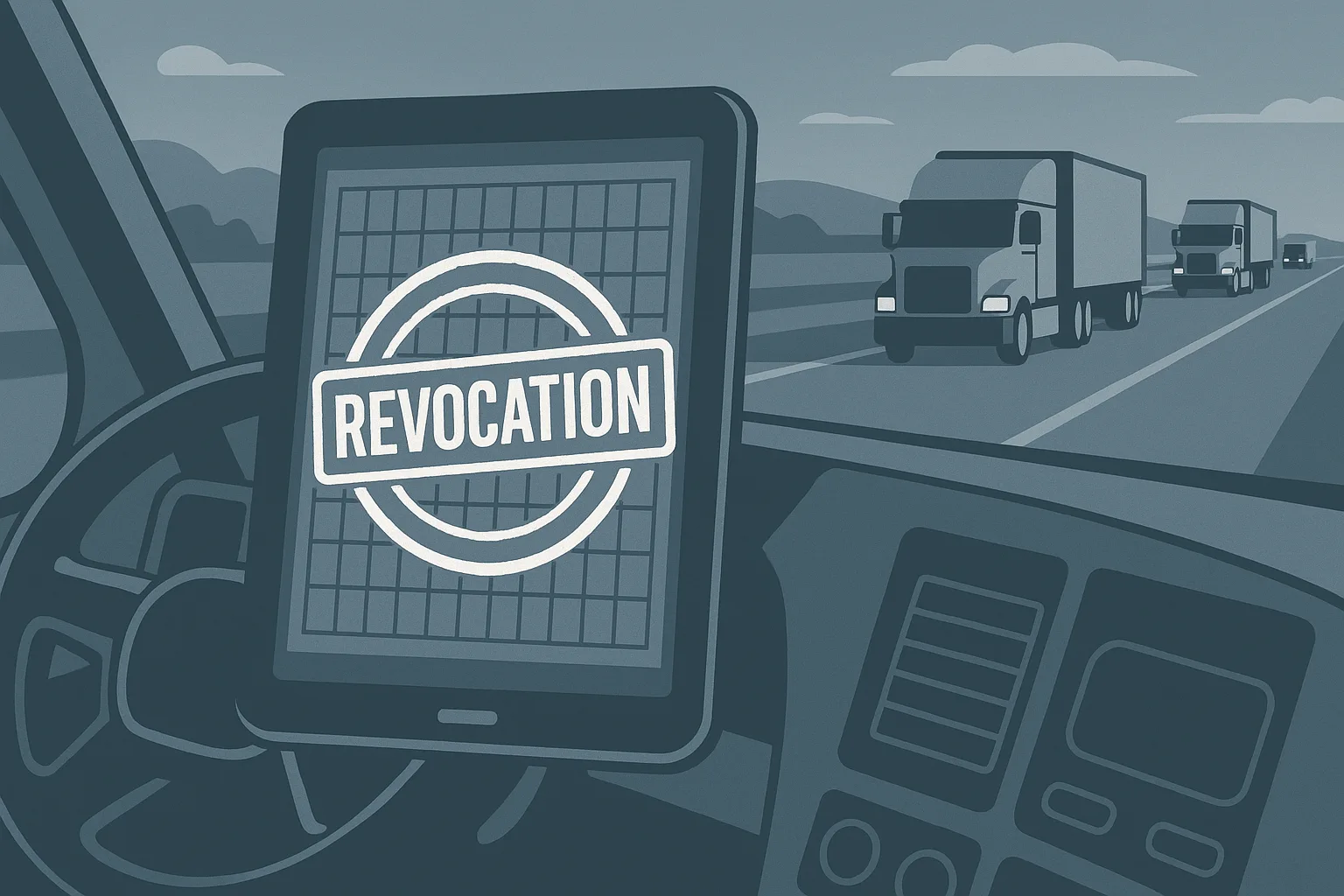
The same notice requires affected carriers to stop using the revoked ELDs and use the specified temporary logging method while replacing them. It says continued use on or after October 6 leads to the stated citation and out-of-service treatment. Do not interpret the replacement period as permission to wait until October to stop normal use of a revoked device.
FMCSA also explains that a device can be restored to the registered list if its provider corrects the deficiencies. Check the current registered and revoked device lists for an official status update; this article's table records the August notice, not an assurance that a device's status can never change.
The list states that manufacturers self-certify their devices and that FMCSA does not endorse any ELD. Registration is therefore not an agency endorsement or a substitute for assessing whether the device meets the requirements of your operation.
What Motor Carriers Should Do Now
1. Match Equipment to the Official Record
Create an inventory of provider, device name, model, identifier, and deployed vehicles. Assign someone to compare it with the current FMCSA lists and notices. If a provider says a product is restored, verify that statement against the official listing.
2. Follow the Specific Replacement Instructions
Identify which deadline applies before planning the transition. The July 20 and September 8 periods are closed. For equipment in the August 6 notice, act on the stop-use instruction now and complete replacement before October 6, unless an official status update changes the relevant position.
3. Prepare Drivers for the Transition
Give affected drivers clear instructions about the permitted temporary logging process, replacement equipment, and whom to contact if the device or records cannot be used as required. Verify that operations and dispatch know which vehicles have completed the transition.
Do not rely on an order confirmation as proof that replacement is complete. Check installation, driver access, and the ability to produce required records. Record completion against the specific vehicle and device rather than only marking a vendor-level task finished.
4. Follow Up on Actual Safety Findings
Use CVSA's behavior categories to structure coaching on speeding, distraction, fatigue, seatbelts, and following distance. Review any actual findings from the campaign or later stops and assign corrective actions.
Do not combine a passenger-vehicle warning, a driver's licensing record, and a carrier inspection finding into an assumed single scoring result. Check the relevant records, respond through the applicable process, and distinguish correcting an inaccurate record from addressing a real safety issue.
5. Assign Ongoing Monitoring
Designate an owner and backup for FMCSA ELD notices. A useful register includes the date checked, affected identifiers, required actions, replacement deadline, assigned vehicles, and completion evidence. These are practical management recommendations, not a claim that a specific software platform is federally required.
Keep Dates and Status Separate
There are three different milestones: the revocation that triggers action, the end of a replacement period, and any later official reinstatement. Keep all three visible. An old news article, a provider's assurance, or another product's deadline is not a substitute for checking the record for the actual device.
The same approach applies to driver-safety campaigns. Keep the July campaign as a historical event, follow up on real findings, and maintain ordinary safety practices after the calendar reminder disappears.
Sources
- CVSA: 2026 Operation Safe Driver Week Dates and Focus
- CVSA: 2025 Operation Safe Driver Week Results
- FMCSA Removes 12 Devices from List of Registered Electronic Logging Devices — May 20, 2026 press release
- FMCSA Registered and Revoked ELD Lists - Manufacturer self-certification and current listing status
- FMCSA: August Revocations and October 6 Deadline
- FMCSA: September 8 Replacement-Period Expiration
Tags
Frequently Asked Questions
CVSA scheduled the 2026 campaign for July 12-18, with a focus on reckless, careless, or dangerous driving by commercial and passenger vehicle drivers. Those dates have passed; employers should now follow up on actual findings and maintain year-round safety practices.
FMCSA's August 6 notice lists MOONLIGHT ELD, HGRS ELD, HIGHEST ELD, TRUCKFORD ELD, and Sparkle ELD, with replacement required before October 6. Match the exact model and ELD identifier and check the current registered/revoked lists for any official reinstatement.
FMCSA's May 20 notice required affected carriers to replace 12 revoked ELDs before July 20. Its July 20 follow-up says the temporary paper-log period ended and directs citations and out-of-service treatment under the applicable criteria for continued revoked-device use or improper paper-log use.
FMCSA's notices direct affected carriers to discontinue the revoked device and use paper logs or logging software temporarily while replacing it. The replacement period is not permission to keep using the device normally, and the temporary logging option does not extend past the applicable deadline.
Yes. FMCSA's September 8 notice confirms that the replacement period for the 10 devices revoked July 9 has ended. Carriers should check their exact device identifiers and current registration status rather than assume every revocation shares one deadline.