OSHA Cites Piggly Wiggly Franchisee After Amputation: What Employers Must Know About Machine Guarding and Lockout/Tagout
OSHA issued nearly $200,000 in penalties against a Georgia supermarket franchisee after a meat grinder amputation. Here's what every employer with machinery needs to know about machine guarding, lockout/tagout, and OSHA's renewed enforcement focus on amputations.
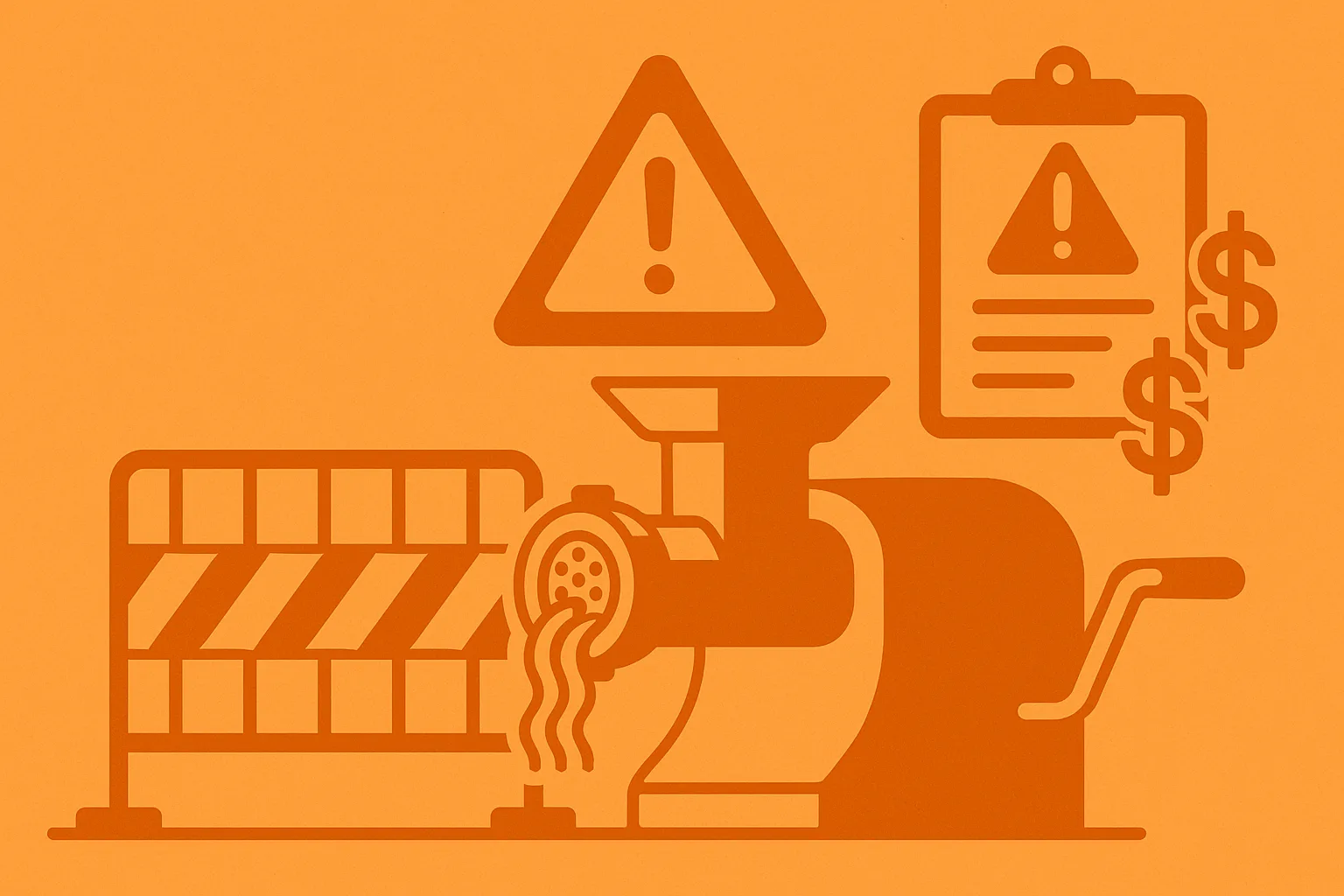

On June 1, 2026, the U.S. Department of Labor announced that OSHA had cited a Piggly Wiggly supermarket franchisee in Bowdon, Georgia, for willful and serious violations after a meat department worker suffered the amputation of four fingers while cleaning a commercial meat grinder. The proposed penalties totaled $196,251.
The case is a stark reminder of a hazard that remains one of OSHA's top enforcement priorities: preventable amputations caused by inadequate machine guarding and failure to control hazardous energy. With OSHA's renewed National Emphasis Program on Amputations running through 2030, employers in manufacturing, food processing, retail, and dozens of other industries should treat this enforcement action as a compliance wake-up call.
What Happened in Bowdon, Georgia
The incident occurred at a Piggly Wiggly location operated by RBG Foods Inc. An employee was cleaning a commercial meat grinder when a coworker inadvertently activated the machine using a foot pedal. The grinder pulled the worker's hand into the equipment, resulting in the amputation of four fingers.
OSHA's investigation found multiple failures:
- Willful violation: The employer had intentionally bypassed manufacturer-installed safety guards on the grinder, exposing workers to dangerous moving parts and flying debris.
- Serious violation: No lockout/tagout (LOTO) program was in place to control hazardous energy during cleaning and maintenance activities.
- Other-than-serious violation: The employer failed to report the amputation to OSHA within 24 hours, as required under 29 CFR 1904.39.
The willful classification — indicating the employer knowingly disregarded safety requirements — carries the highest available penalties under the OSH Act.
Why This Case Matters Beyond One Employer
This enforcement action is not an isolated event. It reflects a broader federal strategy that has intensified over the past year.
OSHA's Renewed Amputations NEP (2025–2030)
In June 2025, OSHA reissued its National Emphasis Program on Amputations in Manufacturing (Directive CPL 03-00-027), extending the program through 2030. The renewed NEP:
- Targets 91 high-risk industries identified by updated NAICS codes, including food manufacturing, metal fabrication, plastics and rubber manufacturing, wood products, and animal slaughtering and processing.
- Directs OSHA area offices to conduct programmed inspections at establishments in these industries, with priority given to those with recent amputation reports.
- Focuses enforcement on two key standards: machine guarding (29 CFR 1910.212) and control of hazardous energy (29 CFR 1910.147).
- Expands inspection scope to cover all phases of machine use — operation, cleaning, service, and maintenance — not just production.
The Scale of the Problem
The numbers behind OSHA's enforcement push are significant:
- Machinery accounts for approximately 58% of reported work-related amputations in manufacturing, according to Bureau of Labor Statistics data.
- In fiscal year 2024, lockout/tagout was OSHA's 5th most-cited standard (2,443 violations), and machine guarding was the 10th most-cited (1,541 violations).
- BLS data indicates approximately 24,000 LOTO-related injuries per year in manufacturing, with over 1,200 amputations traced to LOTO failures in general industry over a recent 10-year period.
These are not abstract statistics — they represent real injuries that OSHA believes are almost entirely preventable with proper compliance.
The Two Standards Every Employer Must Know
Machine Guarding — 29 CFR 1910.212
OSHA's machine guarding standard requires that one or more methods of machine guarding be provided to protect operators and other workers in the machine area from hazards including:
- Point of operation (where work is performed on material)
- Ingoing nip points (where rotating parts create pinch hazards)
- Rotating parts, flying chips, and sparks
Guards must:
- Prevent contact with dangerous machine parts
- Be secure and not easily removed or tampered with
- Not create new hazards (such as shear points or jagged edges)
- Not interfere with machine operation
- Allow for safe lubrication and maintenance
Critical point: Manufacturer-installed guards must never be bypassed or removed. In the Piggly Wiggly case, the intentional removal of safety guards elevated the violation from serious to willful — increasing maximum penalties from $16,550 to $165,514 per violation.
Control of Hazardous Energy (Lockout/Tagout) — 29 CFR 1910.147
The lockout/tagout standard requires employers to establish a program and procedures for disabling machinery or equipment to prevent the unexpected release of hazardous energy during servicing and maintenance. Key requirements include:
- Written energy control procedures for each machine or piece of equipment
- Proper lockout/tagout devices (locks, tags, and other hardware)
- Employee training covering the purpose and function of the energy control program
- Periodic inspections at least annually to ensure procedures are being followed
- Specific steps for shutdown, isolation, lockout/tagout application, stored energy release, and verification
LOTO applies whenever workers perform activities such as cleaning, unjamming, adjusting, or maintaining machines where unexpected energization could cause injury. In the Piggly Wiggly case, the absence of any LOTO program during routine meat grinder cleaning was cited as a serious violation.
What Employers Should Do Now
Whether you operate a supermarket meat department, a manufacturing floor, or any workplace with powered equipment, the following steps are essential:
1. Audit Machine Guards Immediately
- Inspect every piece of equipment to confirm that manufacturer-installed guards are in place and functioning.
- Look for missing, damaged, bypassed, or improperly modified guards.
- Verify that guards cannot be easily removed without tools.
- Document findings and correct deficiencies before the next shift.
2. Review and Update Your LOTO Program
- Confirm that you have written, machine-specific energy control procedures for every piece of equipment that requires servicing.
- Verify that procedures cover all energy sources (electrical, mechanical, hydraulic, pneumatic, thermal, chemical, gravitational).
- Ensure LOTO devices (locks, tags, hasps) are available, standardized, and durable.
- Conduct the required annual periodic inspection for each energy control procedure.
3. Train (and Retrain) All Affected Workers
- Authorized employees (those who perform LOTO) must be trained on the specific procedures for each machine they service.
- Affected employees (machine operators and others in the area) must understand the purpose and limitations of the LOTO program.
- Training must be provided in a language and vocabulary workers understand — critical for diverse workforces in food processing and retail.
- Document all training with dates, topics, and attendee signatures.
4. Eliminate the "Shortcut Culture"
- Many amputation incidents stem from informal practices that bypass safety systems — cleaning equipment while it's energized, reaching past guards, or using foot pedals while others are performing maintenance.
- Establish clear policies that any worker can stop work if they observe a safety shortcut.
- Supervisors must model correct behavior. If management tolerates guard removal, OSHA will likely classify violations as willful.
5. Report Severe Injuries on Time
- Under 29 CFR 1904.39, employers must report:
- Work-related fatalities within 8 hours
- Work-related in-patient hospitalizations, amputations, or losses of an eye within 24 hours
- Failure to report adds additional OSHA citations and signals that an employer may be concealing workplace hazards.
6. Determine Your NEP Exposure
- Review the OSHA NEP Amputations directive Appendix B to determine whether your primary NAICS code is on the list of 91 targeted industries.
- If your industry is listed, anticipate programmed inspections regardless of whether an incident has occurred.
- Establishments with 10 or fewer employees in designated low-hazard NAICS codes may be exempt, but the exemption disappears if an amputation has been reported.
2026 Penalty Exposure
Employers should understand the current OSHA penalty structure:
| Violation Type | Maximum Penalty (2026) |
|---|---|
| Serious | $16,550 per violation |
| Other-than-serious | $16,550 per violation |
| Willful or repeat | $165,514 per violation |
| Failure to abate | $16,550 per day |
| Posting requirements | $16,550 per violation |
In cases involving fatalities or severe injuries with willful classifications, total penalties routinely exceed $100,000 — and multi-million-dollar penalty packages are possible when repeat violations are involved, as seen in recent OSHA trenching and fall protection cases.
The Bottom Line
The Piggly Wiggly enforcement action demonstrates that OSHA's amputation prevention strategy is active, well-funded, and expanding. Every employer with powered machinery — from a single meat slicer to an entire production line — is responsible for ensuring that guards remain in place and that hazardous energy is properly controlled before any worker performs servicing or maintenance.
The compliance requirements are not new. Machine guarding and lockout/tagout have been federal standards for decades. But the enforcement intensity is new, the penalty amounts are at historic highs, and the Amputations NEP means OSHA inspectors are actively looking for these specific hazards in targeted industries through 2030.
Investing in a proper machine guarding program and energy control procedures now is far less costly than a single willful citation — and immeasurably less costly than a worker losing a hand.
Sources
- U.S. Department of Labor. "US Department of Labor cites Piggly Wiggly franchisee for willful violations after worker amputation." June 1, 2026. https://www.dol.gov/newsroom/releases/osha/osha20260601
- OSHA. "National Emphasis Program on Amputations in Manufacturing Industries." Directive CPL 03-00-027. https://www.osha.gov/enforcement/directives/cpl-03-00-027
- OSHA. "Machine Guarding." https://www.osha.gov/machine-guarding/
- OSHA. "Control of Hazardous Energy (Lockout/Tagout)." https://www.osha.gov/control-hazardous-energy
- OSHA. "Injury Tracking Application — Reporting Requirements." 29 CFR 1904.39. https://www.osha.gov/laws-regs/regulations/standardnumber/1904/1904.39
- BlueHive. "2026 OSHA Changes: What Has Taken Effect, What Is Coming, What Employers Should Do Now." https://bluehive.com/white-papers/2026-osha-changes/
- BlueHive. "Surprise OSHA Fines Now Top $165K – What Execs Need to Know." https://bluehive.com/white-papers/surprise-osha-fines-now-top-165k-what-execs-need-to-know-abo/
Tags
Frequently Asked Questions
OSHA proposed $196,251 in total penalties against the Piggly Wiggly franchisee (RBG Foods Inc.) in Bowdon, Georgia, after a meat department worker lost four fingers in a commercial meat grinder. Violations included a willful citation for bypassing safety guards, a serious citation for lacking a lockout/tagout program, and a failure to report the amputation within 24 hours.
OSHA's National Emphasis Program (NEP) on Amputations in Manufacturing (Directive CPL 03-00-027), renewed in June 2025 and effective through 2030, directs OSHA area offices to conduct programmed inspections targeting 91 high-risk industries. It focuses enforcement on machine guarding (29 CFR 1910.212) and lockout/tagout (29 CFR 1910.147) compliance.
Under 29 CFR 1910.212, employers must provide guards on machines to protect workers from hazards such as point of operation, ingoing nip points, rotating parts, and flying debris. Guards must prevent contact with dangerous parts, be securely attached, not create new hazards, and allow for safe maintenance.
Under 29 CFR 1904.39, employers must report all work-related amputations to OSHA within 24 hours of learning about the incident. Fatalities must be reported within 8 hours. Failure to report can result in additional OSHA citations.
In 2026, the maximum OSHA penalty for a willful or repeat violation is $165,514 per violation. Serious violations carry a maximum penalty of $16,550 per violation, and failure-to-abate penalties can reach $16,550 per day beyond the abatement deadline.