FleetPride's Confined-Space Case: Lessons From OSHA's July 2026 Citations
OSHA announced 19 FleetPride violations and $264,380 in proposed penalties after a worker fatality. Review verified findings and general-industry confined-space program, training, and rescue requirements.
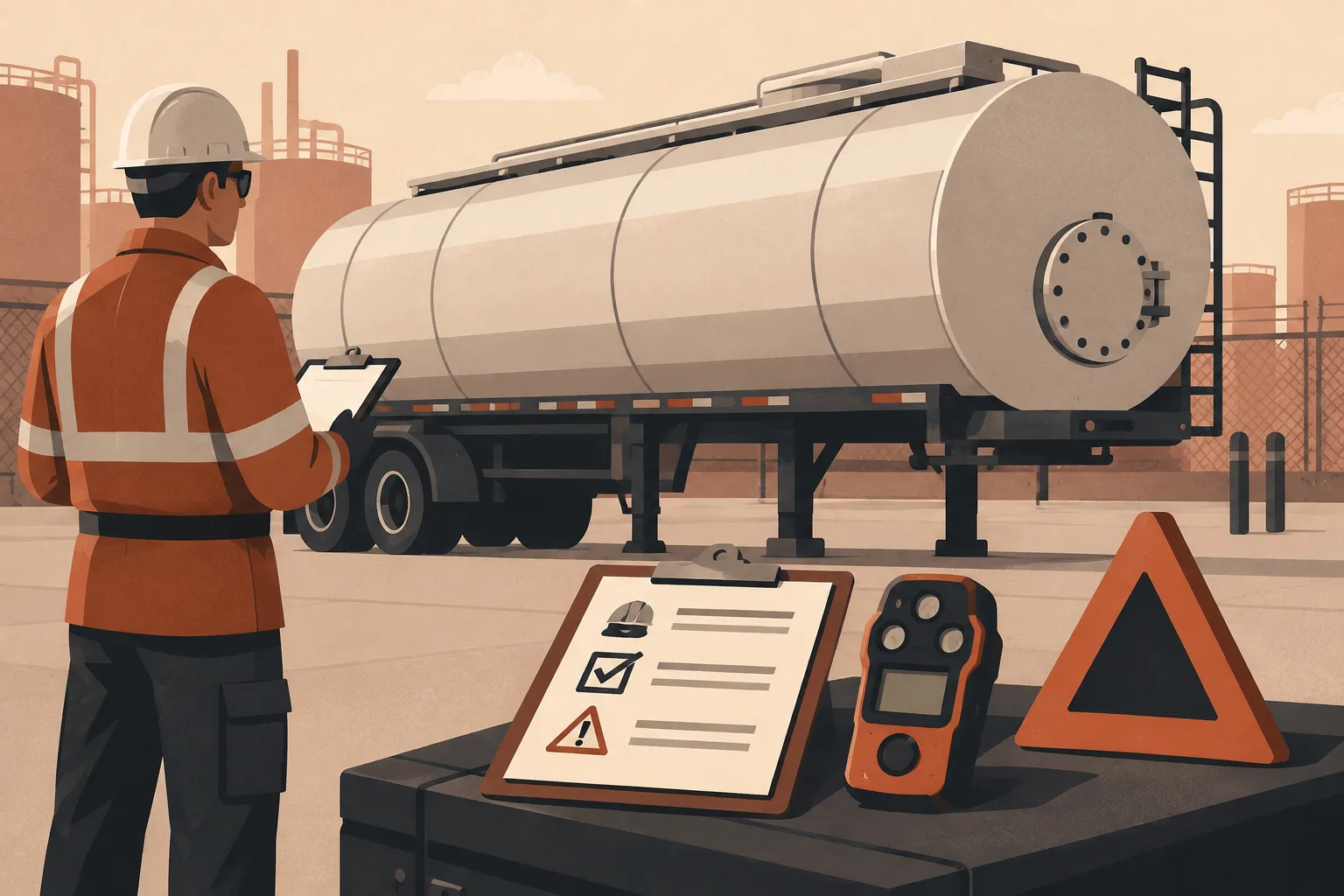

On July 15, 2026, OSHA announced citations against FleetPride Inc. following a worker fatality at the company's Corpus Christi, Texas facility. The agency reported 16 serious and three other-than-serious safety violations and proposed $264,380 in penalties.
The release says OSHA initiated its inspection on January 7, 2026, after an employee asphyxiated while inspecting a tanker trailer. It identifies failures involving a confined-space program, respiratory protection program elements, and electrical hazards. It does not identify the worker or provide a detailed item-by-item account of every alleged violation.
This article uses that announcement as a starting point for a compliance review. It does not report a later final disposition of the case or attribute additional findings to FleetPride. The source itself cautions that news releases may not reflect a case's current or final status.
Why Confined Spaces Are So Deadly
A confined space, as defined by OSHA's Permit-Required Confined Spaces standard (29 CFR 1910.146), is a space that:
- Is large enough for a worker to enter and perform work
- Has limited or restricted means of entry or exit
- Is not designed for continuous occupancy
Common examples include storage tanks, silos, vaults, pits, manholes, tunnels, pipelines, and — as in the FleetPride case — tanker trailers.
The standard distinguishes a confined space from a permit-required confined space. Permit characteristics include an actual or potential hazardous atmosphere, material that could engulf an entrant, a configuration that could trap or asphyxiate someone, or another recognized serious safety or health hazard.
Appearance alone does not establish safety. Employers need to evaluate the particular space, work, and hazards rather than rely on familiarity or the absence of a previous incident. Rescue must be planned; the standard specifically addresses preventing unauthorized rescue attempts.
What OSHA Found at FleetPride
The official release identifies three broad categories:
- Failure to implement a confined-space program
- Lacking elements of a respiratory protection program
- Exposing workers to electrical hazards
Those reported categories support an employer review of the related programs. They do not establish, by themselves, that particular tests, permits, medical evaluations, fit tests, or hospitalization reports were missing in this case. Keep general compliance advice separate from allegations about a named employer.
The release also described the employer's 15-business-day period from receipt of citations to comply, request an informal conference, or contest the findings. That was the announced enforcement process, not a new September deadline.
The Regulatory Framework: What the Law Requires
Section 1910.146 addresses general industry. Its scope excludes agriculture, construction, and shipyard employment, which require evaluation under their applicable rules. Within its scope, an employer must evaluate the workplace for permit spaces and inform exposed workers of their location and danger.
If employees will not enter permit spaces, paragraph (c)(3) requires effective measures to prevent entry and compliance with its specified remaining provisions. If employees will enter, the written permit-program requirements apply unless the employer satisfies an applicable alternative.
For a full permit-entry program, key elements include:
- Workplace evaluation — Identify all confined spaces and determine which are permit-required
- Written program — Develop a written permit space program detailing entry procedures, hazard controls, training, equipment, and emergency response
- Entry permits — Issue a written permit before each entry that documents hazards, safety measures, authorized personnel, and duration
- Atmospheric testing — Test for oxygen content, flammable gases/vapors, and toxic substances before and during entry
- Hazard controls — Implement ventilation, lockout/tagout, and other engineering controls
- Training — Train all personnel involved: entrants, attendants, entry supervisors, and rescue teams
- Rescue services — Ensure rescue capability is available, whether through an in-house team or a pre-arranged outside service
- Program review - Review using retained canceled permits within one year after each entry under (d)(14), and address deficiencies under (d)(13). The standard permits a single annual review and says no review is necessary when no entry occurs during a 12-month period.
The standard also requires at least one attendant outside an authorized permit-space entry for its duration, with duties that protect entrants. A permit or certificate is not a substitute for the people, equipment, and procedures needed to implement the program.
Alternate Procedures Are Conditional
Paragraph (c)(5) allows alternate procedures only when its conditions are met, including demonstrating that the only hazard is an actual or potential hazardous atmosphere and that continuous forced-air ventilation alone can maintain safe entry conditions. Supporting data, documentation, testing, and the prescribed procedures are still required.
Paragraph (c)(7) has separate conditions for reclassifying a permit space after hazards have been eliminated. OSHA expressly distinguishes controlling an atmospheric hazard with ventilation from eliminating it. Have a qualified safety professional evaluate the applicable pathway; do not relabel a space simply to avoid a permit.
What This Means for Employers
For general-industry employers, use the case to check whether the actual entry process matches the written program. For other industries, identify the applicable standard before applying this general-industry checklist.
Immediate Actions to Take
- Conduct a confined space audit — Walk your facilities and identify every space that meets OSHA's definition. Tanker trailers, storage bins, crawl spaces, utility vaults, and even large equipment housings may qualify
- Verify your written program exists and is current — A program written years ago and filed away does not satisfy the standard. It must reflect current operations, equipment, and personnel
- Verify testing equipment and procedures - Ensure suitable equipment is maintained, available, and used by trained personnel under the applicable requirements and manufacturer instructions
- Review training records — Ensure all workers who may enter confined spaces, serve as attendants, or supervise entries have current, documented training
- Test your rescue capabilities — Can your designated rescue team (internal or external) respond within the time window necessary to save a life? Conduct practice drills
- Audit your entry permit system — Review recent permits for completeness and accuracy. Are supervisors actually signing off on atmospheric readings and safety measures before entry?
Common Pitfalls That Lead to Citations
The following are general risks to review, not additional findings about FleetPride:
- "We've always done it this way" — Familiarity breeds complacency. Workers who enter the same space repeatedly without incident may begin skipping safety steps
- Misidentifying spaces — Tanker trailers, like the one in this case, may not look like traditional confined spaces but absolutely meet the OSHA definition
- Assuming a space is safe because it was safe yesterday — Atmospheric conditions can change rapidly due to chemical reactions, biological processes, or displacement of oxygen by inert gases
- Unplanned rescue - Prevent unauthorized rescue attempts and verify the designated service's capability for the particular space and hazards
Rescue Arrangements Need More Than a Phone Number
Paragraph (k) requires evaluation of a prospective rescue service's timely response and proficiency with the relevant tasks and equipment. Inform the selected service about the hazards and provide access needed to plan and practice rescues. Entry supervisors must verify rescue availability and an operable means of summoning the service.
Employers designating their own employees for rescue have additional training, equipment, first-aid/CPR, and practice requirements under (k)(2). Do not assume that calling an outside organization removes the employer's duty to assess whether the proposed arrangement is suitable.
Coordinate Medical and Respiratory Requirements Correctly
Where respirators are required, 29 CFR 1910.134 requires medical evaluation before fit testing or required use, and fit testing applies to tight-fitting respirators. That is different from claiming every confined-space entrant must purchase a generic medical-clearance service.
Have qualified occupational health and safety personnel identify the requirements for the actual tasks and exposures. A medical opinion does not authorize an entry or replace hazard controls, training, the applicable permit process, or rescue readiness.
Keep Records Connected to Operations
Under 1910.146(e)(6), canceled entry permits must be retained for at least one year, with problems encountered during entry noted for program review. Training certification under (g)(4) records the employee, trainer identification, and dates. Where contractors enter permit spaces, paragraphs (c)(8) and (c)(9) address hazard information, coordination, and debriefing responsibilities.
Use those records to find and correct operational gaps. The important question is not simply whether a document exists, but whether the space was evaluated, the required precautions were implemented, the assigned people were prepared, and the entry was appropriately authorized.
Sources
Tags
Frequently Asked Questions
OSHA's July 15, 2026 release reported 16 serious and three other-than-serious violations and $264,380 in proposed penalties. It identified failure to implement a confined-space program, missing respiratory-program elements, and electrical hazards; the announcement is not a final case resolution.
Under 29 CFR 1910.146, a confined space must meet the size/configuration, restricted-entry/exit, and noncontinuous-occupancy criteria. It becomes permit-required when it has a specified atmospheric, engulfment, trapping/asphyxiation, or other recognized serious hazard.
No. OSHA requires evaluation of the space and hazards, and 1910.146 includes specific conditions for alternate procedures and reclassification. Employers must satisfy those conditions and required documentation; a label or a previous uneventful entry does not establish that an exception applies.
First identify the applicable standard and classify the space. Where a permit-entry program is required, 1910.146 addresses hazard evaluation, controls, testing, permits, trained personnel, an attendant, and rescue arrangements; the exact duties depend on the applicable provisions.
No. A certificate does not replace the required space evaluation, controls, entry authorization, training, or rescue planning. Required respirator medical evaluations are governed separately by 29 CFR 1910.134; do not infer a universal confined-space medical-exam requirement from the FleetPride release.