OSHA Cites Roofing Contractor After Fatal Fall — Why Fall Protection Remains the Agency's Top Enforcement Priority in 2026
After a Florida roofing company was cited for willful violations following a worker's fatal fall, OSHA's enforcement data confirms fall protection remains the #1 most-cited standard for the 15th consecutive year. Here's what construction employers must know.

On April 24, 2026, the U.S. Department of Labor cited a Florida roofing company for willfully allowing two employees to work more than 20 feet above ground with no fall protection — a decision that cost one worker his life. Max Home Services LLC, operating as Pasat Roofing and Solar Energy, faces $172,324 in proposed penalties after OSHA investigators found the company failed to provide personal fall arrest systems, failed to train workers on fall hazards, and lacked a hazard communication program for chemicals used on site.
The case is a grim reminder of a persistent reality: fall protection violations remain OSHA's most-cited standard — for the 15th consecutive year. Despite years of enforcement, education, and outreach, workers continue to die from preventable falls on construction sites. For employers in the construction industry, understanding the current state of fall protection enforcement is not optional — it is a legal and moral imperative.
The Fatal Incident That Triggered the Citation
On September 24, 2025, two employees of Max Home Services were installing a tarp on a two-story residence in Fort Lauderdale, Florida. Both workers slipped from the roof and fell over 20 feet into an empty swimming pool below. One employee was fatally injured; the other sustained serious injuries.
OSHA's investigation found that the employer:
- Willfully failed to provide fall protection for employees working at heights exceeding 20 feet
- Failed to train employees to recognize fall hazards and the proper use of fall protection systems
- Did not implement a hazard communication program for hazardous chemicals at the worksite
The agency issued one willful violation and two serious violations with combined proposed penalties of $172,324. The company has contested the citations before the Occupational Safety and Health Review Commission.
Fall Protection: 15 Years as OSHA's #1 Most-Cited Standard
OSHA's Top 10 Most Frequently Cited Standards list for fiscal year 2025 confirms that fall protection violations continue to dominate enforcement activity. The numbers are stark:
| Rank | Standard | Violations |
|---|---|---|
| 1 | Fall Protection – General Requirements (1926.501) | 5,914 |
| 2 | Hazard Communication (1910.1200) | 2,546 |
| 3 | Ladders (1926.1053) | 2,405 |
| 4 | Lockout/Tagout (1910.147) | 2,177 |
| 5 | Respiratory Protection (1910.134) | 1,953 |
| 6 | Fall Protection – Training (1926.503) | 1,907 |
| 7 | Scaffolding (1926.451) | 1,905 |
| 8 | Powered Industrial Trucks (1910.178) | 1,826 |
| 9 | Eye and Face Protection (1926.102) | 1,665 |
| 10 | Machine Guarding (1910.212) | 1,239 |
Fall protection alone accounts for nearly 5,900 citations — more than double the next most-cited standard. When combined with fall protection training violations (1926.503), fall-related citations exceed 7,800 in a single fiscal year.
The persistence of these numbers, despite decades of OSHA attention, suggests systemic compliance gaps in construction that go beyond individual bad actors. Falls remain the leading cause of death in the construction industry, accounting for approximately one in three construction worker fatalities each year.
What the Standard Requires
29 CFR 1926.501 — Fall Protection in Construction — establishes clear requirements that apply to virtually all construction worksites:
The 6-Foot Trigger Height
Any employee on a walking or working surface with an unprotected side or edge 6 feet or more above a lower level must be protected by one of three systems:
- Guardrail systems — Physical barriers that prevent workers from reaching an unprotected edge
- Safety net systems — Nets installed below the work area to catch falling workers
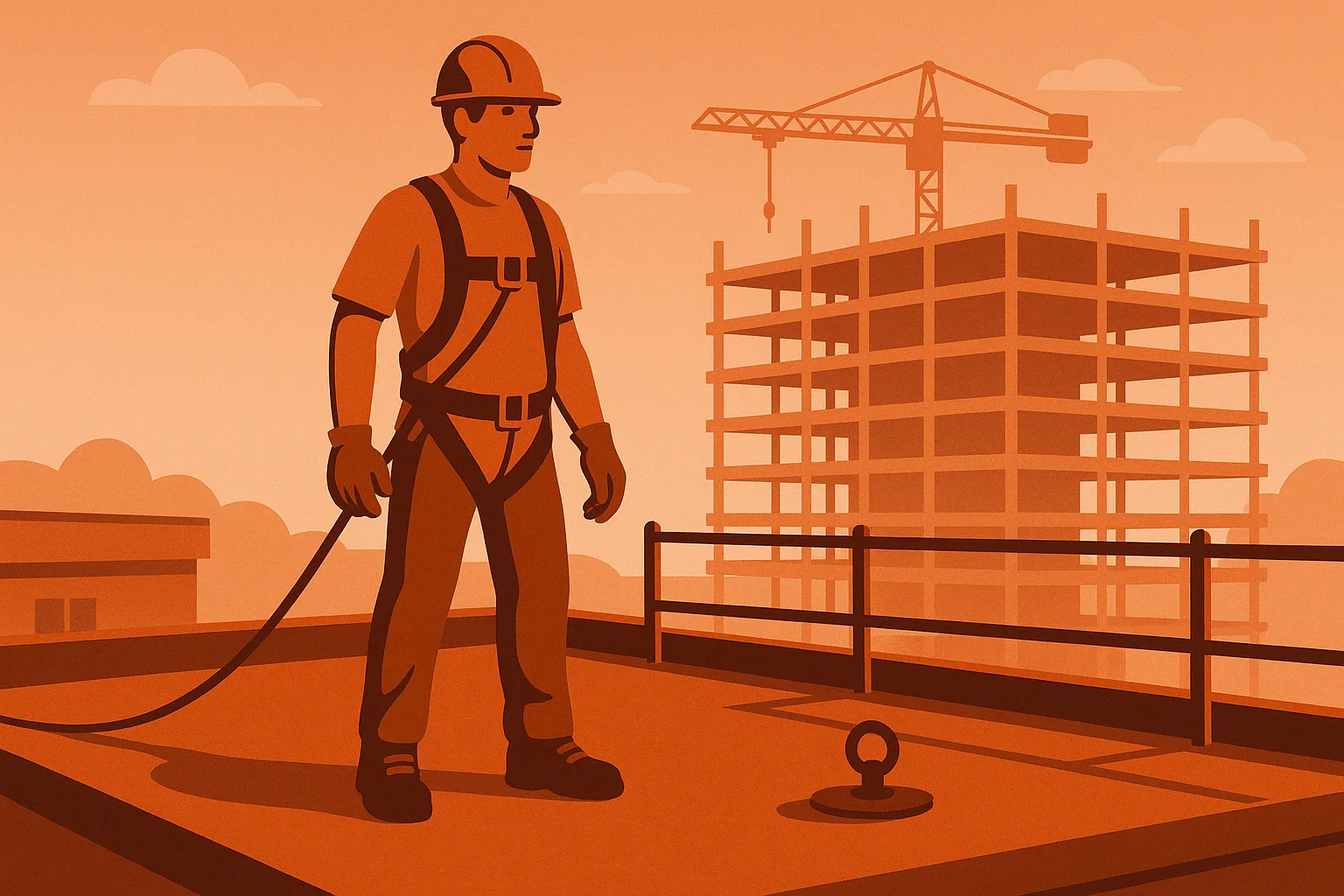
- Personal fall arrest systems — Harnesses, lanyards, and anchor points that stop a fall in progress
Specific Hazard Requirements
The standard addresses specific situations including:
- Unprotected sides and edges (1926.501(b)(1))
- Leading edges where work is being performed (1926.501(b)(2))
- Holes in floors, roofs, and walking surfaces (1926.501(b)(4))
- Roofing work on low-slope and steep-slope roofs (1926.501(b)(10-11))
- Wall openings where the bottom edge is less than 39 inches above the walking surface (1926.501(b)(14))
Training Requirements
Under 29 CFR 1926.503, employers must provide training for each employee who might be exposed to fall hazards. Training must cover:
- The nature of fall hazards in the work area
- Correct procedures for erecting, maintaining, and disassembling fall protection systems
- The use and operation of specific fall protection systems being used
- The role of each employee in any safety monitoring system
Training must be conducted by a competent person, and employers must certify that training has been completed.
2026 Penalty Landscape: The Financial Stakes
OSHA's 2026 penalty schedule reflects inflation-adjusted maximums that continue to rise:
| Violation Type | Maximum Penalty (2026) |
|---|---|
| Serious | $16,550 per violation |
| Other-Than-Serious | $16,550 per violation |
| Willful or Repeat | $165,514 per violation |
| Failure to Abate | $16,550 per day |
For employers with multiple fall protection deficiencies — a common finding during OSHA inspections — penalties can compound rapidly. A single inspection that identifies missing guardrails, absent fall arrest systems, and untrained workers can easily generate combined penalties exceeding $100,000.
Moreover, penalties are only the beginning. Employers found in violation may face:
- Workers' compensation claims and litigation
- Project delays during abatement periods
- Increased insurance premiums
- Reputational damage affecting future contract eligibility
- Entry into OSHA's Severe Violator Enforcement Program
The Severe Violator Enforcement Program: Escalating Consequences
OSHA's Severe Violator Enforcement Program (SVEP) places employers with the worst safety records under heightened scrutiny. Under criteria expanded in 2022, employers can be placed in SVEP for:
- Two or more willful or repeat violations
- Failure-to-abate notices for high-gravity serious violations
- Egregious per-instance citations
- Any willful violation related to a fatality or catastrophe
Once in the program, employers face:
- Mandatory follow-up inspections within one to two years
- Inspections of other worksites owned by the same employer
- Public listing in OSHA's searchable database
- Minimum three-year enrollment before removal is possible
Construction companies with fall protection violations are among the most common entrants into SVEP. For multi-site contractors, a single serious incident can trigger inspections across their entire portfolio of active projects.
What Employers Should Do
The Max Home Services case — and the thousands of fall protection citations issued every year — should prompt every construction employer to evaluate their current compliance posture. Here are the essential steps:
1. Conduct a Site-Specific Fall Hazard Assessment
Before any work at height begins, identify all locations where workers could be exposed to falls of 6 feet or more. Document the specific fall hazards, the protection methods selected, and the rationale for choosing those methods.
2. Provide and Maintain Proper Equipment
Ensure that all fall protection equipment — harnesses, lanyards, guardrails, anchors, safety nets — is:
- Appropriate for the specific work being performed
- Properly sized and adjusted for each worker
- Inspected before each use and removed from service if damaged
- Stored and maintained per manufacturer specifications
3. Train Every Exposed Worker
Training is not optional and cannot be a one-time event. Ensure that:
- All workers who may encounter fall hazards receive initial training
- Training is specific to the fall protection systems in use at your worksite
- Retraining occurs when workers demonstrate inadequate knowledge or when new hazards are introduced
- All training is documented and certified by a competent person
4. Designate a Competent Person
OSHA requires a competent person on each worksite who can identify existing and predictable fall hazards, who has the authority to take prompt corrective measures, and who is capable of identifying and correcting unsafe conditions.
5. Self-Audit Regularly
Don't wait for OSHA to knock on your door. Conduct regular internal audits of your fall protection program. OSHA offers free compliance assistance resources including fact sheets, training materials, and consultation services through its On-Site Consultation Program.
6. Understand the Penalty Multipliers
Review your violation history. Employers with prior fall protection citations face significantly higher penalties for repeat violations and are more likely to be placed in SVEP. If you have unresolved citations, address them immediately. BlueHive's guide on 2026 OSHA changes and their white paper on OSHA fines exceeding $165K provide additional context on the financial exposure employers face.
Looking Ahead: Enforcement Will Continue to Intensify
OSHA has signaled that construction fall protection will remain a primary enforcement focus. The agency's data-driven approach increasingly uses injury and illness data to target employers with the highest risk profiles for unannounced inspections. Employers who assume they will not be inspected because they have not had a complaint or incident are operating on a dangerous assumption.
The fatal fall at the Fort Lauderdale residence — and the willful citation that followed — demonstrates that OSHA will pursue the maximum available penalties when employers deliberately disregard worker safety. With fall protection as the most-cited standard for 15 consecutive years, the message is clear: compliance is not optional, and enforcement is not slowing down.
Sources
- U.S. DOL News Release: OSHA Cites Florida Roofing Company (April 24, 2026)
- EHS Today: OSHA Fines Roofing Company for Willful Actions in Fatality
- NRCA: Roofing Company Faces $172,324 in Proposed Penalties After Worker's Fatal Fall
- OSHA Top 10 Most Frequently Cited Standards
- OHS Online: OSHA Reveals 2025 Top 10 Most Cited Standards
- OSHA Standard 1926.501 — Fall Protection in Construction
- OSHA Standard 1926.503 — Fall Protection Training
- OSHA Penalties Page
- OSHA Falls Prevention Resources
- U.S. DOL: OSHA Severe Violator Enforcement Program Updates (2022)
- OSHA SVEP Information
- BlueHive White Paper: 2026 OSHA Changes
- BlueHive White Paper: Surprise OSHA Fines Now Top $165K
Tags
Frequently Asked Questions
Under 29 CFR 1926.501(b)(1), OSHA requires fall protection for any construction worker on a walking or working surface with an unprotected side or edge that is 6 feet or more above a lower level. Employers must provide guardrail systems, safety net systems, or personal fall arrest systems.
In 2026, the maximum penalty for a willful or repeat OSHA violation is $165,514 per violation. Serious violations carry a maximum penalty of $16,550 per violation. Multiple violations at a single site can result in combined penalties in the hundreds of thousands of dollars.
OSHA issued 5,914 citations for violations of the Fall Protection – General Requirements standard (1926.501) in fiscal year 2025, making it the most-cited OSHA standard for the 15th consecutive year.
The Severe Violator Enforcement Program (SVEP) subjects employers with willful, repeated, or failure-to-abate violations to mandatory follow-up inspections, enhanced scrutiny of other worksites, and public listing. Construction companies with fall protection violations are among the most common entrants into SVEP, which requires a minimum three-year stay in the program.
Employers should conduct site-specific fall hazard assessments, provide appropriate fall protection equipment, train all workers on fall hazard recognition and equipment use, document all training and inspections, and promptly correct any identified hazards. Regular self-audits using OSHA's compliance assistance resources can help identify gaps before an inspection.