OSHA Cites Georgia Stone Manufacturers for Silica Violations — Again: What Employers Need to Know About Silica Enforcement in 2026
OSHA cited two Georgia stone countertop manufacturers for repeat silica exposure violations in March 2026, part of an escalating federal and state enforcement crackdown on respirable crystalline silica hazards in the fabrication industry.
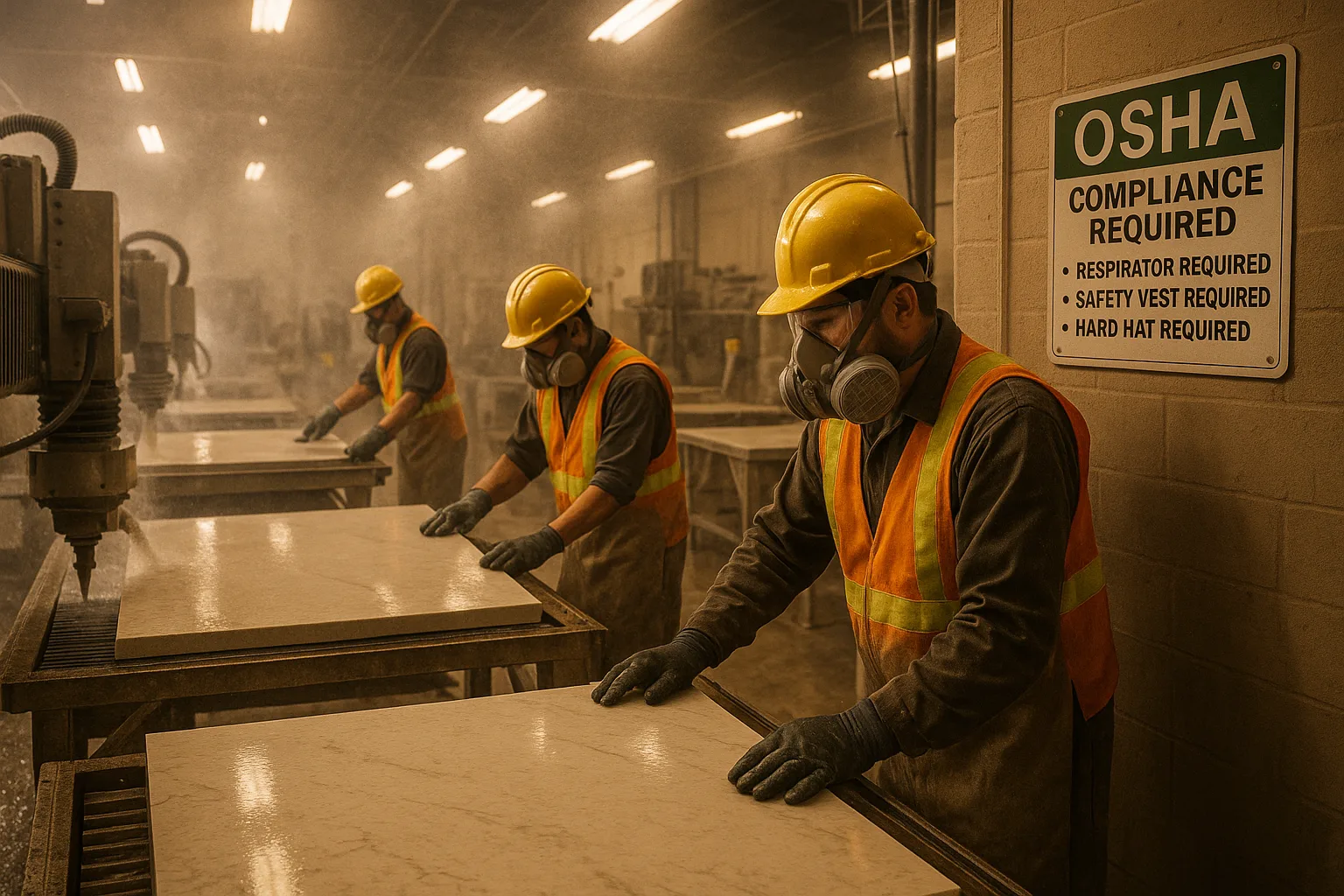

On March 26, 2026, OSHA cited two Cartersville, Georgia stone product manufacturers for exposing workers to respirable crystalline silica — a known carcinogen — after a follow-up inspection found the employers had failed to address violations identified in previous investigations. Stone Atlanta Countertops Inc. was cited for two repeat, seven serious, and three other-than-serious violations, while GT Stone Granite LLC received eight repeat, four serious, and two other-than-serious violations. Combined proposed penalties exceeded $116,000.
The case is not an isolated incident. It is part of a sustained and intensifying enforcement effort by OSHA and state agencies to address silica exposure in the stone fabrication industry — an industry where workers face some of the highest silica dust concentrations in any occupation. For employers in stone fabrication and related industries, understanding the current enforcement landscape is no longer optional.
Why Silica Enforcement Is Escalating
Respirable crystalline silica is a microscopic particle generated when cutting, sawing, grinding, drilling, or crushing stone, concrete, brick, and similar materials. According to OSHA's silica overview page, approximately 2.3 million workers in the United States are exposed to silica on the job. Workers who inhale these particles face increased risk of developing:
- Silicosis — an incurable, progressive lung disease that can lead to disability and death
- Lung cancer
- Chronic obstructive pulmonary disease (COPD)
- Kidney disease
The stone countertop fabrication industry has drawn particular federal attention in recent years. Engineered stone products — popular for kitchen and bathroom countertops — can contain silica concentrations exceeding 90%, significantly higher than natural stone. When these materials are cut, ground, or polished without proper controls, they generate extremely high levels of respirable silica dust.
In one of the most severe cases, OSHA in August 2024 proposed more than $1 million in penalties against Florenza Marble & Granite Corp. in the Chicago area after finding workers exposed to silica dust levels up to six times the permissible limit. Multiple employees developed irreversible silicosis, and some required lung transplants. OSHA cited the company for eight egregious willful, four willful, and 20 serious violations.
The Georgia Citations: A Pattern of Non-Compliance
The March 26 enforcement action against Stone Atlanta Countertops and GT Stone Granite is notable because these were follow-up inspections — OSHA returned to verify whether the companies had corrected previously identified hazards, and found they had not.
Specific violations included:
- Failure to develop a written exposure control plan for silica — a fundamental requirement under 29 CFR 1910.1053
- Failure to develop a written respiratory protection program — required when workers are exposed above the permissible exposure limit (PEL)
- Failure to implement a hazard communication program — ensuring workers know about the chemicals and materials they are exposed to
- Overexposure to noise and respirable crystalline silica — indicating inadequate engineering controls
OSHA proposed $42,699 in penalties for Stone Atlanta Countertops and $73,607 for GT Stone Granite. While these amounts may seem modest compared to the Florenza case, the repeat citation classification is significant — it signals escalating enforcement and means future violations could trigger willful citation classifications with penalties up to $165,514 per violation.
Understanding the Silica Standards
OSHA's respirable crystalline silica standards set clear, enforceable requirements for employers. There are two separate standards:
- 29 CFR 1910.1053 — for general industry and maritime (covers stone fabrication shops)
- 29 CFR 1926.1153 — for construction
Key Requirements Under the General Industry Standard
The core obligations for employers with workers exposed to respirable crystalline silica include:
-
Permissible Exposure Limit (PEL): Employers must ensure no employee is exposed to airborne concentrations of respirable crystalline silica exceeding 50 μg/m³ as an 8-hour time-weighted average (TWA).
-
Action Level: At 25 μg/m³ (8-hour TWA), employers must begin exposure monitoring and implement certain protections.
-
Written Exposure Control Plan: Employers must develop and maintain a written plan that identifies tasks involving silica exposure, describes engineering and work practice controls in use, and outlines respiratory protection measures. The plan must be reviewed and updated at least annually.
-
Exposure Monitoring: Employers must assess each employee's exposure using air monitoring or objective data. Monitoring frequency depends on exposure levels — every six months if between the action level and PEL, every three months if above the PEL.
-
Engineering and Work Practice Controls: Employers must use controls such as wet cutting methods, local exhaust ventilation, and enclosed systems to reduce exposure before relying on respirators.
-
Respiratory Protection: Required when engineering controls cannot reduce exposure below the PEL.
-
Medical Surveillance: Required for employees who will wear respirators for 30 or more days per year due to silica exposure. Exams include chest X-rays and pulmonary function tests.
-
Hazard Communication: Silica must be included in the employer's hazard communication program with proper labeling, Safety Data Sheets, and employee training.
-
Housekeeping: Employers must not use dry sweeping or dry brushing where it could contribute to silica exposure unless wet methods or HEPA-filter vacuums are not feasible.
-
Recordkeeping: Employers must maintain records of air monitoring data, objective data, and medical surveillance.
The Georgia citations demonstrate what happens when employers skip the foundational written programs. Without a written exposure control plan, respiratory protection program, and hazard communication program, an employer essentially has no documented compliance framework — and OSHA treats these as separate citable violations.
OSHA's National Emphasis Program on Silica
The ongoing enforcement pressure is driven in large part by OSHA's National Emphasis Program (NEP) for Respirable Crystalline Silica (CPL 03-00-023). The NEP directs OSHA area offices to conduct programmed inspections in industries with high silica exposure risk.
In September 2023, the Department of Labor announced a focused enforcement initiative specifically targeting the engineered stone fabrication and installation industry, supplementing the broader NEP. This initiative directs OSHA to:
- Prioritize inspections at engineered stone fabrication facilities
- Verify that employers are conducting exposure assessments
- Confirm that written exposure control plans are in place and current
- Check for proper engineering controls, respiratory protection, and medical surveillance
- Issue citations for documentation failures, not just exposure exceedances
The result has been a steady stream of citations in the stone fabrication sector. In July 2025, Brazilian Stone Design LLC in Georgia was cited for seven serious violations and fined $33,000 for failure to enforce respirator use, provide training, and conduct air monitoring. The March 2026 Georgia case continues that pattern.
California's STOP Act: The Strictest State Law
While federal OSHA enforcement has intensified, California has gone further. The Silicosis Training, Outreach and Prevention (STOP) Act (SB 20), signed by Governor Newsom in October 2025 and effective January 1, 2026, establishes the most stringent silica protections in the nation.
Key provisions include:
- Ban on dry cutting: All dry cutting, grinding, drilling, polishing, and dry cleanup of stone containing more than 0.1% crystalline silica is prohibited. Only wet methods or HEPA-filtered vacuums are permitted.
- Worker training requirements: By July 1, 2026, employers must ensure workers performing high-exposure tasks complete specific safety training, with annual attestations submitted to Cal/OSHA.
- Shop certification: By January 1, 2027, fabrication shops must obtain state certification to operate legally.
- Silicosis reporting: Silicosis and silica-related lung cancer are now classified as serious injuries under California law, requiring the California Department of Public Health to report new cases to Cal/OSHA within three days, triggering enforcement investigations.
The STOP Act was driven by alarming silicosis data. As of early 2026, over 500 cases and at least 25 deaths have been linked to engineered stone fabrication in California, with many affected workers being young workers in the countertop industry.
Employers outside California should pay attention: state-level silica legislation is likely to spread as the public health data continues to mount.
What Employers Should Do
Whether you operate a stone fabrication shop, a construction site with concrete cutting, or any facility where workers may be exposed to silica dust, the following steps are essential for compliance in 2026:
1. Develop and Maintain a Written Exposure Control Plan
This is the single most common citation in silica enforcement. Your plan must:
- Identify all tasks that involve or may involve silica exposure
- Describe the engineering controls, work practices, and respiratory protection used for each task
- Outline procedures for establishing regulated areas where exposure may exceed the PEL
- Be reviewed and updated at least annually — and whenever processes change
2. Conduct Exposure Monitoring
Perform initial air monitoring for all employees who may be exposed at or above the action level (25 μg/m³). Maintain a regular monitoring schedule based on results. Use a qualified laboratory for sample analysis in accordance with OSHA's approved methods.
3. Implement Engineering Controls
Wet cutting, local exhaust ventilation, and enclosed systems must be the first line of defense. Respirators are a supplement, not a substitute, for engineering controls. If your facility relies primarily on respirators without using feasible engineering controls, expect citations.
4. Establish a Respiratory Protection Program
If any employee wears a respirator for silica protection, you must have a written respiratory protection program compliant with 29 CFR 1910.134. This includes fit testing, medical evaluations, training, and maintenance procedures.
5. Implement a Hazard Communication Program
Ensure silica is addressed in your hazard communication program. Workers must be trained on silica hazards, know how to read Safety Data Sheets, and understand the protective measures in place. Train new employees before they begin work with silica-generating tasks.
6. Provide Medical Surveillance
Offer medical exams to all employees who wear respirators for silica for 30 or more days per year. Exams should include chest X-rays and pulmonary function tests, conducted by a physician or licensed health care professional familiar with silica-related diseases.
7. Eliminate Dry Cutting and Dry Sweeping
Even outside California, OSHA's housekeeping provisions prohibit dry sweeping and dry brushing where they could contribute to silica exposure. Transition to wet methods and HEPA-filtered vacuums for all cutting, grinding, and cleanup operations.
8. Document Everything
Maintain records of exposure monitoring, medical surveillance, training, and corrective actions. In the event of an inspection, documented compliance history is your most valuable asset. OSHA considers good faith efforts when calculating penalties, and thorough documentation demonstrates a commitment to worker safety.
9. Use OSHA's Free Compliance Resources
Employers can request a free, confidential visit through OSHA's On-Site Consultation Program. These visits are separate from enforcement and do not result in citations. OSHA also provides detailed guidance in its fact sheet on the respirable crystalline silica standard for general industry and through its compliance assistance specialists.
Looking Ahead
The Georgia citations are a clear signal that OSHA's silica enforcement is not letting up. With the National Emphasis Program continuing to drive inspections, state laws like California's STOP Act raising the bar, and penalties for willful and repeat violations reaching up to $165,514 per instance, employers who have not yet brought their silica programs into full compliance face significant financial and legal risk — to say nothing of the health consequences for their workers.
The employers cited in Cartersville had been inspected before. They knew what the violations were. They chose not to fix them. That is exactly the scenario OSHA penalizes most severely.
For employers who are proactive, the path forward is clear: develop your written programs, implement engineering controls, train your workers, and monitor your exposures. The resources are available. The standards are well-established. And the enforcement consequences for inaction are only growing.
Sources
- US Department of Labor cites Georgia stone product manufacturers for exposing workers to respirable crystalline silica, other safety violations (OSHA News Release, March 26, 2026)
- OSHA Respirable Crystalline Silica Standard — General Industry (29 CFR 1910.1053)
- OSHA Respirable Crystalline Silica Standard — Construction (29 CFR 1926.1153)
- OSHA Crystalline Silica Overview
- OSHA National Emphasis Program — Respirable Crystalline Silica (CPL 03-00-023)
- DOL Announces Enforcement and Compliance Initiative for Engineered Stone Fabrication (September 25, 2023)
- OSHA Cites Chicago Countertop Maker for Over $1 Million in Penalties (DOL News Release, August 26, 2024)
- Georgia Countertop Manufacturer Fined $33K for Silica Safety Violations (Fox 5 Atlanta, July 2025)
- California's STOP Act Sets Strictest Silica Rules in U.S. for Stone Fabricators (Stone World)
- Silicosis and the STOP Act: A 2026 Guide for Artificial Stone Workers (ODG Law Group)
- OSHA Penalties
- OSHA On-Site Consultation Program
- OSHA Fact Sheet: Respirable Crystalline Silica Standard for General Industry (PDF)
- OSHA Respiratory Protection Standard (29 CFR 1910.134)
- OSHA Compliance Assistance Specialists
Tags
Frequently Asked Questions
In 2026, OSHA penalties can reach up to $16,550 per serious violation and up to $165,514 per willful or repeat violation. Employers with multiple violations across several standards — such as silica exposure, respiratory protection, and hazard communication — can face combined penalties well into the hundreds of thousands of dollars.
OSHA's permissible exposure limit (PEL) for respirable crystalline silica is 50 micrograms per cubic meter of air (50 μg/m³) as an 8-hour time-weighted average, with an action level of 25 μg/m³ that triggers monitoring and other requirements under 29 CFR 1910.1053 and 29 CFR 1926.1153.
A written exposure control plan is a documented program that identifies tasks involving silica exposure, describes engineering controls and work practices to limit exposure, and outlines respiratory protection and access restrictions. It is required under both the general industry (29 CFR 1910.1053) and construction (29 CFR 1926.1153) silica standards and must be reviewed and updated at least annually.
California's SB 20, the Silicosis Training, Outreach and Prevention (STOP) Act, took effect January 1, 2026. It bans dry cutting of stone containing more than 0.1% crystalline silica, requires worker training and shop certification, and classifies silicosis as a serious injury triggering Cal/OSHA investigations. It is the strictest silica law in the United States.
OSHA's National Emphasis Program (NEP) for Respirable Crystalline Silica (CPL 03-00-023) is an enforcement initiative that targets industries with high silica exposure risks, including stone fabrication, construction, and manufacturing. It directs OSHA to conduct programmed inspections in these industries and has been supplemented with focused initiatives targeting engineered stone fabrication.