OSHA Issues $4.8M in Trenching Penalties After Two Fatal Collapses: What Employers Must Know
OSHA cited two construction companies for fatal trench collapses in April 2026, proposing nearly $4.8 million in combined penalties. Here's what employers in construction and excavation need to do now to avoid deadly violations.
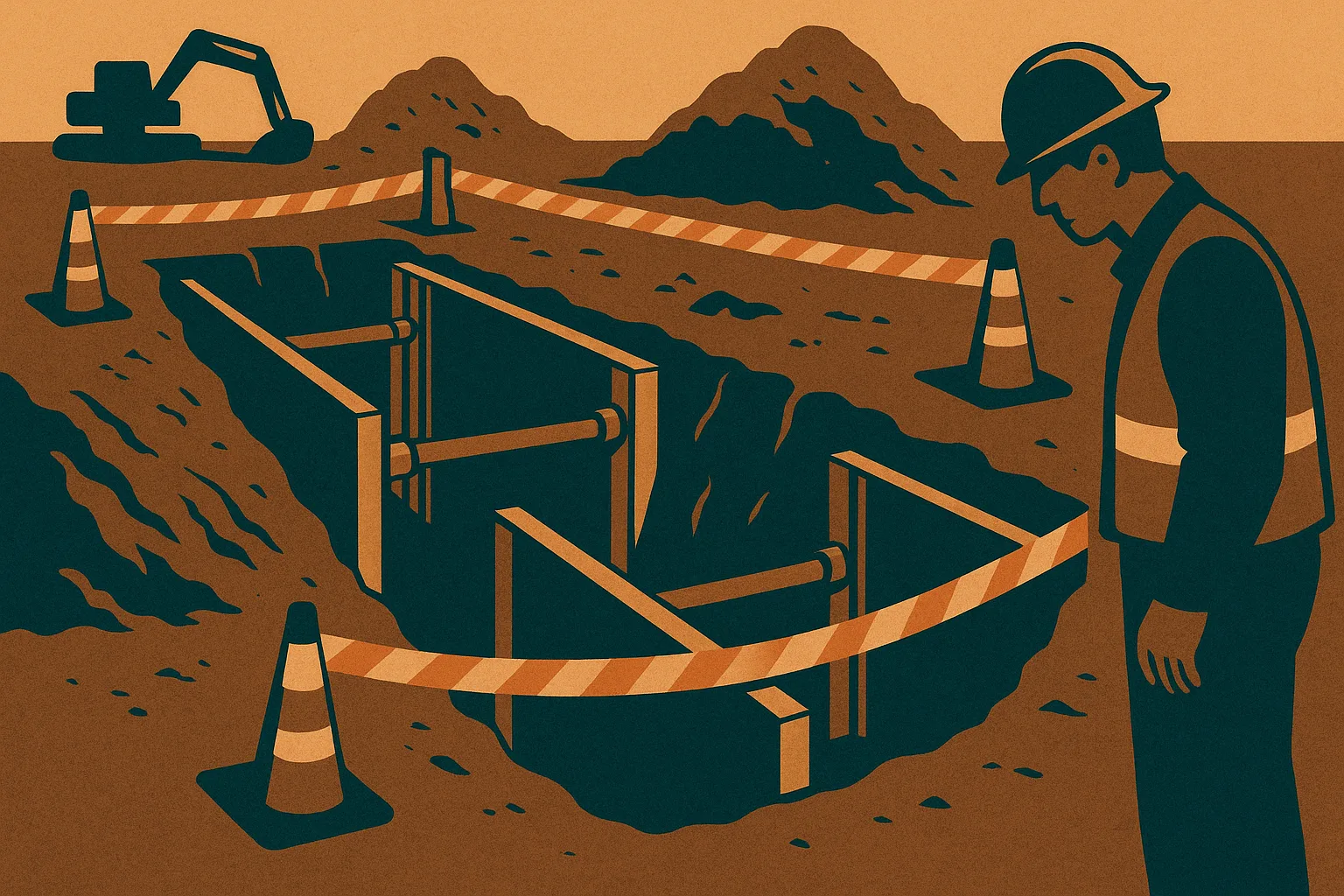

In the first three weeks of April 2026, OSHA announced enforcement actions against two construction companies for fatal trench collapses — proposing a combined $4.8 million in penalties. The cases, one in Massachusetts and one in Alabama, involve nearly identical failures: workers sent into unprotected trenches without the engineering controls, training, or competent supervision that federal law requires. Both workers died.
These are not outlier cases. They are part of a sustained federal enforcement push that has made trenching violations some of the most heavily penalized hazards in construction. For any employer that performs or contracts for excavation work, the message from OSHA is unmistakable: the agency is watching, and the consequences for noncompliance are severe.
Two Fatal Collapses, Two Rounds of Citations
Revoli Construction — Yarmouth, Massachusetts
On April 1, 2026, OSHA cited Revoli Construction Co. Inc. — a Massachusetts-based water and sewer line contractor — with seven willful, 33 repeat, and 17 serious violations following a fatal trench collapse in Yarmouth on November 18, 2025.
Workers were removing sandy soil and installing steel plates outside of a trench when the backfilled sand collapsed and trapped two workers inside. One worker, 61-year-old Miguel Reis, was engulfed and sustained fatal injuries. A second worker was seriously injured.
OSHA's investigation found that the company:
- Failed to provide workers with a safe way to exit the trench
- Lacked adequate cave-in protection
- Had unsupported underground utilities
- Maintained spoil piles within two feet of the excavation
- Neglected to install a shoring system as designed
- Used a damaged protective system
- Exposed employees to electrical and fall hazards
The proposed penalties totaled $4,699,362 — one of the largest trenching-related fines in New England history. U.S. Secretary of Labor Lori Chavez-DeRemer called the incident "a solemn reminder of the dangers construction workers face when basic safety procedures and safe engineering solutions are ignored."
Breland Homes — Madison County, Alabama
On April 16, 2026, OSHA cited Breland Homes Inc., a Huntsville, Alabama-based home builder, with eight serious violations following a fatal trench collapse in December 2025. A worker was killed while installing a sewage drainpipe in a Madison County subdivision after the unprotected trench collapsed.
OSHA found that the company:
- Allowed a worker to be in an unprotected and unsupported section of the trench
- Failed to train workers to recognize unsafe trenching conditions
- Permitted work without protective helmets
- Allowed workers to use a damaged ladder
Proposed penalties totaled $115,855. Breland Homes has 15 business days to comply, request an informal conference, or contest the findings before the Occupational Safety and Health Review Commission.
Why Trenching Enforcement Is Intensifying
Trench collapses are among the deadliest hazards in the construction industry. A cubic yard of soil can weigh as much as a car — roughly 3,000 pounds. When the walls of an unprotected trench fail, workers can be buried in seconds, with virtually no chance of self-rescue.
After trench collapse fatalities surged to 39 in 2022 — a record high — OSHA and industry partners launched intensified enforcement and education efforts. The results have been measurable: fatalities dropped to 15 in 2023 and 13 in 2024, representing a roughly 70% reduction from the 2022 peak. In 2025, at least 12 trench collapse deaths were reported through mid-year.
The decline is encouraging, but OSHA has made clear it will not ease enforcement pressure. The agency's National Emphasis Program on Trenching and Excavation (CPL 02-00-161) directs inspectors to initiate inspections whenever they observe an open trench or excavation — even during travel between worksites or during other unrelated inspections. This "see a trench, inspect a trench" approach means any jobsite with an open excavation is subject to an unannounced OSHA visit at any time.
The penalty amounts in these April 2026 cases reflect the severity with which OSHA treats trenching violations. In 2026, OSHA penalty maximums stand at:
- $16,550 per serious, other-than-serious, or posting violation
- $165,514 per willful or repeat violation
- $16,550 per day for failure to abate
When a fatality is involved and violations are classified as willful or repeat — as in the Revoli case — penalties can rapidly reach into the millions.
What the Law Requires: 29 CFR 1926 Subpart P
OSHA's trenching and excavation standards are found in 29 CFR 1926 Subpart P, covering sections 1926.650 through 1926.652. The requirements are straightforward, well-established, and leave little room for interpretation:
Protective Systems
Under 29 CFR 1926.652, employers must provide a protective system for any trench 5 feet deep or greater, unless the excavation is made entirely in stable rock. The three recognized methods are:
- Sloping or benching — Cutting the trench walls back at an angle to prevent collapse, based on soil type
- Shoring — Installing structural supports (timber, hydraulic aluminum, or other systems) to brace trench walls
- Shielding — Using trench boxes or other prefabricated structures to protect workers if walls fail
The protective system must be designed based on the soil classification and conditions at the site. Materials must be free from damage or defects — the Revoli and Breland cases both involved damaged or improperly installed systems.
Competent Person
Under 29 CFR 1926.650, a competent person must be designated and present at the trench site. This individual must be:
- Capable of identifying existing and predictable trenching hazards
- Authorized to take immediate corrective action, including removing workers from the trench
- Responsible for inspecting the trench daily and after any event that could change conditions (rain, vibrations, adjacent loading)
- Trained in soil classification and protective system selection
In both the Alabama and Massachusetts cases, OSHA found failures in hazard recognition and training — hallmarks of missing or ineffective competent person oversight.
Access and Egress
Employers must provide a safe means of entry and exit — typically a ladder, ramp, or stairway — within 25 feet of every worker in a trench. In the Revoli case, OSHA specifically cited the company for failing to provide a safe exit from the trench.
Spoil Piles and Edge Protection
Excavated materials (spoil piles) must be kept at least 2 feet from the edge of the trench to prevent them from falling back in on workers. Revoli Construction was cited for maintaining spoil piles within two feet of the excavation — a violation that directly increases cave-in risk.
What Employers Should Do Now
If your organization performs or contracts for any work involving trenching or excavation, these enforcement actions should prompt an immediate review of your compliance posture. OSHA's "see a trench, inspect a trench" policy means enforcement is not limited to the 55 targeted industries in other emphasis programs — any open trench on any jobsite is a potential inspection trigger.
1. Designate and Train a Competent Person
Every trench must have a designated competent person who has received specific training in soil classification, protective system selection, and hazard recognition. This is not a role that can be assigned to someone without training or authority to stop work.
2. Require a Protective System for Every Trench 5 Feet or Deeper
No worker should enter a trench 5 feet or deeper without sloping, shoring, or shielding in place. Audit your current practices: are protective systems being used consistently, or only when supervision is present?
3. Inspect Daily and Document
The competent person must inspect the trench at the start of each shift and after any event that could change conditions. Document these inspections. Consistent documentation of daily inspections is one of the strongest defenses in an OSHA investigation.
4. Ensure Safe Entry and Exit
Ladders, ramps, or stairways must be positioned so that no worker has to travel more than 25 feet laterally to reach one. Inspect access equipment for damage — the Alabama case included citations for a damaged ladder.
5. Keep Spoil Piles Back
Excavated soil and materials must remain at least 2 feet from the trench edge. This is a simple, visible compliance requirement — and one of the most frequently cited violations.
6. Train Every Worker
All employees who work in or around trenches must be trained to recognize cave-in hazards, understand protective systems, and know how to report unsafe conditions. Training should be documented and refreshed whenever conditions change.
7. Review Your Subcontractor Oversight
General contractors and project owners can face citations when subcontractors perform trenching work without proper protections. Ensure your contracts require Subpart P compliance, and verify that subcontractors are following through on the jobsite.
As BlueHive's 2026 OSHA Changes white paper notes, 2026 is a year to tighten basic compliance across established standards — and trenching safety is one of the most consequential areas where that applies.
Looking Ahead: Workers Memorial Day and Continued Enforcement
On April 14, 2026, OSHA announced ceremonies to honor fallen workers ahead of Workers Memorial Day on April 28 — the annual observance commemorating workers killed, injured, or made ill on the job. The timing of these trenching enforcement actions, just weeks before Workers Memorial Day, reinforces the agency's broader message: preventable workplace fatalities remain unacceptable, and enforcement is not slowing down.
For employers in construction and related industries, the path forward is clear. The standards are established, the protective measures are well-understood, and the cost of noncompliance — measured in both lives and penalties — is rising. Review your trenching safety program now, before an OSHA inspector arrives to do it for you.
Sources
- OSHA News Release: Revoli Construction Cited After Fatal Yarmouth Cave-In (April 1, 2026)
- DOL News Release: Breland Homes Cited After Fatal Trench Collapse in Alabama (April 16, 2026)
- OSHA Trenching and Excavation Safety Overview
- 29 CFR 1926 Subpart P — Excavations (eCFR)
- 29 CFR 1926.650 — Scope, Application, and Definitions
- 29 CFR 1926.652 — Requirements for Protective Systems
- OSHA National Emphasis Program: Trenching and Excavation (CPL 02-00-161) (PDF)
- OSHA Penalty Amounts
- Construction Briefing: What's Driving a 70% Decrease in U.S. Trench Worker Fatalities?
- Equipment World: 12 Trench Collapse Deaths Reported in 2025
- BlueHive: 2026 OSHA Changes — What Has Taken Effect, What Is Coming
Tags
Frequently Asked Questions
In 2026, OSHA can impose fines of up to $16,550 per serious violation and up to $165,514 per willful or repeat violation. In the Revoli Construction case alone, OSHA proposed $4,699,362 in penalties for 57 combined willful, repeat, and serious trenching violations.
Under 29 CFR 1926.652, OSHA requires employers to provide a protective system — sloping, shoring, or shielding — for any trench 5 feet deep or greater, unless the excavation is made entirely in stable rock. A competent person must select and inspect the system.
Under 29 CFR 1926.650, a competent person is someone capable of identifying existing and predictable trenching hazards and authorized to take immediate corrective action. This person must inspect the trench daily and whenever conditions change, such as after rain or vibrations.
OSHA's Trenching and Excavation National Emphasis Program (CPL 02-00-161) directs inspectors to initiate inspections whenever they observe an open trench or excavation, even during unrelated site visits. It focuses on reducing the serious injuries and fatalities caused by cave-ins in construction.
Employers should ensure every trench 5 feet or deeper has a protective system in place, designate a trained competent person for daily inspections, provide safe entry and exit within 25 feet of workers, keep spoil piles at least 2 feet from the trench edge, and train all workers to recognize cave-in hazards before beginning excavation work.