AI-Powered Compliance Platforms Are Going Mainstream: What HR Teams Need to Know
From Vensure's new AI compliance platform to the DOL's AI Literacy Framework, 2026 is the year AI-powered tools are reshaping how employers manage HR compliance. Here's what's driving the shift and how to evaluate these systems.
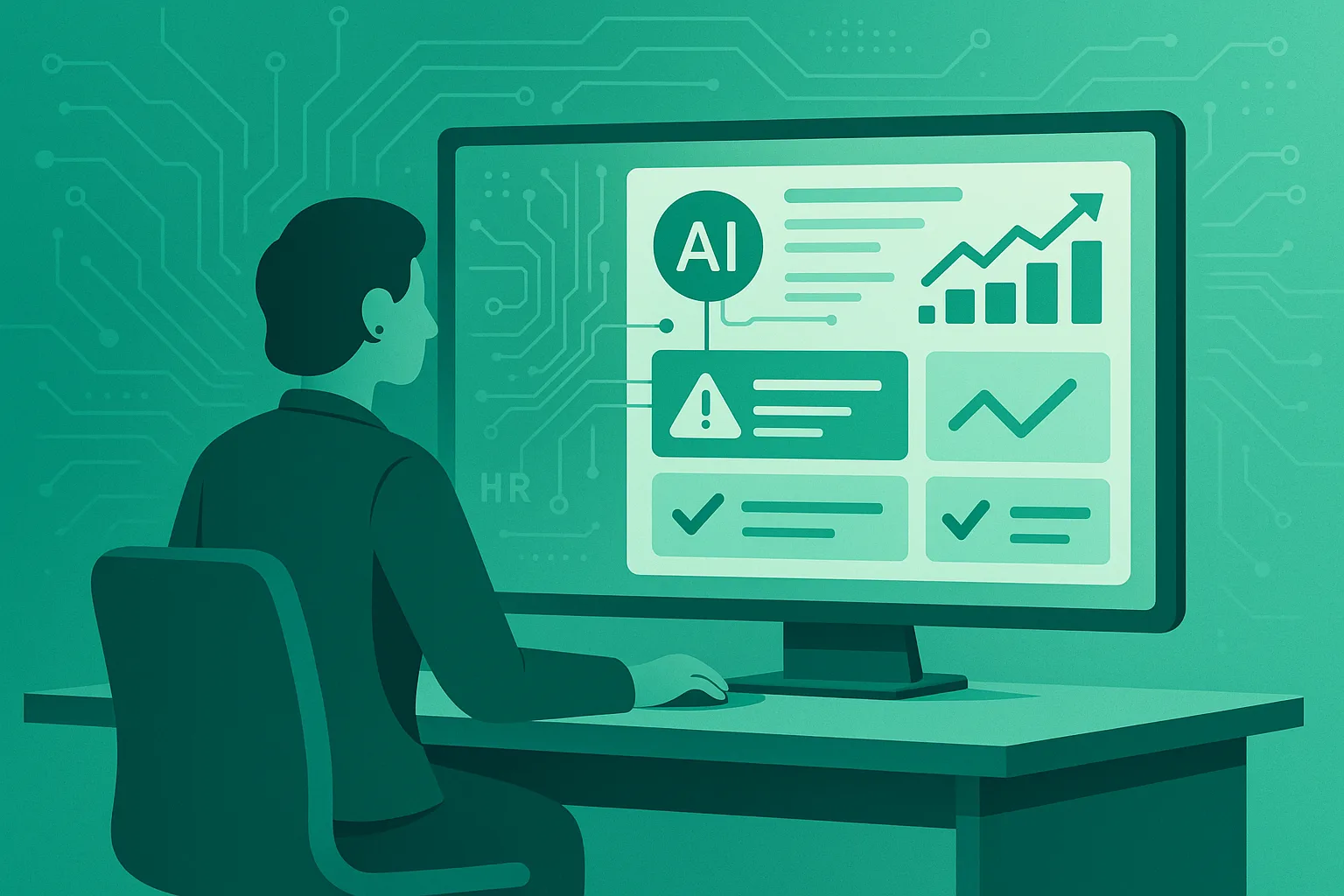

The compliance technology market just crossed a threshold that HR teams cannot afford to ignore. In April 2026, Vensure Employer Solutions — one of the largest privately held HR technology providers — launched an AI-powered compliance platform that embeds real-time, attorney-backed legal guidance directly into HR workflows. It is not the first AI compliance tool on the market, but its scale — serving an ecosystem of more than 161,000 businesses and 4.2 million employees — signals that AI-powered compliance has moved from early adoption to mainstream infrastructure.
This shift is not happening in isolation. OSHA's expanded electronic recordkeeping requirements have turned employer-submitted data into an enforcement targeting tool. The Department of Labor released a national AI Literacy Framework in February 2026, signaling that AI competency is now a federal workforce priority. And SHRM data shows that 69% of HR professionals now use AI in at least one HR function — up from 51% the previous year.
For HR technology teams and compliance officers, the question is no longer whether AI belongs in compliance workflows. It is how to evaluate, deploy, and govern these tools responsibly.
What Changed: The Regulatory Environment That Created Demand
The rapid adoption of AI compliance tools is not driven by hype. It is driven by a regulatory environment that has made manual compliance management increasingly untenable.
OSHA's Data-Driven Enforcement
OSHA's final rule on electronic recordkeeping expanded which employers must submit injury and illness data electronically — and how much data they must submit. Establishments with 100 or more employees in high-hazard industries must now submit detailed case-level data from Forms 300, 300A, and 301 through the Injury Tracking Application. OSHA feeds this data into the Site-Specific Targeting (SST) program, which uses DART rates, trend analysis, and anomaly detection to select workplaces for inspection.
The compliance consequences are direct: inaccurate data, late submissions, and suspiciously low injury rates all increase inspection risk. Penalties for serious violations reach $16,550 per instance, and willful or repeat violations can cost up to $165,514 each. For organizations managing multiple facilities, the volume of recordkeeping and the precision required to avoid enforcement attention have outstripped what spreadsheets and manual processes can reliably deliver.
An Expanding Regulatory Patchwork
Beyond OSHA, employers face a growing matrix of compliance obligations across agencies and jurisdictions. The EEOC secured a record $660 million in settlements and judgments in fiscal year 2025. State-level AI employment laws — including Illinois HB 3773 and Colorado's Artificial Intelligence Act — are creating new compliance requirements for employers using automated decision tools. Pay transparency mandates, anti-harassment training requirements, and accommodation obligations continue to expand state by state.
Each new requirement adds administrative load, increases the risk of inconsistency, and demands faster response times from HR teams. This is the environment that AI compliance platforms are designed to address.
What AI Compliance Platforms Actually Do
Not all AI compliance tools are equivalent. The current generation of platforms generally falls into three functional categories, and the most capable solutions combine elements of all three.
Real-Time Regulatory Guidance
The most visible feature of platforms like Vensure's HR Compliance tool is the compliance chatbot — an AI interface that delivers scenario-specific, jurisdiction-aware answers to compliance questions. These systems go beyond static content libraries by interpreting the user's specific context (state, industry, company size, employee classification) and delivering prescriptive guidance rather than general information.
For multistate employers, this capability is particularly valuable. Instead of researching whether a particular policy satisfies requirements in California, New York, and Texas simultaneously, the platform compares requirements and flags conflicts in real time.
Automated Compliance Workflows
The second functional layer is workflow automation: automated reminders for filing deadlines, training renewal tracking, incident report generation, and document management. These features reduce the administrative burden that consumes HR teams — and they eliminate the human errors that create compliance gaps.
For OSHA recordkeeping specifically, AI tools can automate injury classification, calculate DART and TRIR rates across facilities, flag data anomalies before submission, and integrate with the ITA API for electronic filing. This is the layer where the connection between technology adoption and enforcement risk reduction is most direct.
Predictive Analytics and Risk Detection
The most advanced platforms add a predictive layer: analyzing historical incident data, training completion patterns, and regulatory change velocity to identify compliance risks before they materialize. This capability is especially relevant in the context of OSHA's SST program, where upward-trending DART rates or data anomalies trigger inspection selection.
Organizations that can detect a rising injury trend in Q2 and intervene before the annual data submission have a tangible advantage over those that discover the problem only when an inspector arrives.
The Federal Government's Position on AI in the Workplace
The DOL has not mandated AI adoption for compliance. But its recent actions signal clearly that the federal government expects both employers and workers to develop AI competencies — and that it views AI as a tool that should benefit workers when used responsibly.
The AI Literacy Framework
In February 2026, the DOL's Employment and Training Administration released Training and Employment Notice 07-25, establishing a national AI Literacy Framework. The framework defines five foundational content areas:
- Understanding what AI is — core concepts, capabilities, and limitations
- Exploring AI uses — how AI can be applied productively across jobs and industries
- Directing AI effectively — creating clear instructions and prompts for useful results
- Evaluating AI outputs — assessing quality, accuracy, and relevance of AI-generated content
- Using AI responsibly — ethical use, data protection, and compliance with legal and organizational rules
The framework is voluntary, but it provides a structured approach that employers can use to build internal AI training programs. Given that AI compliance tools require human operators who understand both the technology's capabilities and its limitations, this framework is directly relevant to organizations deploying AI for compliance management.
DOL Principles for Responsible AI
The DOL has also published principles and best practices for AI use in the workplace, emphasizing eight key areas: worker empowerment, ethical development, governance and human oversight, transparency, protection of labor rights, enabling workers, supporting job transitions, and responsible data use.
For HR teams evaluating AI compliance platforms, these principles provide a useful governance framework. A platform that makes compliance decisions without human review, collects worker data without transparency, or replaces rather than augments HR judgment would fall short of the DOL's stated expectations — even without formal regulatory requirements.
What Employers Should Do Now
The organizations that will manage this transition effectively are the ones that approach AI compliance technology as infrastructure, not as a shortcut. Here is what that means in practice.
1. Audit Your Current Compliance Technology Stack
Before evaluating new platforms, assess what you already have. Many HRIS and EHS systems include compliance modules that may be underutilized. Identify where your current tools fall short: Is it recordkeeping accuracy? Multistate tracking? Deadline management? Training documentation? Understanding the gaps directs investment toward the highest-impact solutions.
BlueHive's white paper on what OSHA and DOT compliance really mean for HR teams provides a practical framework for assessing where manual processes create the most risk and administrative burden.
2. Evaluate Platforms Against Real Compliance Scenarios
When evaluating AI compliance tools, test them against your actual compliance challenges — not generic demos. Key evaluation criteria include:
- Jurisdiction awareness: Does the platform accurately track requirements across every state where you operate?
- Integration capability: Can it connect to your existing HRIS, payroll, and EHS systems?
- Data governance: How does it handle employee data, and does it comply with applicable privacy laws?
- Audit trail: Does it document the guidance it provides, creating a defensible record of compliance decisions?
- Human oversight: Can HR professionals review, override, and escalate AI-generated guidance?
3. Establish AI Governance Before Deployment
The DOL's principles for responsible AI and the requirements emerging from state AI employment laws make governance a prerequisite, not an afterthought. At minimum, employers deploying AI compliance tools should:
- Designate a responsible owner for AI compliance tools (typically in HR, legal, or compliance)
- Document the scope of decisions the AI system can influence
- Establish protocols for human review of high-stakes compliance guidance
- Create transparency policies that inform employees how AI is used in compliance processes
- Schedule regular reviews for accuracy, bias, and regulatory alignment
4. Invest in AI Literacy for HR Staff
An AI compliance platform is only as effective as the people using it. The DOL's AI Literacy Framework provides a starting point, but employers should go further by training HR staff specifically on the compliance tools they will use. This includes understanding what the AI can and cannot do, how to evaluate its outputs, and when to escalate to human judgment or external legal counsel.
5. Connect Compliance Technology to Safety Outcomes
The most effective compliance technology strategies do not stop at regulatory box-checking. When AI-powered compliance data flows into the same systems that manage incident investigations, workers' compensation claims, and return-to-work programs, the organization gains a unified view of workforce health and safety. This integration transforms compliance from a cost center into a risk management asset.
The Market Is Moving. The Regulations Are Tightening.
The convergence of OSHA's data-driven enforcement, expanding state-level compliance requirements, and the DOL's AI workforce initiatives has created a clear trajectory: compliance technology is no longer optional for employers with complex regulatory obligations. The organizations that move now — evaluating platforms carefully, establishing governance frameworks, and investing in their teams' AI literacy — will be the ones that manage the transition on their terms rather than in response to an enforcement action.
The Vensure launch is significant not because a single platform changes the market overnight, but because it reflects a market reality that HR technology teams should recognize. When the largest privately held HR technology provider builds AI compliance into its core infrastructure, it confirms what the regulatory environment has been signaling for years: the future of compliance management is automated, intelligent, and integrated — and the future is already here.
Sources
- Vensure Employer Solutions Launches HR Compliance, an AI-Powered Platform — PR Newswire
- Final Rule to Improve Tracking of Workplace Injuries and Illnesses — OSHA
- Injury Tracking Application (ITA) — OSHA
- Site-Specific Targeting Directive CPL 02-01-067 — OSHA
- OSHA Penalties — OSHA
- Training and Employment Notice 07-25: AI Literacy Framework — U.S. Department of Labor
- Artificial Intelligence and Worker Well-Being: Principles and Best Practices — U.S. Department of Labor
- EEOC Highlights Record-Breaking Results in Agency Reports — EEOC
- Illinois HB 3773 — LegiScan
- Colorado Artificial Intelligence Act (SB 24-205) — Colorado General Assembly
- 47 AI Recruiting Statistics for 2026 (SHRM & LinkedIn Data)
- What OSHA and DOT Compliance Really Mean for Your HR Team — BlueHive
Tags
Frequently Asked Questions
An AI-powered HR compliance platform uses artificial intelligence to deliver real-time regulatory guidance, automate compliance workflows, track legal changes across jurisdictions, and help HR teams make consistent, defensible decisions. Unlike static content libraries, these platforms provide scenario-specific, jurisdiction-aware answers embedded directly into HR workflows.
Employers are adopting AI compliance tools because OSHA's expanded electronic recordkeeping requirements and data-driven enforcement have raised the stakes for accuracy, the regulatory landscape is increasingly complex across federal and state levels, and SHRM data shows 69% of HR professionals already use AI in at least one HR function. Manual processes can no longer keep pace with the volume and velocity of compliance obligations.
The DOL released its AI Literacy Framework in February 2026 through Training and Employment Notice 07-25. It defines five foundational content areas and seven delivery principles for AI education across workforce and education systems. While voluntary, the framework signals that the federal government expects employers and workers to develop AI competencies, and it provides a structured approach for workforce AI training programs.
Employers should evaluate AI compliance platforms based on jurisdiction-aware guidance, integration with existing HRIS and EHS systems, transparent AI governance including human oversight of high-stakes decisions, real-time regulatory update capabilities, audit trail documentation, and alignment with the DOL's principles for responsible AI use in the workplace.
No. The DOL has not mandated AI adoption for compliance. However, OSHA's expanded electronic recordkeeping requirements, data-driven enforcement through the Site-Specific Targeting program, and the DOL's AI Literacy Framework collectively signal that technology-enabled compliance management is becoming the practical standard for employers in high-hazard and regulated industries.